About
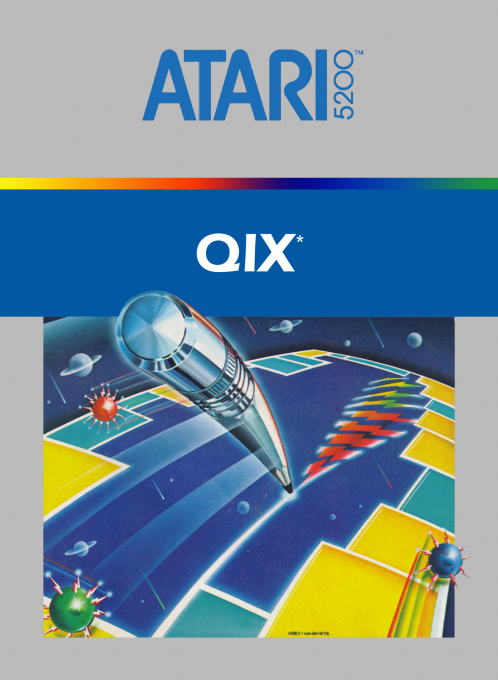
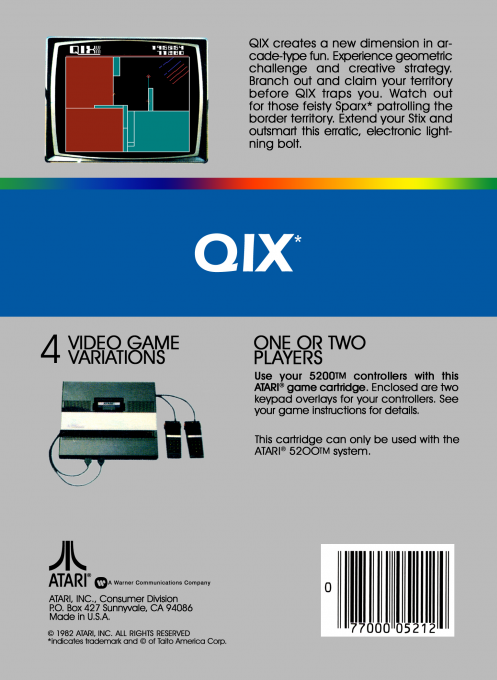
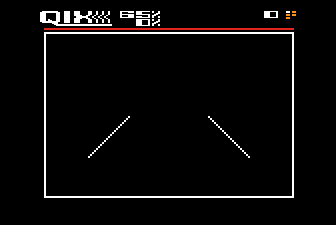
Qix for Atari 5200 brings Taito’s abstract 1981 arcade game to Atari’s home console in an Atari-published cartridge release from 1983. Rather than sending a character through a maze or firing at waves of enemies, it turns a plain rectangular field into a tense contest for territory. The player’s small diamond marker begins on the border while the ever-changing Qix, a multicolored geometric shape, moves unpredictably through the open interior. The aim is to divide that space into claimed sections without allowing the Qix or the screen’s other hazards to catch the marker.
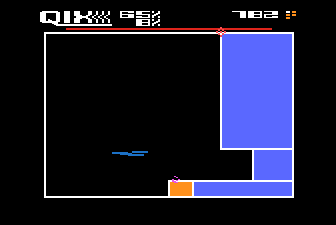
The central move is drawing a Stix: leave the safe border and steer a straight line through unclaimed ground until it joins another edge. Completing a boundary separates the field, and the region that does not contain the Qix is filled in as captured territory. Each decision is a calculated risk. A long line can secure a major area, but it leaves the marker exposed until the enclosure is finished. The Qix does not need to chase the player directly; touching an unfinished Stix is enough to cost a life.
The Atari 5200 controller uses separate fire-button functions for fast and slow drawing. Fast lines are the quicker way to close a shape, while slow-drawn territory earns more points, giving score chasers a reason to remain vulnerable longer. A fuse appears on an unfinished line if play stops or the marker is trapped, racing toward the player unless movement resumes. Sparx patrol the established borders, so even returning to safety requires attention. As stages progress, more dangerous Super Sparx can pursue along unfinished Stix, increasing the pressure on every route.
To clear a screen, the player must capture a required percentage of the playfield. Qix for Atari 5200 provides Novice, Skilled, Advanced, and Expert difficulty selections, with different target percentages and speeds; Advanced follows the arcade game’s 75-percent objective. It also supports one or two players taking alternating turns. The early screens feature a single Qix, while later play adds a second, creating another strategic possibility: separating the two Qixes into different regions ends the level and establishes a scoring multiplier for later rounds.
The 5200 conversion preserves the original game’s unusual balance of simple inputs, visual abstraction, and tactical scoring. Its playfield changes with every successful partition, so no fixed map needs to be memorized; instead, players read the current positions of the Qix, Sparx, and available borders before committing to a line. The Atari 5200 version arrived during the system’s early library and carries the arcade concept into a format built around the console’s joystick and keypad overlays for selecting players and game level.
Qix became one of the era’s most distinctive territory-capture games because its challenge comes from spatial judgment rather than a conventional theme or cast of characters. The Atari 5200 edition keeps the elements that define the design: claim just enough ground to advance, decide whether extra territory is worth the risk, and keep a route open before the moving hazards turn a promising partition into a lost life. Later sequels, conversions, and many games inspired by its approach reflect how durable that deceptively direct idea proved to be.
Gallery
Details
- Developer
- Atari
- Publisher
- Atari
- Genre
- Logic Puzzle
- Players
- 1-2
- Release Date
- January 1, 1983
- System
- Atari 5200