About
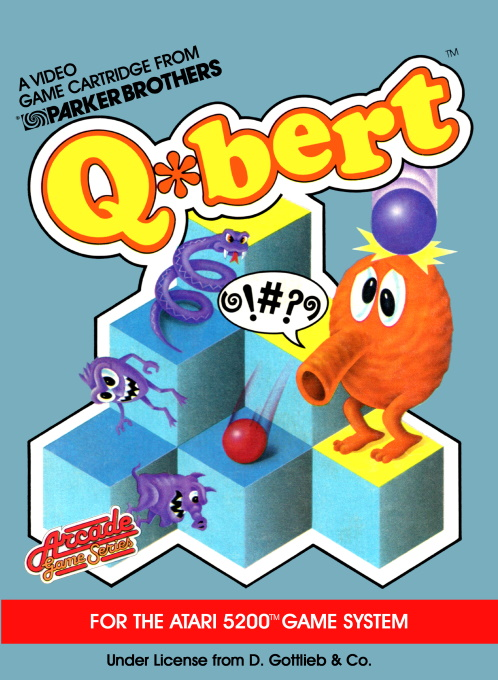
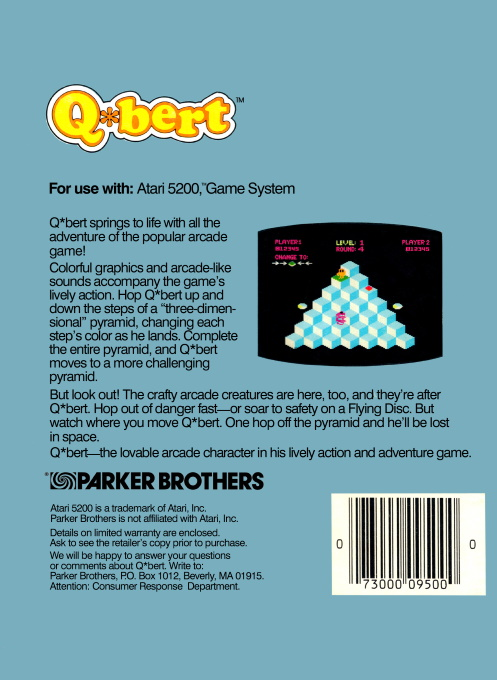
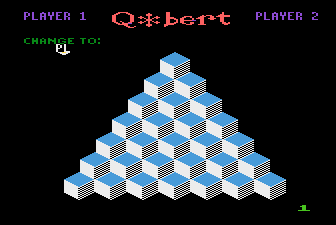
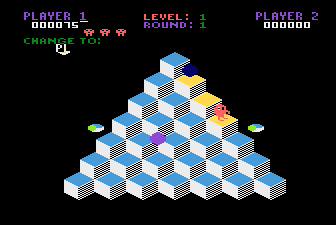
Q*bert is Parker Brothers’ 1983 Atari 5200 adaptation of Gottlieb’s arcade game. The action takes place on a stepped, cube-shaped pyramid rather than a flat playfield. Q*bert begins on its top cube and must hop across the surface until every cube has been changed from its starting color to the destination color shown at the left of the screen. Completing the entire pyramid ends the round and brings up a new one with a different destination color.
Movement is built around the pyramid’s diagonal geometry. The player holds the Atari 5200 controller’s fire button and moves the stick in the direction of the intended hop; Q*bert can only travel diagonally from one cube to the next. This extra button hold is part of the 5200 version’s control method. A pause button stops and resumes play. A mistaken hop off a side or the bottom of the pyramid sends Q*bert falling and costs one of the available Q*berts.
The cartridge provides three one-player selections and three alternating-turn two-player selections. Games 1 through 3 start a solo player with five, four, or three Q*berts, while Games 4 through 6 give both players those same respective starting totals. In the two-player games, the left player starts, and turns change when a player loses a Q*bert. The game finishes when the current player has no Q*berts left.
The pyramid becomes more demanding from round to round. Q*bert, the other characters, and the rate at which those characters appear all increase in speed or frequency. Later rounds can require a cube to be hopped on more than once to reach its destination color. They can also make repeated landings undo a cube’s progress, so clearing the board becomes a route-planning problem as well as a reflex challenge.
Red Balls are immediate hazards: Q*bert must stay out of their path or be squashed. Purple Balls are dangerous in the same way, and a Purple Ball that reaches the bottom of the pyramid hatches into Coily. Coily pursues Q*bert across the cubes. Ugg and Wrong Way enter along the lower portion of the pyramid and move sideways and upward, making contact dangerous. Sam does not catch Q*bert, but he alters cubes’ colors and can force the player to revisit them; catching Sam removes him for points.
Green Balls offer a brief reprieve rather than a threat. Catching one freezes every character except Q*bert for a moment, leaving time to make safe hops while adding to the score. Flying discs along the sides of the pyramid provide another escape. Q*bert must leave from the correct adjacent exit cube to board one; the disc then returns him safely to the top. With careful timing, Coily can be lured toward that exit and sent off the pyramid when Q*bert takes the disc.
Scoring distinguishes each stage of a cube’s color change: reaching an intermediate color earns 15 points, and changing a cube to the destination color earns 25. Catching Sam is worth 300 points, catching a Green Ball earns 100, and luring Coily off the pyramid adds 500. Each unused flying disc contributes 50 points at the end of a round. The first completed round awards a 1,000-point bonus; the bonus rises by 250 points each successive round until it reaches 5,000.
Extra Q*berts are awarded differently depending on the selected game. In Games 1, 2, 4, and 5, the first arrives at 8,000 points and later ones arrive every 14,000 points. Games 3 and 6 award an extra Q*bert every 14,000 points. Together with the selectable starting totals, alternating two-player mode, changing cube rules, and growing enemy pressure, those score thresholds shape the long-form challenge of this home version.
Gallery
Details
- Developer
- D. Gottlieb & Co.
- Publisher
- Parker Brothers
- Genre
- Logic Puzzle
- Players
- 1-2
- Release Date
- January 1, 1983
- System
- Atari 5200