About
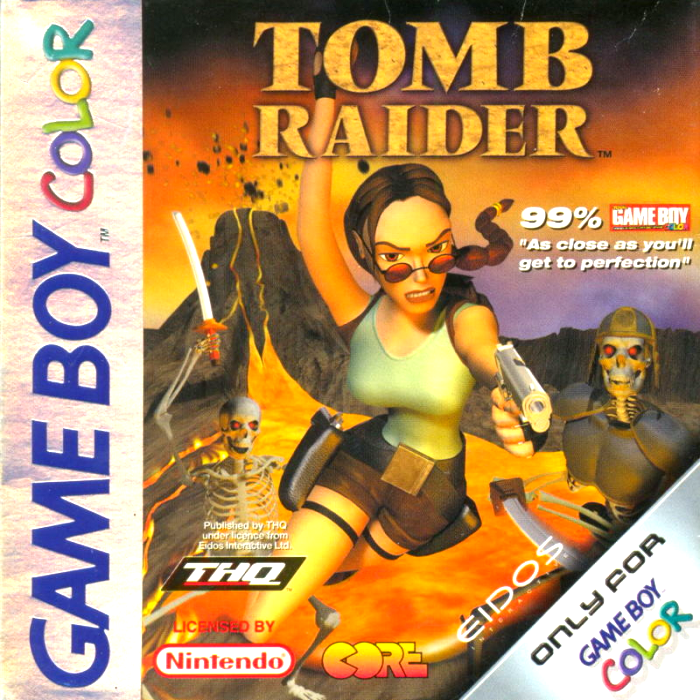
Tomb Raider Starring Lara Croft for Game Boy Color is a 2000 action-adventure game that brings Core Design's archaeologist to Nintendo hardware for the first time. Published by THQ under licence from Eidos Interactive, it was released as Tomb Raider Starring Lara Croft in North America and simply Tomb Raider in several other territories. Rather than attempting to reproduce the series' large 3D spaces on a handheld, the game recasts Lara's expedition as a deliberately paced 2D side-scrolling quest built around exploration, acrobatics, combat, and environmental puzzles.
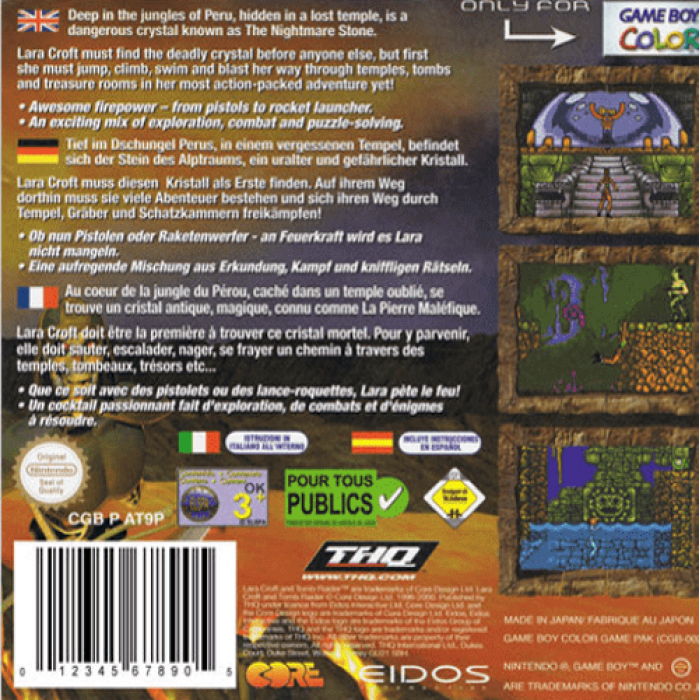
The story sends Lara into the jungles and ruins of South America after the Nightmare Stone, a powerful artifact connected to the evil god Quaxet. Other treasure hunters are pursuing the same prize, turning the search into a race through forgotten temples, underground caverns, and dangerous treasure rooms. The premise gives the adventure a distinct plot of its own while retaining the familiar Tomb Raider ingredients: ancient architecture, occult danger, rival explorers, and a lone protagonist probing deeper into a hostile site.
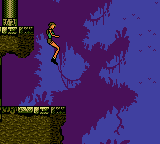
Play unfolds across 14 levels arranged in five areas. Each stage asks the player to study its layout, find a route onward, and deal with hazards and enemies along the way. Ledges, gaps, ropes, bodies of water, switches, and concealed paths make progress more than a matter of moving from left to right. The structure encourages careful observation, since an inviting platform may be a way forward, a detour may hide a useful item, and a seemingly impassable section may depend on a nearby mechanism.
Lara's movement is central to the design. She can run, jump, climb, grab ledges, roll, turn quickly, swim, and dive, giving the Game Boy Color game a broad set of actions for a side-view adventure. Her twin pistols return as her primary defense, with aiming simplified for the portable format so players can concentrate on positioning around threats. The result is a methodical rhythm of scouting ahead, lining up a jump or climb, drawing weapons when danger appears, and using the environment to reach the next chamber.
Core Design built the game specifically around the Game Boy Color rather than treating it as a direct port of the earlier console adventures. Its side-scrolling presentation and puzzle-platforming emphasis set it apart from Lara Croft's polygonal PlayStation and PC outings, but the developers retained many recognizable motions and the sense of navigating hazardous ruins. The conversion was also notable for giving Lara a highly animated, unusually large on-screen character for the system, helping convey the athletic identity associated with the series in a much smaller format.
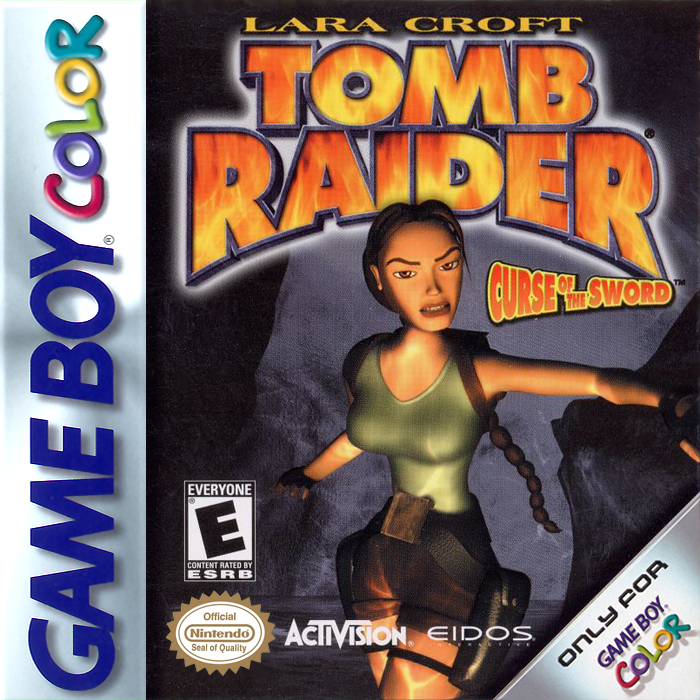
As a standalone entry, Tomb Raider Starring Lara Croft sits at an interesting point in the franchise's early expansion. It followed the rapid success of the original Tomb Raider games and showed how the character could be adapted to a portable system without abandoning exploration or tomb-based problem-solving. Core Design later returned to the Game Boy Color for Tomb Raider: Curse of the Sword, making this first handheld chapter the start of a short, separate 2D branch of Lara Croft's classic-era adventures.
Gallery
Details
- Developer
- Core Design
- Publisher
- Eidos Interactive
- Genre
- Tile-Matching Puzzle, Other Action & Arcade
- Players
- 1
- Release Date
- July 8, 2000
- System
- GBC