About
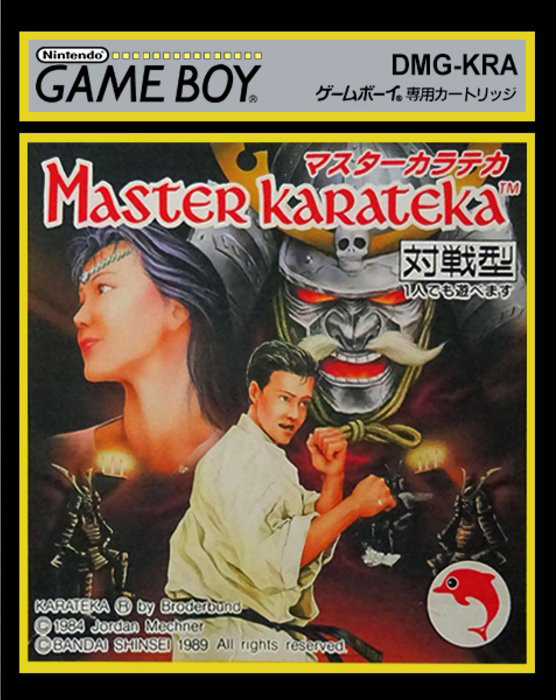
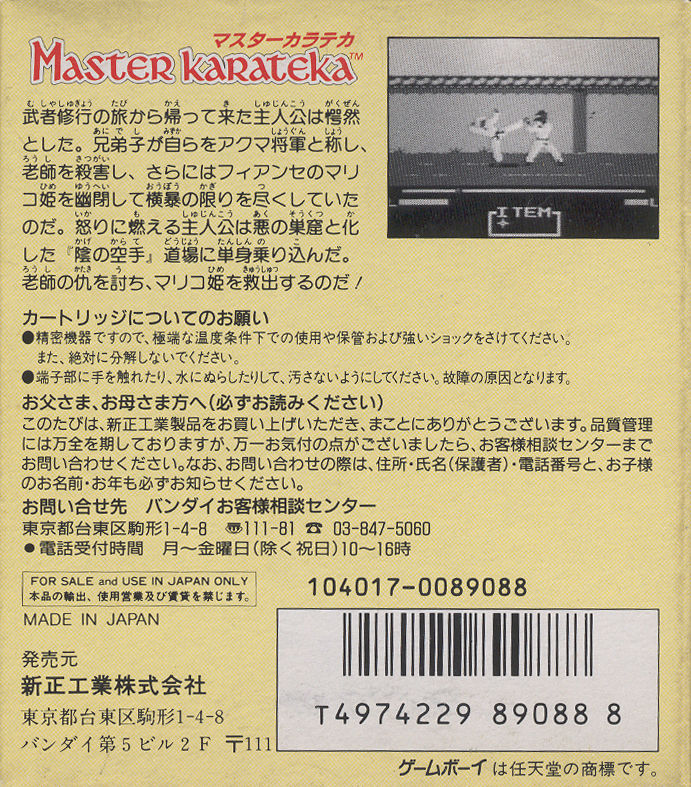
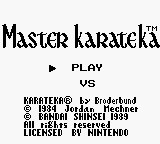
Master Karateka for Game Boy is a single-player martial-arts action game developed by TOSE and published by Shinsei in Japan at the end of 1989. It is a reworked handheld version of Karateka, Jordan Mechner's 1984 computer game, rather than a direct reproduction of every earlier release. The adventure follows a karateka entering the fortress of the villain Akuma to rescue Princess Mariko. Its compact, monochrome presentation turns that premise into a succession of tense side-view confrontations, with the player advancing through the stronghold one screen and one opponent at a time.
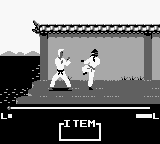
The basic rhythm alternates between travelling and fighting. Outside combat, the hero runs to the right through the castle grounds and interiors; pressing down shifts him into a fighting stance when danger approaches. In that stance, the Game Boy's buttons deliver punches and kicks, while combinations with up or down select high or low attacks. The direction pad also governs cautious forward and backward movement and defensive blocks. Each duel depends on spacing, timing, and recognizing whether an enemy is attacking high, low, or guarding rather than on a long list of special moves.
Master Karateka distinguishes itself from the original Karateka with an attribute-allocation system. At the start, the player divides a small pool of points among power, life, and speed, then receives further points between stages. Those choices give the straightforward rescue mission a measure of personalization: added power helps shorten confrontations, life offers a greater margin for mistakes, and speed becomes relevant when navigating certain hazards. Health is displayed in bars for both the hero and the current foe, and careful defense can allow the hero's energy to recover, making patience part of the game's strategy.
Akuma's domain is divided into three escalating sections: the courtyard, the castle, and the area beneath it. Ordinary guards give way to tougher masked opponents and bodyguards, while short scenes keep Mariko and Akuma in view of the quest. The Game Boy version also adds or rearranges challenges around its own progression, including thrown shuriken, Akuma's attacking eagle, locked doors, pickups, and a dangerous closing gate. These obstacles interrupt the line of one-on-one battles and require the player to change stance, block, strike at the right height, or move with deliberate timing.
The final stretch brings the hero through Akuma's defenses before the confrontation with Akuma himself and the rescue of Mariko. It remains an exacting game because progress is built around survival through a continuous journey rather than separate selectable fights. That structure connects Master Karateka to the cinematic, story-led design of its celebrated 1984 source while showing how an early Game Boy adaptation could reshape a computer action game for a handheld screen. For players exploring the Game Boy's earliest Japanese library, it is a notable version of Karateka: familiar in premise, but materially different in its character development, enemy sequence, hazards, and presentation.
Gallery
Details
- Developer
- TOSE
- Publisher
- Shinsei
- Genre
- Fighting
- Players
- 1
- Release Date
- December 28, 1989
- System
- GB