About
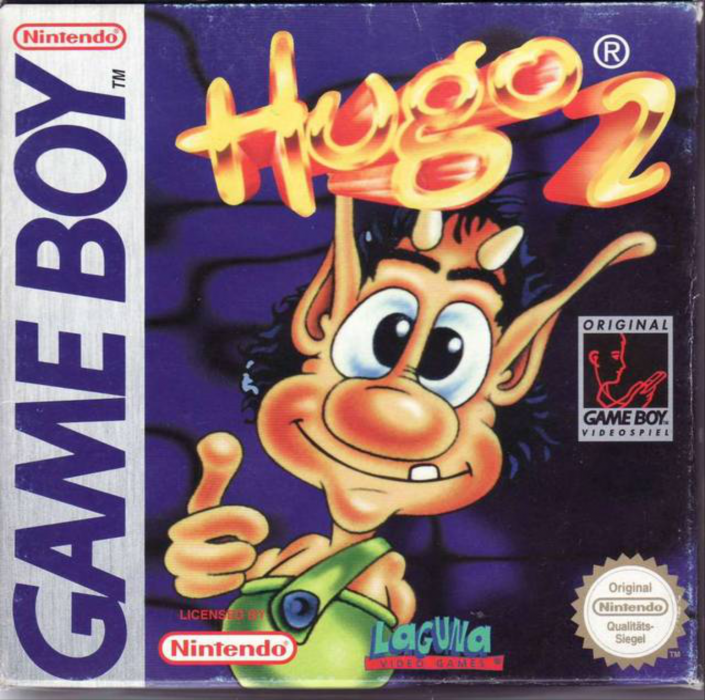
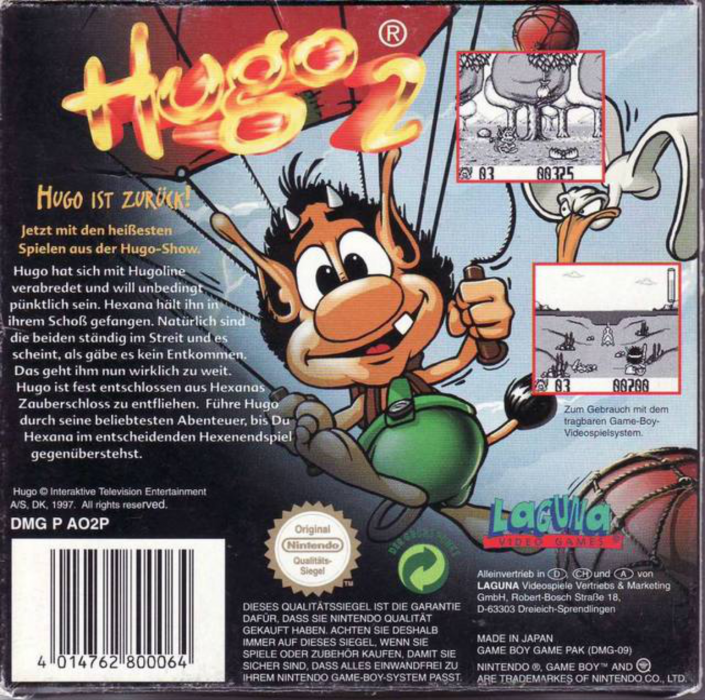
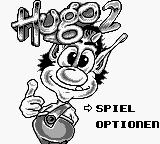
Hugo 2 for Game Boy is a 1997 action game developed by Bit Managers and published in Europe by Laguna Videospiele Vertriebs & Marketing. It adapts the family-oriented Hugo interactive television format for Nintendo's monochrome handheld, putting players in control of the small troll Hugo across a set of short, obstacle-filled challenges. Rather than following the later PlayStation game that shares its name, this is a compact Game Boy production built around scenarios associated with the television show and designed for single-player play.
The central aim in each main challenge is straightforward but demanding: keep Hugo alive while gathering enough bags of money to meet the requirement for the selected difficulty. The requirement changes with the difficulty setting, so a successful run depends on both survival and efficient collecting. The game uses the Game Boy's directional controls and action buttons for quick responses as hazards approach, giving its simple rules an arcade-like emphasis on timing, positioning, and learning which threats need to be avoided.
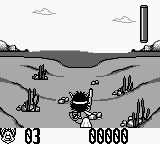
One scenario sends Hugo underwater. Seen from behind, he swims through an oncoming stream of obstacles while trying to collect bags and manage his air supply. Staying near the middle of the screen is important because that is where he can take a fresh breath; drifting away from that safe position for too long adds another concern to the route ahead. The level combines forward motion, evasive steering, and a recurring need to return to the center before the next danger closes in.
Snowboarding provides a second kind of reflex challenge. Hugo rides down a wintry course and must steer away from hazards while continuing to pick up money bags. The forest sequence changes the rhythm again: Hugo moves automatically from left to right, leaving the player to react by jumping over dangers or ducking beneath them. These stages retain the TV show's quick, accessible premise while translating it into direct handheld inputs instead of the original call-in format.
The ice-cave challenge is more spatial. Hugo crosses a bottomless gap by moving among pillars that rise and fall unpredictably, so waiting in one place is risky and a route can disappear at the wrong moment. He can move in four directions here, making it less of a side-scrolling dodge course and more of a test of observation and safe placement. Completing the four regular scenarios opens a fifth level, giving the collection a final reward beyond the initial set of minigames.
Hugo 2 arrived during a period when the Hugo character was familiar to audiences in several European markets through the interactive children's program and its many game adaptations. The Game Boy edition pares that broad concept down to five focused activities and a portable format, with 2D presentation and alternating behind-view and side-view perspectives. It should not be confused with Hugo 2½, the 1999 Game Boy Color follow-up version released by Infogrames; that later release added a training mode that lets players practice the individual challenges separately. The original 1997 Game Boy Hugo 2 remains a licensed, single-player action title whose identity comes from its concise series of survival-and-collection tests.
Gallery
Details
- Developer
- Bit Managers
- Publisher
- Laguna Videospiele Vertriebs & Marketing
- Genre
- Platformer
- Players
- 1
- Release Date
- January 1, 1997
- System
- GB