About
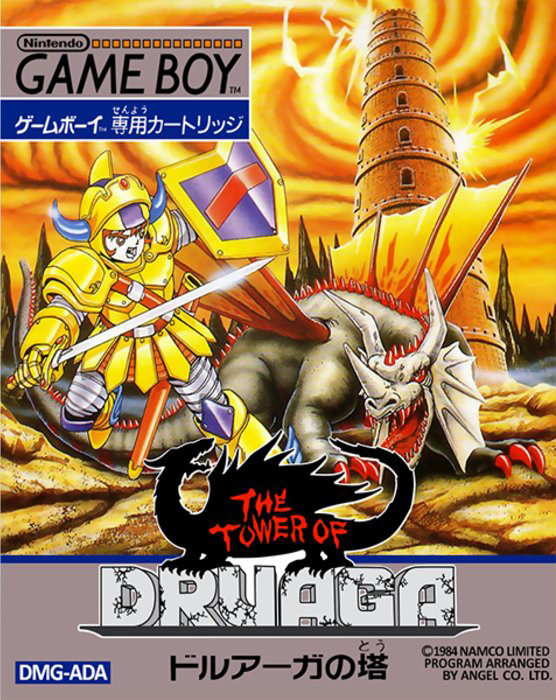
Druaga no Tou for Game Boy is a Japanese 1990 action-maze adaptation of Namco’s The Tower of Druaga. Developed by TOSE and published by Angel, this monochrome handheld version follows the golden knight Gil as he enters a 60-floor tower to rescue Kai, the royal priestess imprisoned by the demon Druaga, and return the Blue Crystal Rod to the heavens. It is a distinct Game Boy conversion of the earlier arcade game, rather than the Famicom release, the later PC Engine remake, or a sequel in the Babylonian Castle Saga.
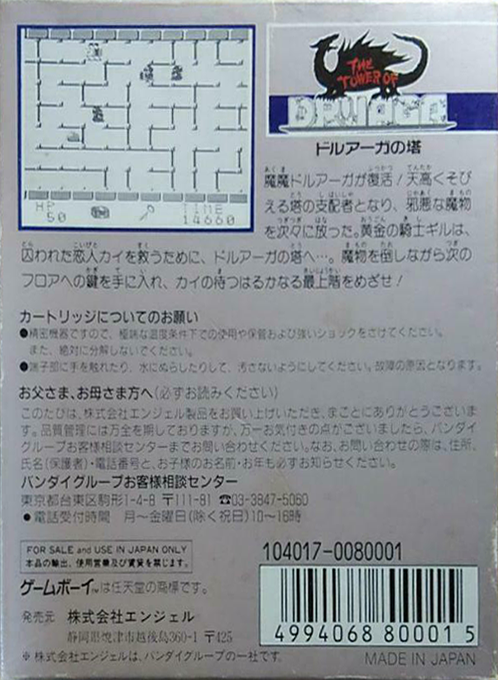
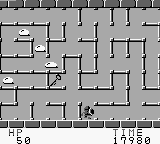
Each floor is a compact overhead maze. Gil must find its key and take it to the exit door to climb upward, while using the D-pad to navigate corridors crowded with monsters. The A or B button swings or holds out his sword; this can clear a route through enemies, while the shield protects him from spells arriving from the direction it faces. A countdown places pressure on each expedition, and enemy hits or an expired timer reduce Gil’s health instead of immediately ending a run.
Treasure chests are central to progression. They appear only after the player fulfils a floor-specific condition, and their contents can improve combat, reveal otherwise unseen parts of a maze, or answer hazards introduced later in the tower. Equipment includes stronger swords, gauntlets that speed sword handling, candles for revealing ghosts, books that uncover maze information, rings for surviving contact with Will-o’-the-Wisps, and matocks for breaking walls. Some tools operate automatically, while matocks are selected and used during a floor.
The Game Boy edition presents useful information that changes how the adventure is managed on a small screen. Its floor display shows Gil’s current and maximum health, score, key status, and remaining time, while the Select button opens a separate window for status and collected items. Health can be restored through certain treasure and by score milestones, and hidden floors add mandatory encounters to the climb. These additions coexist with altered floor layouts and revised chest requirements, so knowledge of the arcade or Famicom game does not completely substitute for this version’s own route through the tower.
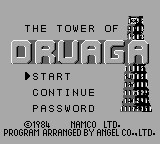
Continuing is more accommodating than an arcade session: if the Game Boy remains powered on, a game over can be continued from the affected floor with obtained items retained. Passwords become available after hidden floors from floor 10 onward, allowing the adventure to be resumed after power is switched off. The ending presentation also varies according to the number of continues used. The tower’s later floors preserve the series’ need for careful preparation, including hazards and equipment requirements that can determine whether Gil is ready to confront Druaga.
Druaga no Tou is rooted in the same fantasy setting that made Namco’s 1984 game a foundation for the broader Druaga franchise, but its Game Boy cartridge has its own publisher, developer, interface, and balance of portable conveniences. It returned in Japan in 1996 within Namco Gallery Vol. 2 alongside Galaxian, Dig Dug, and Famista 4; that compilation added Super Game Boy support. For players exploring the original handheld library, the standalone 1990 release is the version built specifically around Game Boy controls, status displays, passwords, and its own set of tower revisions.
Gallery
Details
- Developer
- TOSE
- Publisher
- Angel
- Genre
- JRPG
- Players
- 1
- Release Date
- December 31, 1990
- System
- GB