About
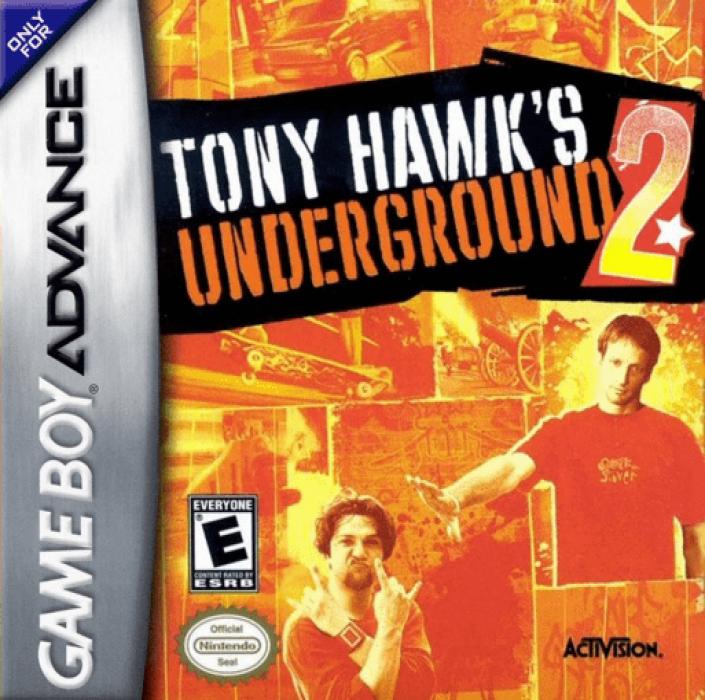
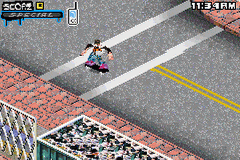
Tony Hawk's Underground 2 for Game Boy Advance is a 2004 skateboarding game developed by Vicarious Visions and published by Activision. Released in North America on October 4, 2004, it brings the sixth main Tony Hawk game to Nintendo's handheld in a form built around the hardware rather than simply duplicating the PlayStation 2, Xbox, GameCube, and PC release. The GBA game uses an angled, isometric view and polygonal skaters, preserving the series' emphasis on flowing through skate parks, linking tricks, and turning a successful run into a high-scoring combo. It follows 2003's Tony Hawk's Underground and shares that sequel's World Destruction Tour theme, celebrity skaters, and irreverent presentation.
At its center, Tony Hawk's Underground 2 GBA is about momentum and score building. Players roll through compact versions of locations inspired by the larger game's stops, looking for ramps, rails, ledges, and other scenery that can be joined into a line. Ollies launch the skater into the air, while grabs, flips, spins, grinds, manuals, and lip tricks contribute to a combo. Landing safely banks the points; falling ends the string, so the challenge is to judge speed, balance, and when to finish a sequence. The handheld controls retain the recognizable Tony Hawk rhythm: directional inputs shape movement and tricks, while shoulder buttons help select aerial trick types.
The main Story Mode lets players create a rookie skater and travel alongside established personalities including Tony Hawk, Bam Margera, Bob Burnquist, Eric Koston, Rodney Mullen, Chad Muska, Mike Vallely, and Eric Sparrow. Rather than making every task a short timed sprint, the portable version allows many Story Mode objectives to remain active at once. That gives each area a more exploratory structure: players can pursue score targets, environmental trick challenges, and other assignments while also improving the created skater. Progression is tied to performance, with stat gains earned by demonstrating skills such as long combos, sustained grinds, manuals, spins, grabs, and flip tricks. The result is a campaign that frames practice and increasingly ambitious lines as part of the character's development.
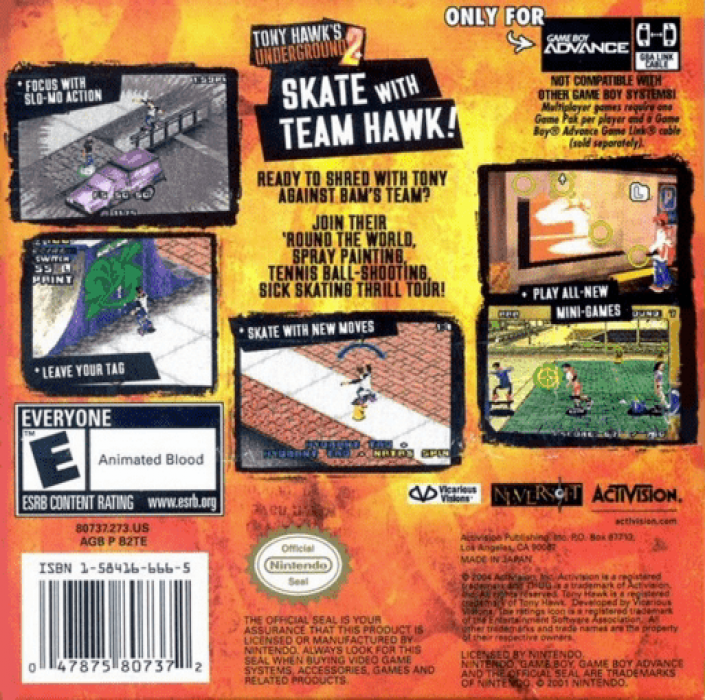
Arcade Mode provides a more traditional goal-focused alternative. Here, players tackle a set of objectives within the familiar two-minute format associated with earlier Tony Hawk titles, including high-score challenges and stunt-based tasks. The game also carries over several of Underground 2's signature additions. Focus can slow time during a combo to make balance and difficult landings more manageable. The Natas Spin gives skaters another way to score from small upright objects, and a Sticker Slap turns a wall interaction into a trick opportunity. A recovery-style move after a bail can help a run continue, while custom special-trick inputs allow players to tailor parts of the move list to their own button preferences.
Vicarious Visions' version stands as a platform-specific entry in the series, not merely a handheld replay of Neversoft's console game. Its maps reinterpret destinations such as Boston, Barcelona, Berlin, Australia, New Orleans, and Skatopia for an isometric portable format, and its roster and modes draw from the broader Underground 2 package while making selective changes. The game arrived near the end of a run of Game Boy Advance Tony Hawk adaptations from the same studio, whose approach used 3D character models and a viewpoint designed for fast, readable handheld skating. For players exploring the Tony Hawk catalog on Game Boy Advance, Underground 2 combines the series' combo-driven skateboarding with character progression, classic timed challenges, and several mechanics introduced by its 2004 counterpart.
Gallery
Details
- Developer
- Vicarious Vision
- Publisher
- Activision
- Genre
- Extreme Sports
- Players
- 1-2
- Release Date
- October 4, 2004
- System
- GBA
/Summon_Night_Craft_Sword_Monogatari_Hajimari_no_Ishi.png)