About
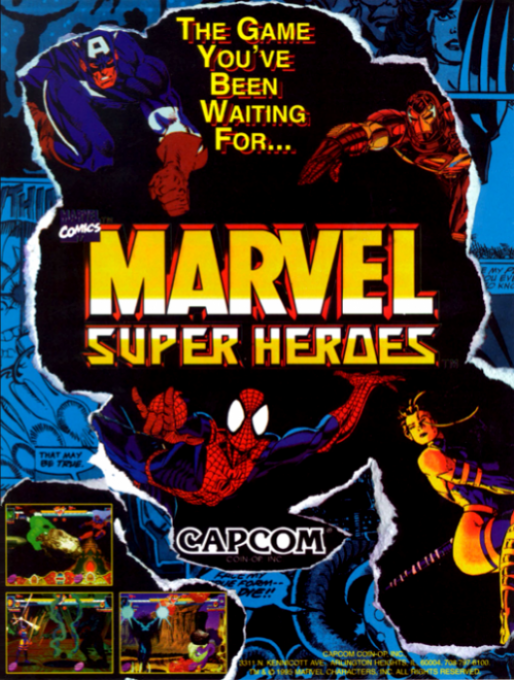
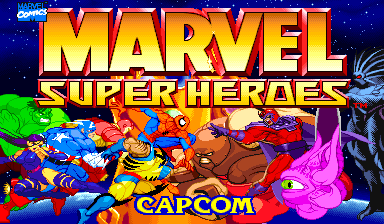
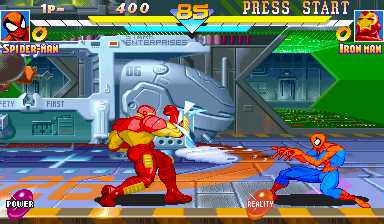
Marvel Super Heroes is Capcom’s 1995 arcade fighting game built around Marvel’s Infinity Gauntlet storyline. Developed and published by Capcom for its CPS-2 hardware, it follows 1994’s X-Men: Children of the Atom and brings Marvel heroes and villains into a fast, brightly animated one-on-one contest. The arcade game frames its action as a battle for the Infinity Gems, with Thanos seeking the power to rule the universe. Its comic-book presentation, large character art and dramatic special effects make every round feel like a compact superhero showdown.
Players choose from a roster that combines familiar heroes with formidable rivals. Captain America, Hulk, Iron Man, Spider-Man and Wolverine stand alongside Psylocke, while Blackheart, Juggernaut, Magneto and Shuma-Gorath supply some of the opposition. The cast reflects Capcom’s earlier Marvel work as well as the company’s interest in pairing visually distinctive fighters with very different movement, reach and special-move options. Thanos is the central threat in the arcade progression, and Doctor Doom also appears during the game’s single-player journey.
At its core, Marvel Super Heroes uses the round-based structure of a traditional 2D fighter. Competitors trade normal attacks, throws, aerial pressure and character-specific special moves while trying to empty the other life bar before time expires. Successful offense and defense build the Infinity Combo meter, which can be spent on stronger super attacks. That familiar Capcom rhythm gives the game an immediate arcade feel, but the gem system adds another strategic layer to matches.
The six Infinity Gems are Power, Time, Space, Reality, Soul and Mind. During arcade play, gems can be won from opponents; versus play provides conditions for bringing them into a match. Activating one grants a temporary benefit, such as greater attack strength, improved defense, health recovery, new attack opportunities or altered movement. The effect depends on both the gem and the selected character, encouraging players to learn not just a fighter’s command list but also the situations in which a particular gem can change momentum.
Capcom used CPS-2 to fill the screen with detailed sprites, energetic hit effects and animated backgrounds that echo the scale of Marvel comics. The presentation is supported by character voices, stylized portraits and a soundtrack designed for the noisy atmosphere of an arcade cabinet. The game was dedicated to influential Marvel artist Jack Kirby, connecting Capcom’s adaptation to one of the most important creative figures in the publisher’s superhero history.
Marvel Super Heroes became an important step in Capcom’s long-running Marvel fighting lineage. It was followed by X-Men vs. Street Fighter in 1996, a transition toward the crossover format that later became synonymous with Marvel vs. Capcom. The original arcade game also led to Sega Saturn and PlayStation conversions, appeared with Marvel vs. Capcom: Clash of Super Heroes in Marvel vs. Capcom Origins, and returned in Marvel vs. Capcom Fighting Collection: Arcade Classics. For arcade fighting fans, it remains a distinctive 1990s Capcom game whose Infinity Gem mechanic gives its comic-book clashes an identity of their own.
Gallery

Details
- Developer
- Capcom
- Publisher
- Capcom
- Genre
- Fighting
- Players
- 1-2
- Release Date
- January 1, 1995
- System
- Arcade