About
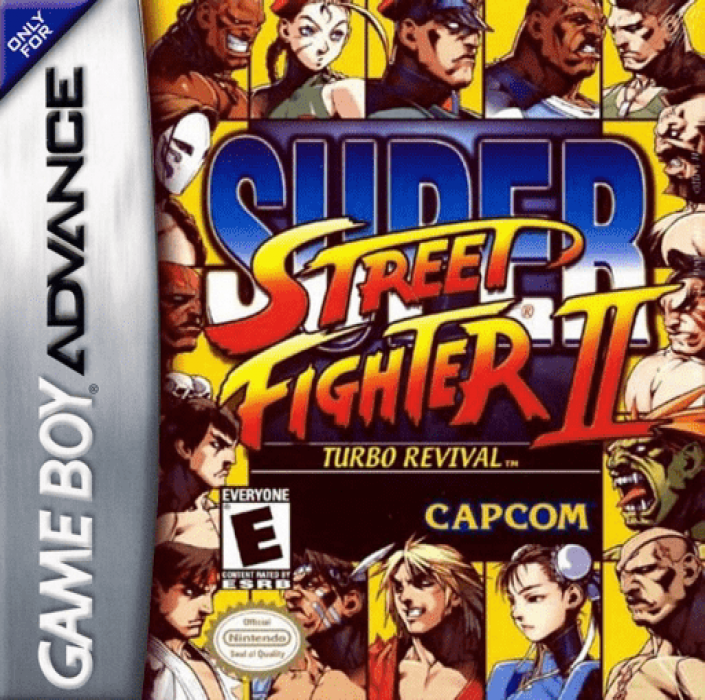
Super Street Fighter II Turbo Revival is Capcom’s 2001 Game Boy Advance adaptation of the 1994 arcade fighter Super Street Fighter II Turbo. Released in Japan as Super Street Fighter II X: Revival before arriving in North America and Europe, it brings the Street Fighter II roster and its fast one-on-one matches to Nintendo’s handheld. Fighters from around the world enter the World Warrior tournament, each using a distinct move set as they battle through computer opponents or face another player.
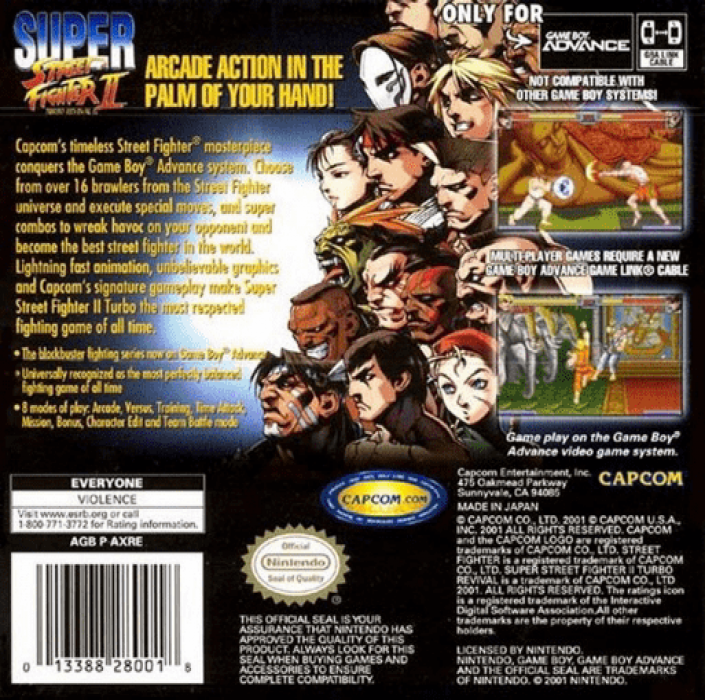
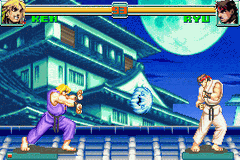
The foundation is the familiar best-of-rounds contest: reduce the opponent’s vitality before time expires by choosing attacks carefully, blocking, jumping, throwing, and capitalizing on openings. The 16 standard fighters include series regulars such as Ryu, Ken, Chun-Li, Guile, and Zangief, alongside the four characters introduced in Super Street Fighter II—Cammy, Dee Jay, Fei Long, and T. Hawk—and the four boss characters. Every combatant has different normals, special techniques, reach, and movement, so learning spacing and the right moment to attack remains central to play.
Like its arcade source, Super Street Fighter II Turbo Revival uses a Super meter that fills during a fight. Once charged, it lets a character perform a powerful Super Combo with the right command, turning a successful opening into a major swing. The Game Boy Advance version also retains selectable game speeds and includes an optional easy-special-move setting for simplified inputs. These choices sit alongside the traditional directional-pad commands for projectiles, uppercuts, throws, spinning attacks, and other signature techniques.
Capcom adapted the six-attack arcade layout to the Game Boy Advance’s A, B, L, and R buttons. Light and medium attacks can share the face buttons according to how they are pressed, while the shoulder buttons handle heavy attacks; the controls can also be configured to suit the player. That compromise makes the portable version recognizably Street Fighter II while giving players several ways to approach its demanding move inputs. Matches can be played alone in Arcade mode or head-to-head through the Game Boy Advance link connection, with a second cartridge required for multiplayer.
Beyond the main tournament, the cartridge offers training, survival, time-attack, and other challenge-oriented options, with some activities and modes opened through continued play. It also restores familiar Street Fighter II bonus challenges such as the car-smashing sequence. Akuma, the hidden fighter introduced by Super Turbo, is available as unlockable content, and the Game Boy Advance release adds an unlockable stronger Akuma variation. These extras give the adaptation more to do between standard arcade runs and versus matches.
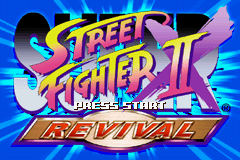
Turbo Revival is not a byte-for-byte arcade port: its presentation was reshaped for the handheld, with new character illustrations and a new title presentation, altered or newly composed stages, and some reduced animation. Even so, it preserves the character-based matchups, Super Combo system, and direct competitive focus that defined Super Street Fighter II Turbo. The game was later reissued for Wii U Virtual Console, leaving this Game Boy Advance version as a distinct portable chapter of Capcom’s long-running fighting series.
Gallery
Details
- Developer
- Capcom
- Publisher
- Capcom
- Genre
- Fighting
- Players
- 1-2
- Release Date
- October 31, 2001
- System
- GBA