About
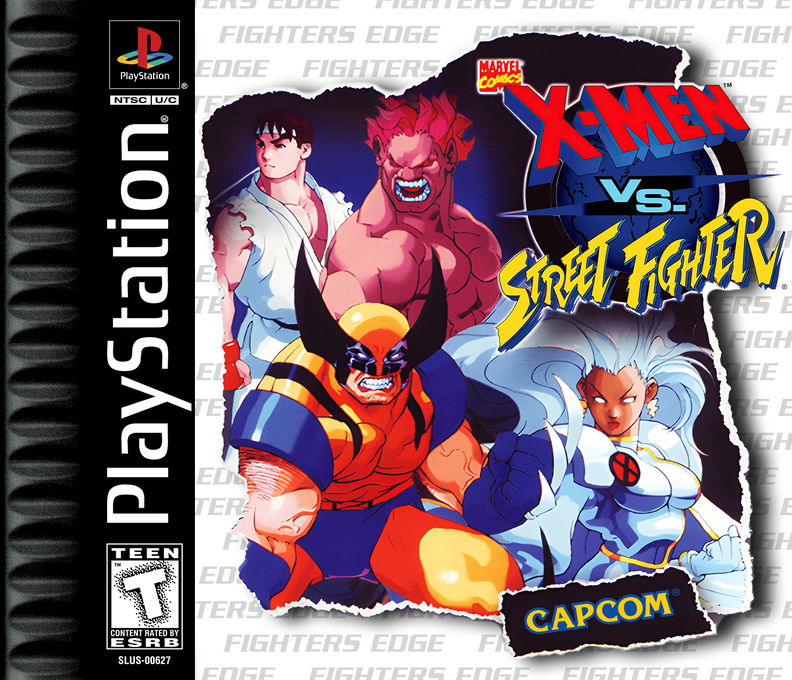
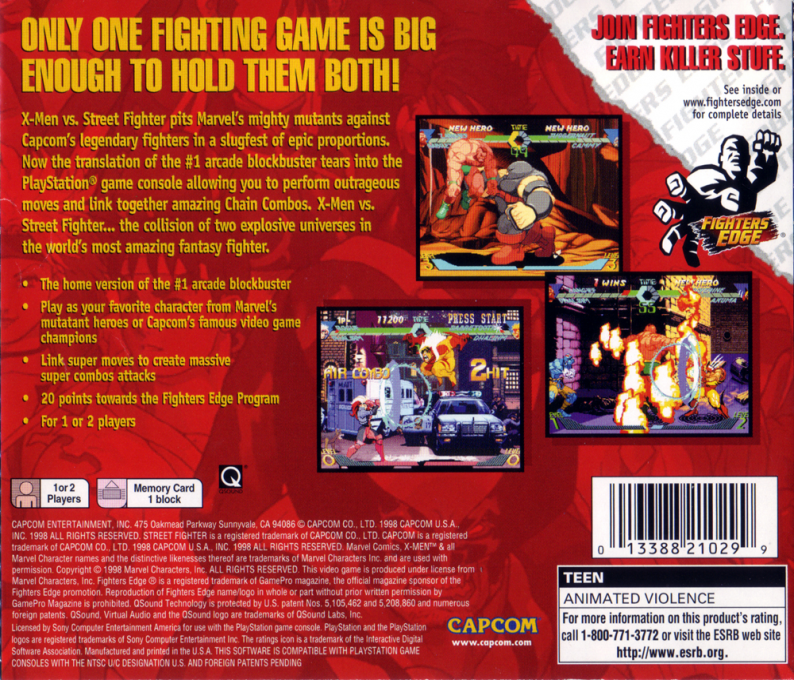
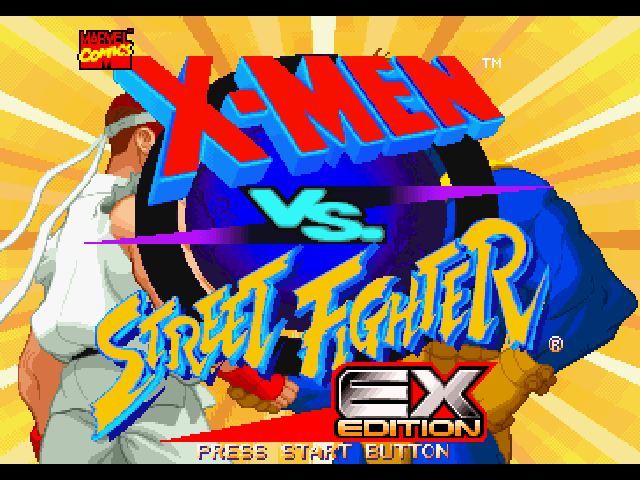
X-Men vs. Street Fighter for PlayStation brings Capcom’s Marvel-and-Street-Fighter crossover to Sony’s 32-bit console. Developed and published by Capcom, this 2D fighting game reached North America in June 1998 after debuting in arcades in 1996; the Japanese PlayStation edition was titled X-Men vs. Street Fighter: EX Edition. It joins mutants from Marvel’s X-Men world with Capcom’s Street Fighter competitors in fast, brightly animated one-on-one bouts. The original arcade game is an early cornerstone of the Marvel vs. Capcom line, following Capcom’s X-Men: Children of the Atom and Marvel Super Heroes.
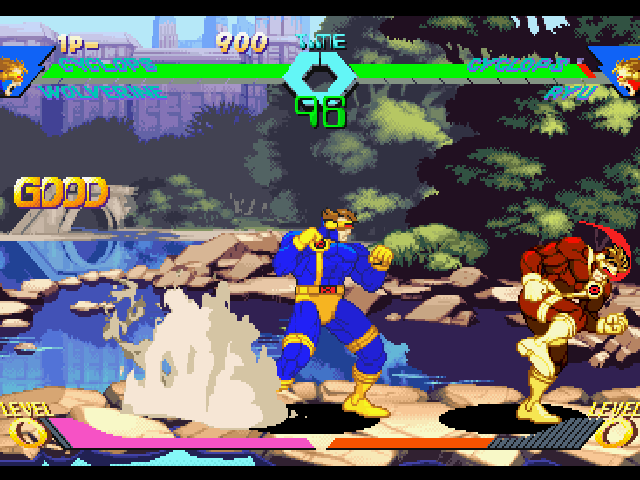
At its heart, the PlayStation version uses the familiar language of Capcom’s six-button fighters. Players move with the directional controls and attack with light, medium, and heavy punches and kicks, combining normal attacks with character-specific special moves. Projectiles, anti-air attacks, throws, and carefully timed blocks all matter, while a match can quickly become a contest of positioning and combo execution. Familiar Street Fighter moves are deliberately reimagined on a larger, more spectacular scale so the human fighters can trade blows with Marvel’s super-powered cast.
The game’s roster places Cyclops, Wolverine, Rogue, Storm, Gambit, Juggernaut, Sabretooth, and Magneto alongside Ryu, Ken, Chun-Li, Zangief, Dhalsim, Cammy, Charlie, and M. Bison. Akuma is also available as a hidden character. The X-Men artwork draws heavily on the colorful visual language of the 1990s animated series, while the Street Fighter side carries forward the look of the Street Fighter Alpha era. Arcade Mode sends a chosen fighter through computer-controlled opponents before a final confrontation with Apocalypse, the X-Men antagonist; Versus Mode supports local two-player matches.
X-Men vs. Street Fighter is best known for its two-character team system in the arcade game, where partners can be called in and resting fighters recover some health. That structure is important context for the PlayStation adaptation, but the console’s memory limits changed it substantially. Rather than allowing a partner to be switched in freely, the PlayStation release centers on one active character at a time. A second selection still contributes to certain special attacks, including Variable Combinations and Variable Counters, so team choice remains part of the game even though the full arcade tag system is absent.
Its other defining mechanics come from Capcom’s earlier Marvel fighters. A Super Jump launches characters high above the standard fighting-game playfield, opening space for aerial pursuits. An Aerial Rave lets a player continue a successful combo after taking an opponent into the air. Combat also fills a Hyper Combo Gauge as attacks are landed or damage is received. Spending that meter enables powerful Hyper Combos, and the PlayStation version’s altered gauge behavior can make those high-impact techniques appear more often than in the arcade release.
The PlayStation edition also differs in its modes and match format. Alongside Arcade and local Versus play, it includes Training Mode for practicing attacks and combinations against a passive opponent, plus Survival Mode for consecutive battles. Its standard matches use a two-out-of-three-round structure rather than the single extended team battle of the arcade game. Animation was reduced and the port cannot reproduce every aspect of the arcade presentation, yet it remains a distinct version of a major 1990s crossover: a meeting point between Capcom’s fighting-game design and Marvel’s X-Men characters that led directly to Marvel Super Heroes vs. Street Fighter and the broader Marvel vs. Capcom series.
Gallery
Details
- Developer
- Capcom
- Publisher
- Capcom
- Genre
- Fighting
- Players
- 1-2
- Release Date
- June 11, 1998
- System
- PS1