About
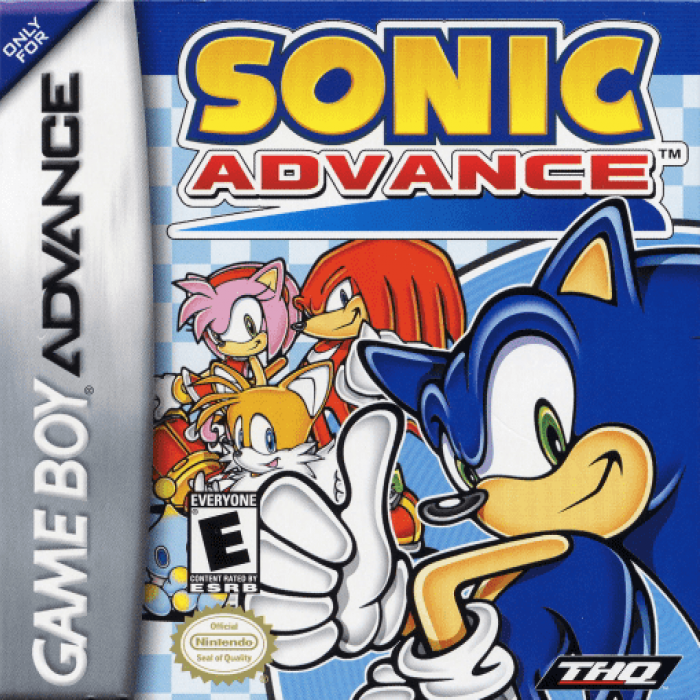
Sonic Advance for Game Boy Advance is a side-scrolling platform game developed by Dimps with Sonic Team and published by Sega. It debuted in Japan in December 2001 and reached North America and Europe in early 2002, bringing Sega's blue hedgehog to Nintendo hardware during the series' tenth-anniversary period. The game returns to the fast, level-based 2D format associated with Sonic's Mega Drive and Genesis adventures while incorporating the character designs and some ideas familiar from the Sonic Adventure era.
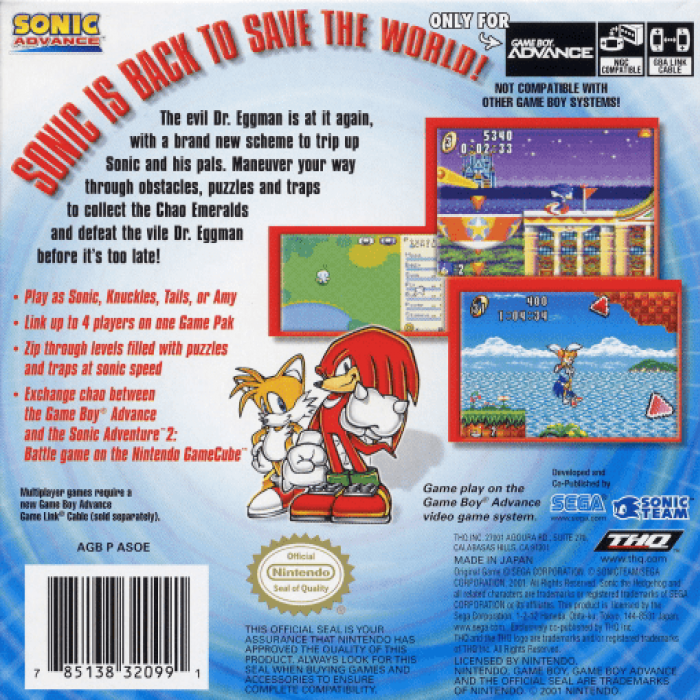
Doctor Eggman, also known as Dr. Robotnik, is once again turning animals into robots, and the campaign sends Sonic and his friends across a chain of themed zones to stop him. Players may begin the main game as Sonic, Tails, Knuckles, or Amy, rather than treating the additional heroes as merely cosmetic choices. Each has a different movement specialty, so the same acts can be approached in different ways: Sonic emphasizes speed, Tails can fly for a limited time, Knuckles can glide and climb, and Amy attacks with her hammer.
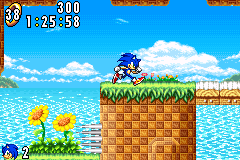
The basic goal in each act is to reach the signpost before the ten-minute time limit while avoiding hazards, enemy machines, and bottomless drops. A jump becomes Sonic's familiar spinning attack in the air, and building momentum with a spin dash helps launch a character through slopes and along alternate routes. Springs, dash panels, rails, and other stage devices keep the action moving, while rings function as protection: taking a hit without any rings costs a life. The second act of a zone ends with a confrontation against Eggman, after which a captured-animal capsule is freed.
Sonic Advance rewards exploration as well as speed. Special springs can lead to Special Stages, where collecting enough rings earns a Chaos Emerald. Gathering all seven emeralds unlocks an additional final encounter, giving repeat play a purpose beyond simply clearing the story with another character. Power-up monitors provide effects such as shields, invincibility, and faster running, and the branching layouts make the characters' individual abilities particularly useful for reaching higher paths or otherwise inaccessible areas.
The Game Boy Advance cartridge also includes the Tiny Chao Garden, a separate mode centered on raising a Chao. Rings earned through its small games can be spent on food and items, and a Nintendo GameCube Game Boy Advance Cable allows Chao data to move between Sonic Advance and the Chao Garden in Sonic Adventure 2 Battle. That connection reflects the game's blend of classic portable platforming with the series' then-current Dreamcast and GameCube-era features.
Multiplayer gives the handheld release another dimension. Up to four people can take part with Game Boy Advance systems and link cables; some competitive modes can operate from a single Sonic Advance Game Pak, while additional options are available when every player supplies a cartridge. These sessions turn the focus from the solo quest into short races and Chao-oriented contests, making the game usable as both a traditional single-player Sonic adventure and a local group game.
Sonic Advance was followed on Game Boy Advance by Sonic Advance 2 and Sonic Advance 3. Its arrival was historically notable because Sonic had long been Sega's console mascot and a defining rival to Nintendo during the 1990s. On the GBA, the collaboration between Dimps and Sonic Team produced a compact entry that preserved ring collecting, high-speed platform routes, Chaos Emeralds, and Eggman boss fights while giving four playable heroes and the Chao link feature a prominent place in the experience.
Gallery
Details
- Developer
- Sonic Team
- Publisher
- SEGA
- Genre
- Platformer
- Players
- 1-4
- Release Date
- February 3, 2002
- System
- GBA