About
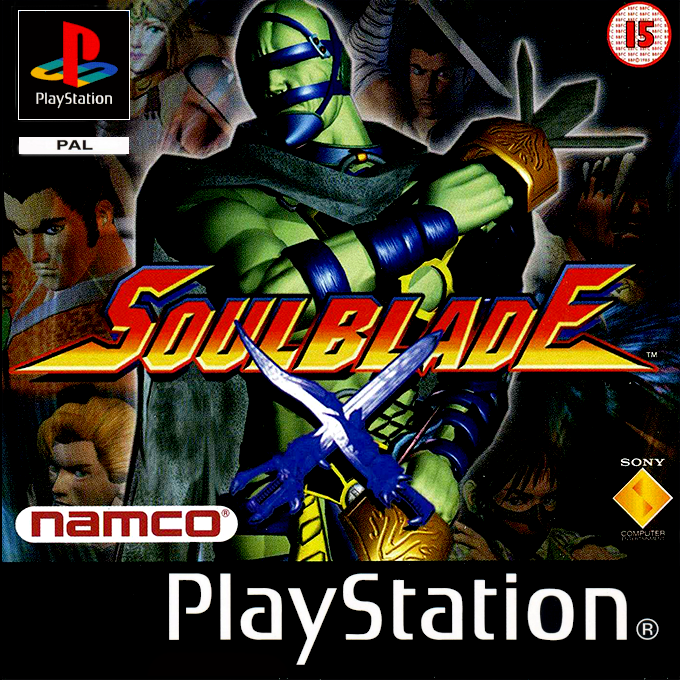
Soul Blade is Namco's PlayStation adaptation of the weapon-fighting game released in Japanese arcades as Soul Edge. Set in 1583, it opens the long-running Soul series with a search for Soul Edge, a legendary blade whose promises of power conceal a destructive will. Warriors from Europe, Asia, and the Americas pursue the weapon for sharply different reasons: revenge, duty, ambition, redemption, or the belief that it can save someone close to them. The result is a fighting game built around individual rivalries as much as a contest for the same dangerous prize.
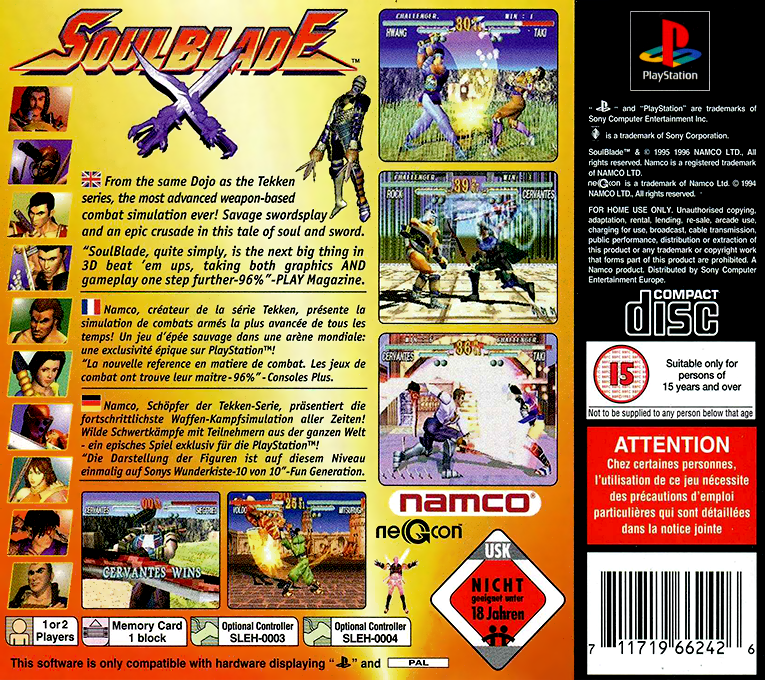
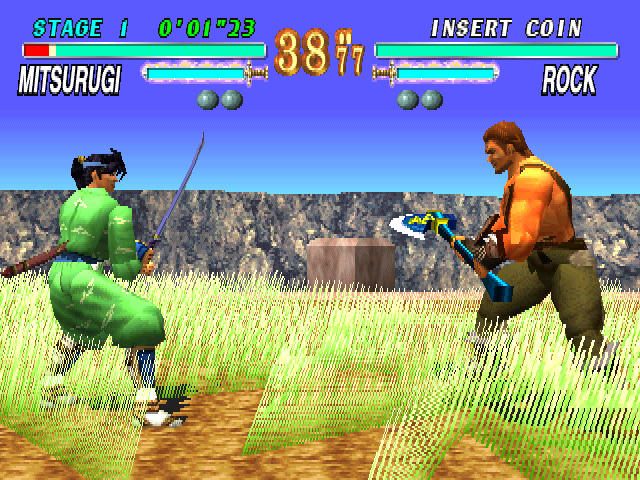
The PlayStation edition expands the arcade foundation into a full home fighting package. Its combat uses three primary attacks—horizontal strikes, vertical strikes, and kicks—alongside guarding, throws, jumping, and limited lateral movement. Rather than free-roaming around an opponent, fighters can step into or away from the foreground to change alignment, while stages retain the threat of a ring out. Every combatant brings a distinct weapon and style, from Mitsurugi's katana techniques and Sophitia's sword-and-shield attacks to Taki's ninja blades, Voldo's unusual claw weapons, and Cervantes' paired swords.
Weapons are central to both the look and the mechanics. Blocking drains a Weapon Gauge, and an exhausted gauge leaves a fighter disarmed and forced to use a shared unarmed move set. The game also gives players timing-based defensive options through Guard Impact, which can repel an incoming attack and create a counterattack opportunity. Character-specific Critical Edge attacks add high-commitment combo sequences, while simultaneous strikes can produce weapon clashes that ask each player to react quickly. These systems give matches more to consider than health bars alone, especially near an arena boundary or when a weapon is close to breaking.
Soul Blade's PlayStation roster starts with ten standard fighters and grows through unlockables, including the sword's monstrous wielder. The international release uses the Soul Blade name, while the Japanese version remains Soul Edge. Namco changed the overseas title because of trademark concerns around the word “Edge,” but the game is otherwise the same major entry: an enhanced console version of the arcade game rather than a separate sequel. The PAL release was published by Sony Computer Entertainment Europe, matching this catalog record, while Namco developed the game and handled publishing in other regions.
The console-exclusive Edge Master mode gives the game its strongest single-player identity. Presented as a storybook journey across a map, it follows a chosen character through themed battles and special conditions while revealing their personal route through the wider hunt for Soul Edge. Progress earns additional weapons with different power, defense, weapon-damage, durability, weight, and occasional special properties. Those rewards can then change how a character feels in versus play, making Edge Master more than a gallery of cutscenes and helping turn the campaign into a practical way to experiment with the cast.
Other modes include Arcade, versus battles, Survival, Team Battle, Time Attack, Training, and character endings. The PlayStation version also supplies extra costumes, selectable soundtracks, and a prominent computer-generated opening sequence, features that helped distinguish it from a straightforward coin-op conversion. Its cast received story material and endings that establish familiar figures such as Siegfried, Taki, Sophitia, Mitsurugi, and Voldo before the series’ mythology became more elaborate in later games.
Released during the PlayStation's formative years for 3D fighters, Soul Blade combines Namco's readable arcade-style controls with a weapon-focused identity that separates it from Tekken. It became the direct predecessor to Soulcalibur, whose 1998 arcade debut and Dreamcast conversion would carry the franchise forward. For players interested in the series' origins, this PlayStation release remains the place where its cursed sword, character-driven quest structure, weapon conditions, and theatrical presentation first came together.
Gallery
Details
- Developer
- Namco
- Publisher
- Sony Computer Entertainment
- Genre
- Fighting
- Players
- 1-2
- Release Date
- May 1, 1997
- System
- PS1