About
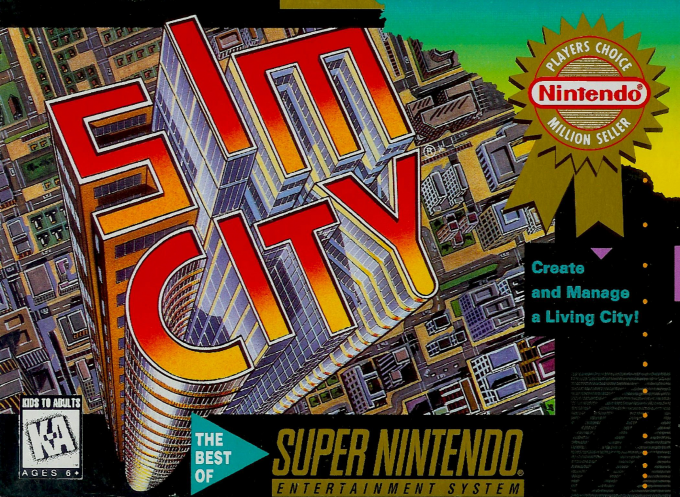
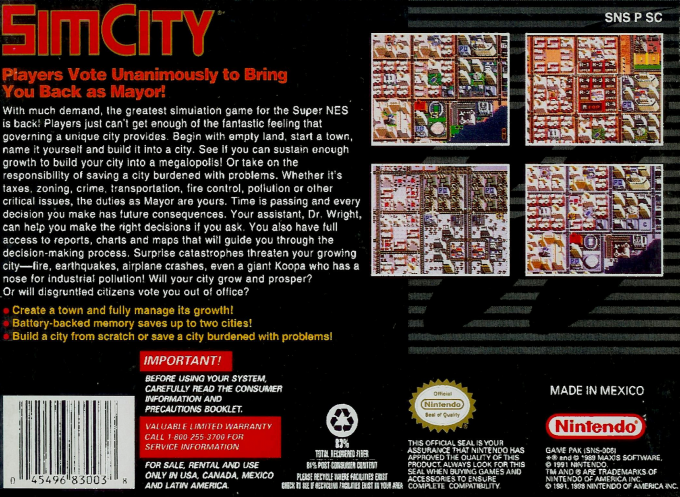
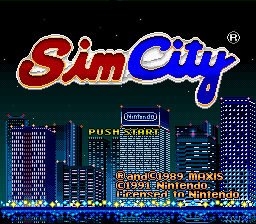
SimCity SNES is Nintendo’s 1991 Super Nintendo Entertainment System adaptation of Maxis’s landmark city-building simulation. Published by Nintendo, it recasts Will Wright’s open-ended municipal planning concept for a gamepad while retaining the central challenge: turn a bare map into a healthy, solvent city. Rather than following a conventional story or fighting through levels, the player serves as mayor, balancing development, public services, money, and the changing demands of an expanding population.
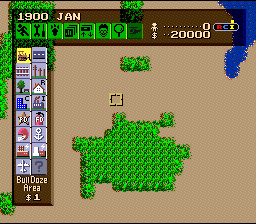
A new city begins with a choice of terrain and a treasury, then the mayor lays roads or railways, connects a power source, and zones land for residential, commercial, and industrial use. The controller moves a cursor across the overhead map and opens construction, budget, map, and information menus. Zoning alone does not create a thriving community; buildings need practical access, electricity, and suitable conditions before Sims move in and businesses develop. The player sets tax rates, adjusts funding for services such as roads, police, and fire protection, and decides when costly additions are affordable.
The simulation encourages attention to the links between city systems. Industry supplies jobs but may bring pollution, traffic can make districts less desirable, and inadequate services can contribute to crime or fires. A city can grow from a small settlement through larger classifications as its population and infrastructure develop, but growth is never automatic. Financial reports, advisor messages, and map views help identify problems, while the calendar lets the player advance time and watch neighbourhoods change. Disasters add another form of pressure, including fires, floods, earthquakes, tornadoes, and attacks by the port’s Nintendo-themed monster.
SimCity on SNES is not simply the 1989 computer game transferred unchanged to a cartridge. Nintendo worked with Maxis to reshape the presentation and add character to the console version. Dr. Wright, a friendly adviser modeled on creator Will Wright, appears to explain city issues and offer encouragement. The edition also awards special buildings for meeting particular milestones or conditions, giving long-term planning visible landmarks beyond ordinary zones and utilities. These rewards include civic and leisure structures, while a Mario statue becomes available when a city reaches the required population milestone. Bowser takes the role of the giant destructive creature, a notable departure from the computer version.
Several tools give the SNES city its own rhythm. Players may seek a bank loan when funds are tight, then must repay it before taking another. Schools and hospitals are part of the city’s needs, although they are not placed directly in the same way as roads, zones, or power plants. The game includes regular free-building play and a set of scenario cities with deadlines and specific crises to solve. Some scenarios draw on familiar locations, while the SNES version also includes its own challenges, such as an alien-threatened Las Vegas and the waterless Freeland map.
The conversion’s design makes it approachable without reducing it to a fixed solution. A carefully laid rail network, a sensible tax policy, or early investment in essential services can each support a different kind of city, while poor placement can leave an apparently busy map short of workers, revenue, or power. The changing seasonal presentation and music composed for the Super NES reinforce the passage of time as districts fill in. Its simple visual language makes the consequences of zoning and infrastructure easy to read, even as the economic decisions become more demanding.
Released during the SNES’s early years, SimCity showed that a console game could accommodate a slow, creative management simulation as well as action-focused genres. It is an important version in the history of the series because its collaboration with Nintendo produced additions that did not define the original computer release, particularly Dr. Wright, the reward buildings, and the Mario references. Later games would greatly expand the scope of city simulation, but this edition remains a focused exercise in building a city, responding to its problems, and deciding what kind of place it should become.
Gallery
Details
- Developer
- Maxis Software
- Publisher
- Nintendo
- Genre
- Management Simulation
- Players
- 1
- Release Date
- August 13, 1991
- System
- SNES