About
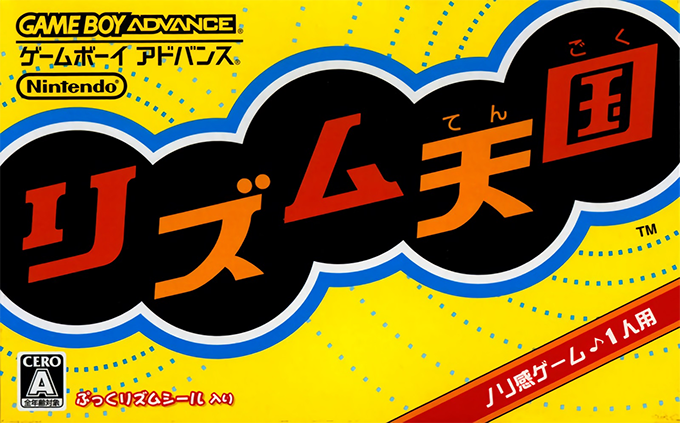
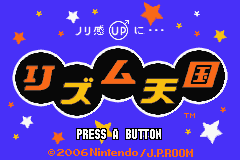
Rhythm Tengoku for Game Boy Advance is Nintendo’s 2006 Japanese rhythm game and the starting point for the series later known internationally as Rhythm Heaven. Developed in collaboration with the music company J.P. Room and supervised musically by producer Tsunku, it arrived in Japan on August 3, 2006, near the end of the GBA’s life. Its compact format and deliberately odd scenarios share some of the quick, playful spirit associated with Nintendo’s WarioWare teams, but every challenge is built around listening closely and acting in time.
Rather than asking players to follow a scrolling note chart, Rhythm Tengoku teaches each routine through short demonstrations and spoken or musical cues. The objective is to feel the beat, wait for the right moment, and press the appropriate Game Boy Advance button with clean timing. A missed input is immediately obvious in the animation and sound, while a well-timed response keeps the performance flowing. The game’s simple controls make the individual actions easy to understand; the demanding part is learning the pulse, syncopation, pauses, and call-and-response patterns particular to each piece.
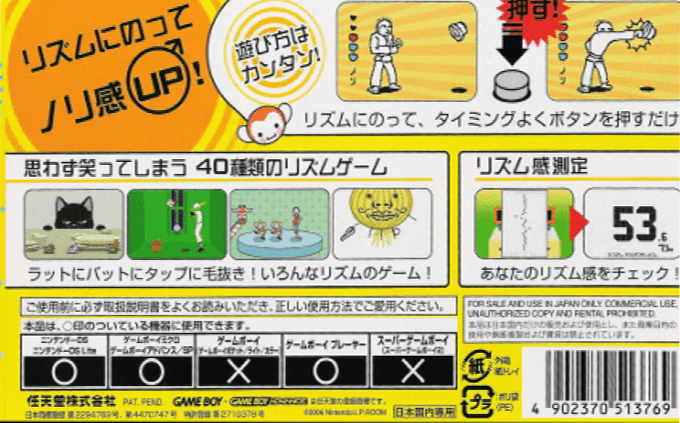
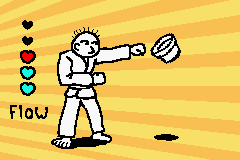
The GBA game is organized as a succession of short Rhythm Games, each with its own cast, visual joke, and musical rule. One routine has a karate student striking objects thrown his way, while others involve plucking hairs from an onion-like character, clapping with a trio, marching in formation, batting, or handling more fantastical tasks. These scenes are not disconnected button tests: their movement, sound effects, and music all establish the timing that the player must reproduce. As the game advances, familiar ideas return in tougher variations that ask for greater consistency and a sharper ear.
Sets culminate in remix stages that combine pieces of earlier games into a continuous new song. Switching from one activity to another without losing the beat is a central part of their challenge, and the remixes turn the lessons of several routines into a single performance. Completing stages earns an evaluation, with progress depending on meeting the game’s standard rather than merely reaching an ending. Strong performances can also open optional material, including Endless Games, Rhythm Toys, drum-related activities, and opportunities to pursue special perfect clear challenges.
The drum material is especially fitting for a game conceived around physical rhythm. Nintendo’s later staff interviews describe how the original GBA project developed through extensive experimentation and how team members even took dance lessons after Tsunku’s advice, seeking a shared understanding of rhythm rather than a purely visual reflex test. That design philosophy is visible throughout Rhythm Tengoku: the music signals when to act, the animation makes the result readable, and the best way to improve is to internalize a pattern instead of watching for a marker.
Rhythm Tengoku remained a Japan-exclusive GBA release, so it should not be confused with the Nintendo DS sequel Rhythm Tengoku Gold, released overseas as Rhythm Heaven or Rhythm Paradise. It nevertheless established the series’ defining combination of catchy songs, concise comic scenes, escalating remixes, and timing-led play. Later entries revisited some of its concepts, but this original Game Boy Advance title has its own button-based controls, Japanese presentation, and late-handheld-era identity. For players exploring Nintendo’s GBA catalogue, it is a distinctive rhythm game whose character comes from the close connection between sound, input, and animation.
Gallery
Details
- Developer
- J.P. Room
- Publisher
- Nintendo
- Genre
- Rhythm Game
- Players
- 1
- Release Date
- August 3, 2006
- System
- GBA