About
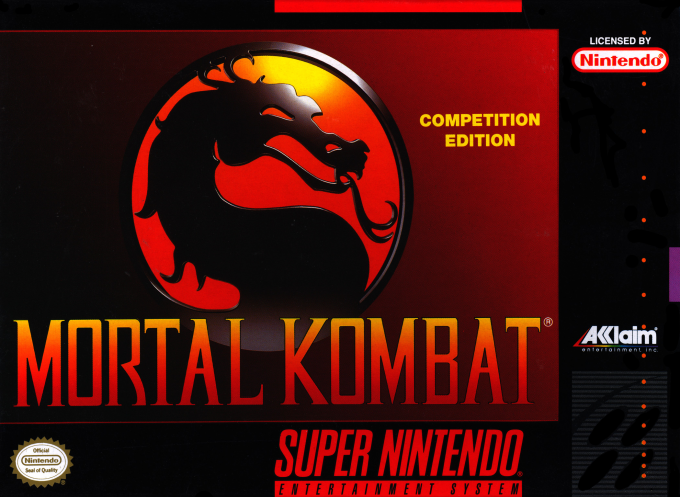
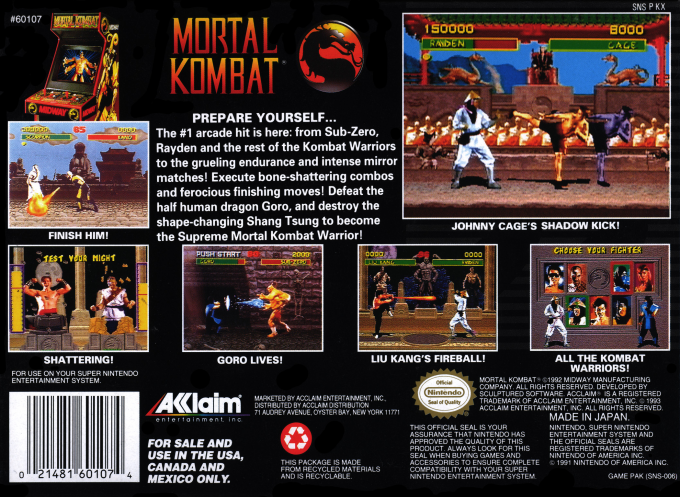
Mortal Kombat brought Midway’s 1992 arcade fighter to the Super Nintendo Entertainment System on September 13, 1993, the heavily promoted “Mortal Monday” launch date. The arcade original was created by Midway, while Sculptured Software converted it for Nintendo’s 16-bit console and Acclaim Entertainment published the North American release. Its digitized performers, photographed and turned into animated sprites, gave every bout a distinctly live-action look compared with the hand-drawn characters common to fighting games of the period.
The contest takes place on Shang Tsung’s island, where Earthrealm faces the prospect of losing its tenth consecutive Mortal Kombat tournament to Outworld. Players choose from seven warriors: Liu Kang, Johnny Cage, Sonya Blade, Kano, Raiden—spelled Rayden in this home version—Scorpion, and Sub-Zero. Their paths converge on the reigning four-armed champion Goro, then the shapeshifting sorcerer Shang Tsung; winning the tournament is the route to thwarting Outworld’s claim on Earthrealm.
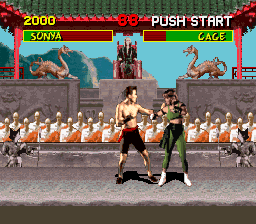
Matches are one-on-one, with a round won by emptying the rival’s life bar or holding the larger remaining share when the timer expires. The first fighter to win two rounds takes the match. The game’s five combat functions are high and low punches, high and low kicks, and a dedicated block, while the Super NES controller maps those actions around its face and shoulder buttons. Directional inputs combined with attacks produce throws, sweeps, uppercuts, and character-specific techniques such as Scorpion’s spear and fire, Sub-Zero’s ice blast, Liu Kang’s fireball, and Raiden’s lightning.
A single-player ascent pits the chosen combatant against the roster before a mirror match, three endurance battles, Goro, and Shang Tsung. In endurance encounters, a second opponent enters after the first falls, the clock resets, and the player’s depleted health does not. Between some fights, Test Your Might turns rapid button presses into a strength challenge to smash successively tougher materials. Local two-player battles let opponents settle their own matchups, and the combat system’s blocking and close-range counterplay reward timing as much as knowledge of move inputs.
After the final round, the familiar “Finish Him!” prompt gives the winner a brief chance to enter a character-specific closing move. In the arcade game these Fatalities were graphic executions, a major part of the series’ identity and controversy. The Super NES release preserves the ritual and the input-based challenge, but revises much of the result: it substitutes gray sweat for red blood and reworks several of the most violent finishers. Sub-Zero freezes and shatters an opponent instead of removing a spine, Johnny Cage uses a powerful chest kick rather than a decapitation, and Kano’s heart-rip presentation is stripped of its visible heart.
Those alterations distinguish the Super NES cartridge from the contemporary Genesis release, which could unlock red blood and the uncensored Fatalities with a code. The SNES version nevertheless retains its roster, tournament structure, digitized art, stage-based duels, special moves, announcer, and Test Your Might breaks. Contemporary comparisons often noted that its color and sound presentation tracked the arcade game closely, even as its violence policy made it a notably different version of the same landmark fighter.
Mortal Kombat’s home arrival came during public debate about violent games, and the contrast between the two leading console editions became part of that moment. On Super NES, the conversion remains a record of both the arcade game’s breakthrough formula—individualized fighters, secrets, special-move commands, and cinematic finales—and the content limits Nintendo imposed on a major 1993 release.
Gallery
Details
- Developer
- Midway
- Publisher
- Acclaim
- Genre
- Fighting
- Players
- 1-2
- Release Date
- September 13, 1993
- System
- SNES