About
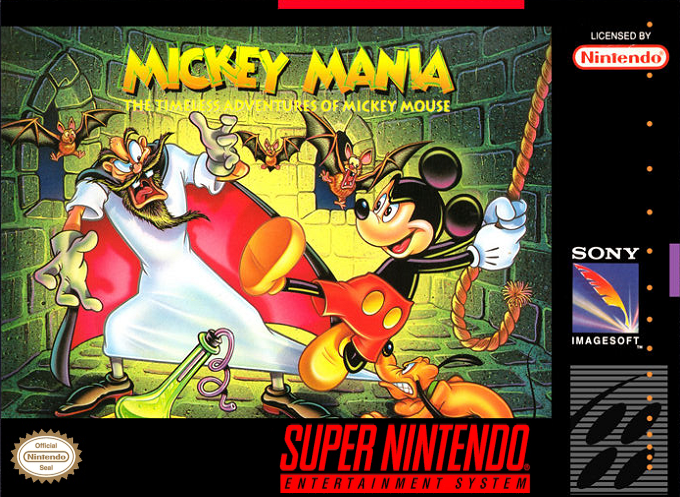
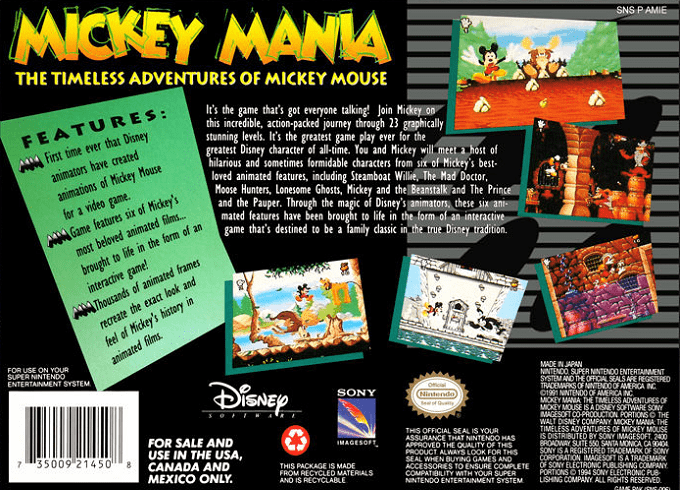
Mickey Mania: The Timeless Adventures of Mickey Mouse for Super NES is a 1994 side-scrolling platform game developed by Traveller's Tales and published by Sony Imagesoft. It places Disney's mascot inside a sequence of worlds inspired by landmark Mickey cartoons, turning material from different eras of animation into a single 16-bit adventure. Rather than presenting one new cartoon story, the game frames its journey as Mickey revisiting familiar screen roles, from the black-and-white setting of Steamboat Willie to the later world of The Prince and the Pauper.
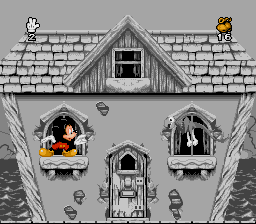
The basic Super NES Mickey Mania controls are direct but demand careful timing. Mickey runs, jumps over hazards, and can defeat many opponents by landing on them. He also collects and throws marbles, giving him a ranged option when a jump would be unsafe. A hand-shaped health display shows how much damage he can take, while stars restore health and Mickey-head pickups grant extra lives. The result is a platformer in which ordinary leaps and enemy encounters share space with more elaborate obstacles, so progress depends on watching a stage's movement as much as on simply moving right.
Each cartoon-inspired section changes the scenery and its challenges to reflect the source material. Steamboat Willie begins the trip in a stylized early-animation environment, while later stops draw on The Mad Doctor, Moose Hunters, Lonesome Ghosts, Mickey and the Beanstalk, and The Prince and the Pauper. These settings supply more than backdrops: players may deal with traps, moving scenery, puzzles, chase sequences, and threats that make use of the particular cartoon setting. The game is single-player, with Mickey as the sole playable character throughout the main adventure.
Traveller's Tales used animation-inspired art, scrolling backgrounds, and changing visual treatments to distinguish the stages, including a gradual move away from the opening black-and-white look. That visual idea gives the Super NES version a clear through line even as it moves across decades of Disney material. Its stage design also varies the pace, alternating conventional platforming with set pieces such as escapes and environmental problems. The cartridge's presentation is built around short stage transitions rather than a continuous animated feature, letting each cartoon world establish its own hazards and visual identity.
Mickey Mania was released for several 16-bit systems, so the Super NES edition is important to identify on its own. It is not the later PlayStation adaptation, Mickey's Wild Adventure, and it does not contain every sequence found in the Sega CD release. The Super NES version omits the hidden The Band Concert bonus stage and the staircase sequence associated with The Mad Doctor, and it uses loading screens between areas. Those differences make the SNES game a distinct version of the broader 1994 project rather than a simple copy of every other release.
For Super NES players, Mickey Mania combines a licensed Disney setting with a mechanically focused platform adventure. Its appeal comes from the way familiar cartoon locations are converted into individual levels with their own movement, enemy, and hazard ideas, while Mickey's jump-and-marble toolkit remains consistent from one era to the next. The game also sits within the long line of Mickey Mouse console platformers, but its premise is unusually rooted in the character's animation history. That makes its progression feel like a tour through changing cartoon styles as well as a challenge built around precision jumps, resource pickups, and stage-specific obstacles.
Gallery
Details
- Developer
- Traveller's Tales
- Publisher
- Sony Imagesoft
- Genre
- Platformer
- Players
- 1
- Release Date
- October 1, 1994
- System
- SNES
/Wizardry_I-II-III_Story_of_Llylgamyn.png)