About
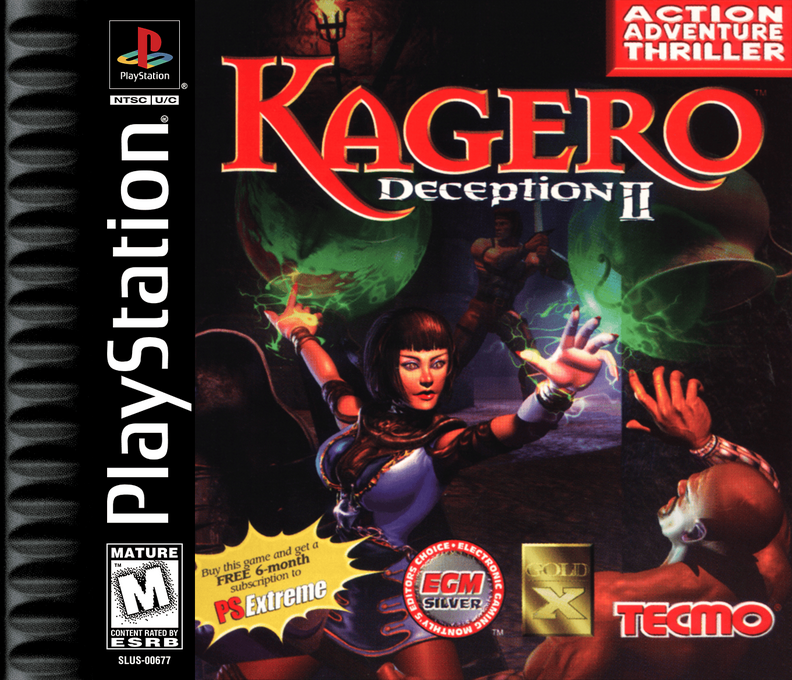
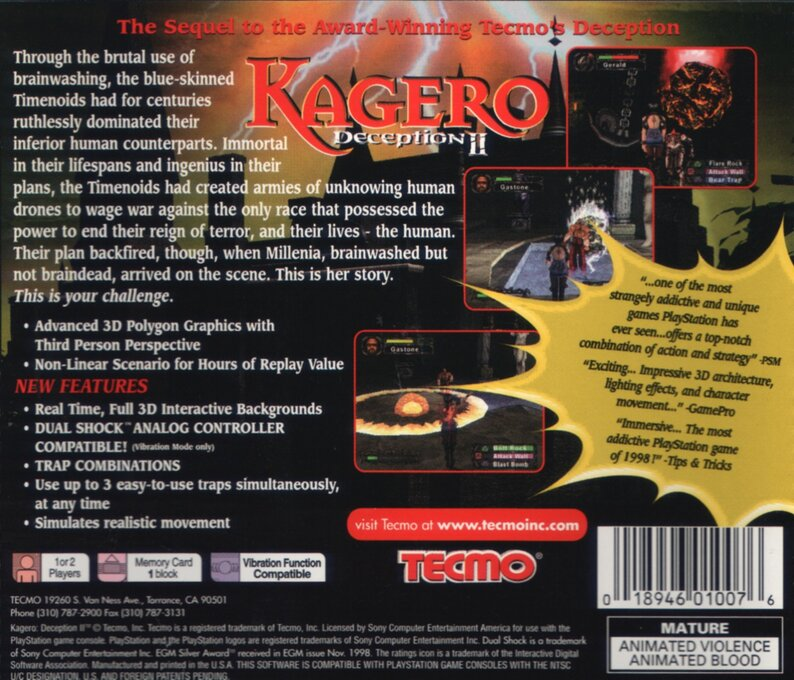
Kagero: Deception II is Tecmo's 1998 PlayStation strategy-horror game and the second entry in the Deception series. Released first in Japan as Kagero: Kokumeikan Shinsho and later in North America as Kagero: Deception II, it puts its player in the role of Millennia, a human girl controlled by the immortal, blue-skinned Timenoids. Rather than winning battles through a conventional weapon, she guards their castle by preparing lethal ambushes for the humans who enter it. Tecmo developed and published the original Japanese and North American versions; the game arrived in North America in October 1998, following its July Japanese release.
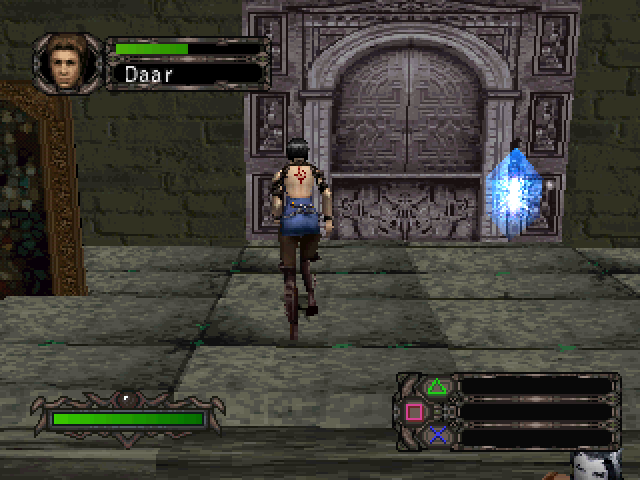
The PlayStation game changes the viewpoint established by Tecmo's Deception. Millennia is visible on screen in a third-person perspective, allowing the player to move through castle rooms, observe approaching enemies, and lead them toward prepared hazards. Each encounter is a contest of positioning and timing. Before or during an invasion, the player selects and places traps on floors, walls, and ceilings, then activates them at the moment an opponent reaches the danger zone. A trap must recharge after use, so rushing a trigger can leave an important route temporarily unprotected.
Its defining idea is the trap combo. A successful hit can send an invader stumbling, flying, or otherwise moving into the path of another device, making it possible to turn one planned attack into a longer chain. The aim is not simply to set the strongest available trap in a room, but to understand where enemies will travel, how a room's layout can redirect them, and which effects can follow one another. This gives the game a deliberate, puzzle-like rhythm: Millennia has to lure a target into position, react when a plan goes wrong, and decide when a limited opening is worth using.
Defeating intruders earns Ark, the resource used to create and improve traps. The available equipment is organized through connected upgrade paths, encouraging players to build a collection that suits their preferred setups instead of relying on a single solution. Traps are divided by their mounting position, so an effective arrangement can combine hazards above an enemy, beside them, and underfoot. The castle itself also matters as part of every encounter, with corridors, corners, doors, and room features shaping how easily Millennia can guide pursuers into a sequence.
The campaign's dark fantasy premise centers on Millennia's uncertain allegiance. The Timenoids have convinced her to defend them and promised her immortality, yet she is human and gradually confronts the consequences of serving those who hold power over humanity. Story choices lead to different conclusions, giving the player reasons to revisit the campaign and see alternate outcomes. The game also includes secrets that become available through repeated play, including a guest trap based on Suezo from Tecmo's Monster Rancher series after the required endings have been seen.
Kagero: Deception II occupies an important place in the early Deception line because it established the third-person presentation and emphasis on chained traps that later installments continued to develop. It remains a distinctive PlayStation game: its action unfolds in real time, but its victories come from preparation, spatial awareness, and carefully engineered accidents rather than direct combat. For players exploring the series after the first Tecmo's Deception, Kagero offers a more focused trap-combination system while retaining the castle-defense setting and branching dark-fantasy story.
Gallery
Details
- Developer
- Tecmo
- Publisher
- Tecmo
- Genre
- Turn-Based Strategy
- Players
- 1
- Release Date
- October 23, 1998
- System
- PS1