About
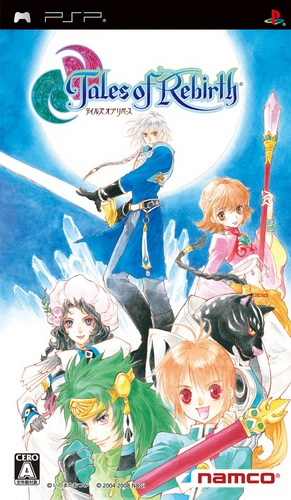
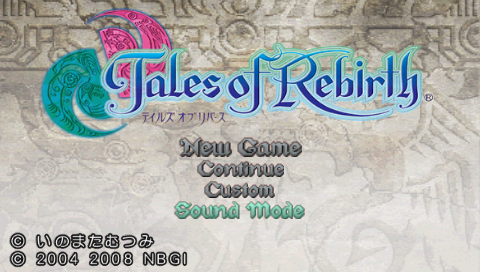
Tales of Rebirth for PSP is Bandai Namco's 2008 portable version of the Japanese role-playing game first released for PlayStation 2 in 2004. Developed by Namco Tales Studio's Team Destiny and published by Bandai Namco Games, it is a mainline entry in the Tales series built around sprite-based characters, 3D environments, animated event scenes, and real-time combat. This PSP release brings the complete adventure to a handheld widescreen format while retaining the original Japanese setting, voices, and presentation.
The story takes place in a land shared by the Huma and the animal-featured Gajuma. Veigue Lungberg, a withdrawn young man who can wield the Force of Ice, is drawn into a crisis after his friend Claire Bennett is taken by forces connected to Karegia's royal succession. His rescue attempt grows into a journey across a country strained by prejudice, political manipulation, and old wounds between its peoples. The premise gives the party's travels a larger purpose than reaching the next destination, as events repeatedly test whether Huma and Gajuma can live together.
Veigue is joined by a varied group of allies with different histories and abilities. The spear fighter Eugene, fiery Mao, healer Annie, energetic Tytree, and card-using Hilda each contribute to both the combat lineup and the story's competing perspectives on the conflict. Their personal ties to Karegia and its divisions make the party conversations central to the journey. Optional character exchanges, called Screen Chats in this installment, offer additional dialogue away from the main scenes, while towns, dungeons, and the world map structure the route between major story events.
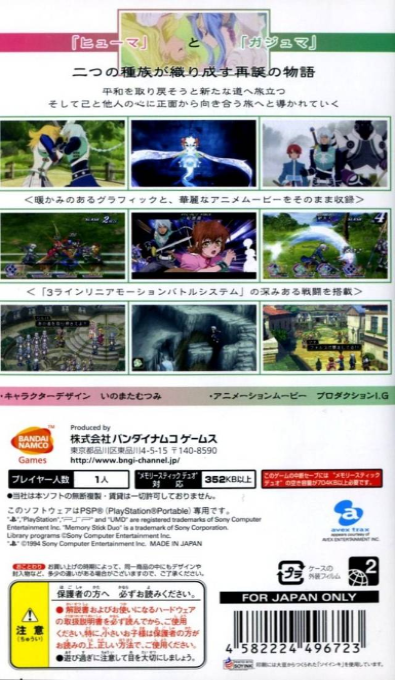
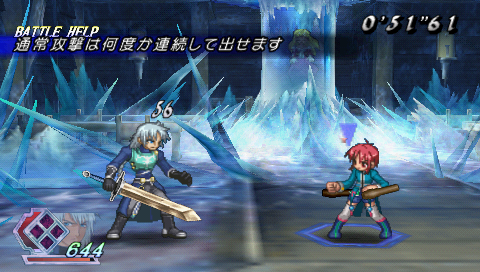
Combat uses the Three-Line Linear Motion Battle System, a variation on the series' real-time Linear Motion Battle System. Up to four party members can take part in a battle, moving and attacking across three horizontal lanes rather than standing in a conventional turn-based formation. Positioning matters: characters can pursue opponents on a line, change lanes to avoid danger, and work around enemies for openings. The system combines ordinary attacks, character-specific artes, defensive choices, and resource management, with Force-related abilities tied to a gauge that refills during battle. Stronger actions and cooperative Mystic Artes provide options when an encounter calls for a more committed attack.
Progression extends beyond leveling alone. Battles award resources used to improve equipped weapons, armor, and accessories, encouraging players to consider how each character is built for the active party. Cooking can restore the group between fights, and repeatedly preparing recipes lets characters master them for further benefits. Difficulty settings, a small collection of side activities, and the series' familiar balance of exploration, conversations, and action battles give the campaign room beyond its main plot. Mutsumi Inomata designed the principal characters, while the score was composed by Motoi Sakuraba and Shinji Tamura; the animated sequences were produced by Production I.G.
The PSP edition was released in Japan on March 19, 2008, several years after the PlayStation 2 original. Its presentation was adjusted for the PSP's widescreen display and it adds content not present in the first release, including a battle arena with solo and multiplayer modes, additional story material, and a gallery feature. It remains distinct from other Tales games with similar names: Tales of Rebirth is its own tale rather than a remake, sequel, or version of Tales of Destiny, Tales of Symphonia, or Tales of the Abyss. For players exploring the Japanese PSP library, Tales of Rebirth PSP preserves Team Destiny's 2D-led Tales style while pairing its fast, lane-based battles with a story about rebuilding trust across a divided world.
Gallery
Details
- Developer
- Bandai Namco
- Publisher
- Bandai Namco
- Genre
- Action RPG
- Players
- 1
- Release Date
- March 19, 2008
- System
- PSP