About
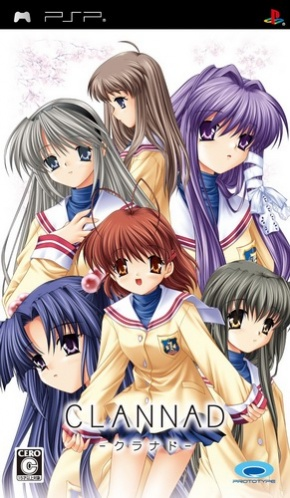
CLANNAD is a Japanese visual novel created by Key, with the PlayStation Portable edition released in Japan by Prototype on May 29, 2008. It is an all-ages drama presented as a single-player, text-led adventure, but its scale reaches well beyond a typical school romance: the story follows its protagonist from a difficult final year of high school into an extended consideration of adulthood, work, parenthood, and family.
Tomoya Okazaki begins as a disengaged Hikarizaka High School senior whose injured shoulder has ended his basketball ambitions and whose relationship with his father has grown painfully distant. On the walk to school he meets Nagisa Furukawa, a soft-spoken girl repeating her final year in the hope of reviving the dormant drama club. Her small act of resolve gives Tomoya a reason to become involved with other people again, turning the familiar school setting into a web of friendships, old regrets, and hopes for the future.
Progress comes through choices at key conversations rather than through action sequences. Early decisions direct Tomoya into individual character routes, and the game rewards close attention to prior scenes and to the consequences of his help. Nagisa's route anchors the main relationship, while routes for the brilliant but isolated Kotomi Ichinose, the mysterious Fuko Ibuki, the outspoken Fujibayashi sisters, and student-council contender Tomoyo Sakagami reveal very different kinds of loneliness, obligation, and recovery.
The structure gives its supporting cast room to matter. Tomoya's banter with his roommate-bound friend Youhei Sunohara supplies much of the comedy, but recurring families, classmates, and town residents gradually connect the separate episodes. Completing the school-era paths opens the After Story material, where the perspective shifts from adolescent possibility to the responsibilities that follow it. A parallel fantasy-world thread and the collection of luminous orbs link the routes into the larger ending.
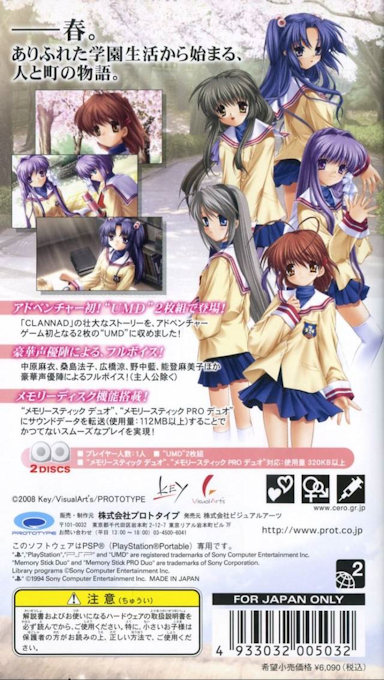
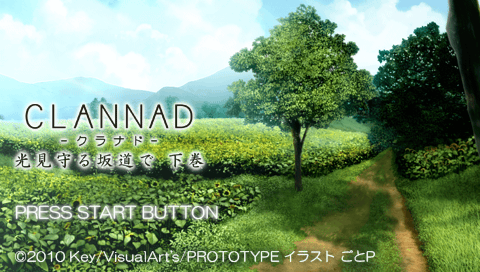
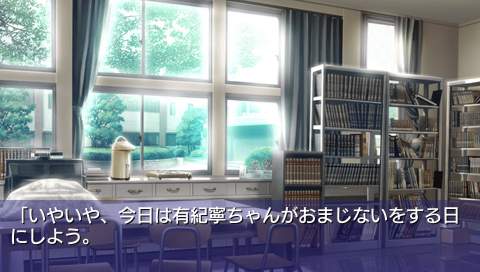
Prototype's PSP release carries the additions associated with the Windows Full Voice edition: dialogue is voiced for the cast while Tomoya remains unvoiced. It retains the character art, music, and long-form reading pace of the original while adapting the presentation to the PSP's 16:9, 480-by-272 display; the reframed backgrounds and event images use close-ups where necessary rather than simply squeezing the earlier composition onto the handheld screen. The complete story is distributed across two UMDs.
The handheld port also includes features tailored to long sessions away from a television. Its Memory Disc install option copies data to a Memory Stick Duo, using roughly 120 MB to reduce transfer-related pauses and keep the text flow responsive. Save data is kept separately for the system and individual save slots, and the game includes a screenshot feature that lets players store in-game scenes on compatible Memory Stick media for use from the PSP's home interface.
Gallery
Details
- Developer
- Prototype
- Publisher
- Prototype
- Genre
- Compilation
- Players
- 1
- Release Date
- May 29, 2008
- System
- PSP