About
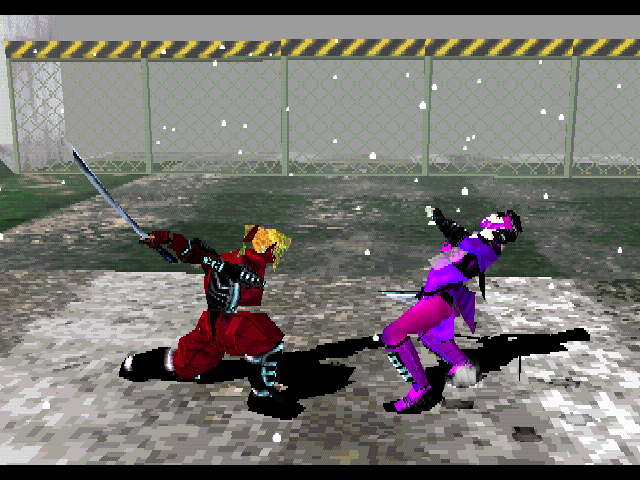
Bushido Blade for PlayStation is a 1997 weapon-fighting game developed by Lightweight and released by Square in Japan, with Sony Computer Entertainment handling the North American and European PlayStation editions. Its title invokes the Japanese idea of bushidō, but its combat is not a conventional arcade brawler. Every duel is built around the danger of a decisive cut: there are no life bars, round timers, or super meters to turn a clean sword strike into a long exchange of attrition. A carefully placed attack can settle a match immediately, making distance, timing, and the opponent’s posture central to every encounter.
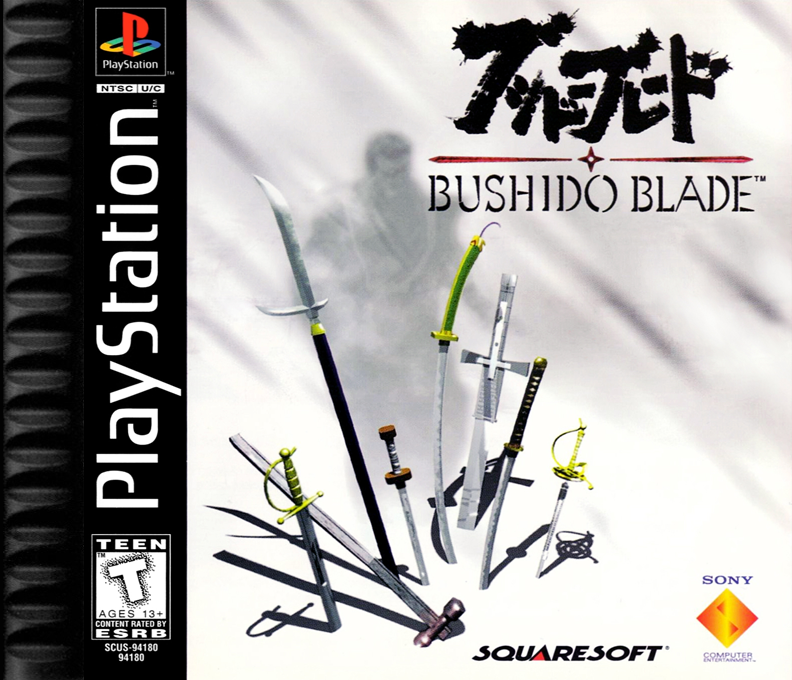
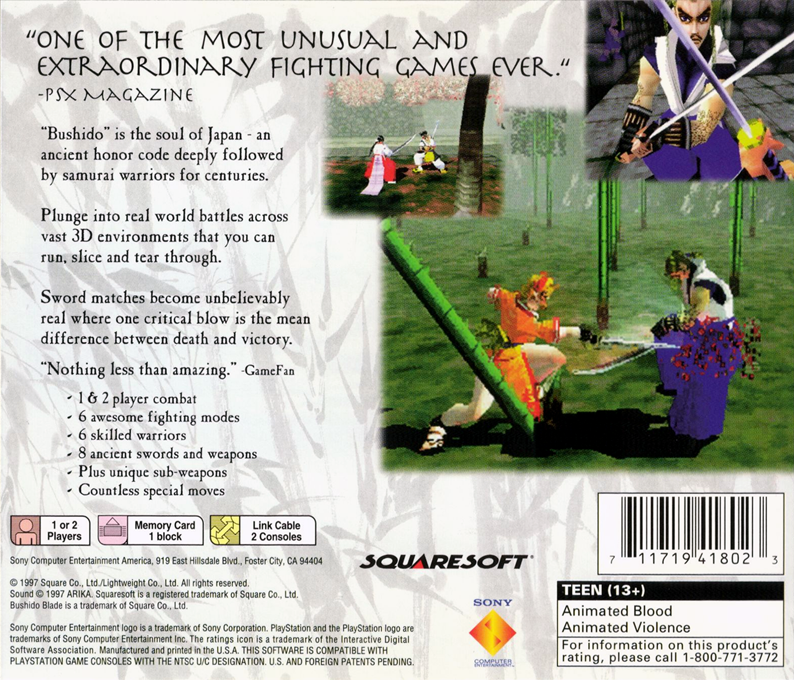
Players choose from six fighters and select from eight melee weapons, a lineup that includes Japanese blades alongside weapons such as the rapier, broadsword, saber, long sword, naginata, and sledgehammer. Each tool has its own reach and handling, while the characters differ in speed, strength, preferred equipment, and special techniques. Before committing to an attack, a fighter can shift between high, middle, and low stances. Those stances change both the available swings and the areas being defended, so the game asks players to read an opponent’s guard as much as to memorize commands. Directional inputs and follow-up strikes allow combinations, but reckless offense is often punished faster than in a health-bar fighter.
Bushido Blade’s location-based damage system gives nonfatal hits lasting consequences. An injured arm can limit a combatant’s effectiveness, while a damaged leg can slow movement or force the fighter to crawl; blows to critical areas are usually lethal. The combatants can run, jump, and move through broad 3D spaces rather than being confined to a small enclosed ring. The connected castle grounds include areas such as bridges, paths, and bamboo, and the surroundings can affect how a duel unfolds. That combination of open movement, weapon reach, and vulnerable limbs makes even a short fight a contest of positioning.
The single-player story follows an assassin trying to escape the Kage organization within the Meikyokan dojo’s world, with the chosen character affecting parts of the narrative. It also makes honorable conduct part of play: actions such as attacking a bowing opponent or striking from behind can end a run prematurely. Outside that route, the PlayStation game offers practice and first-person options, a two-player versus mode, and Slash Mode, which sends the player through a long succession of opponents. Compatible consoles could also be connected with the PlayStation Link Cable for linked play.
Originally released in Japan in March 1997, Bushido Blade arrived in North America that September and in Europe in early 1998. Regional releases differed in the presentation of fatal strikes, with blood appearing in the North American version where the Japanese release used a flash effect. Lightweight and Square returned to the format with Bushido Blade 2 on PlayStation the following year, but the first game remains the series’ defining starting point: a PlayStation duel game where a single opening, a wounded limb, or a lapse in discipline can change the outcome at once.
Gallery
Details
- Developer
- Light Weight
- Publisher
- Squaresoft
- Genre
- Fighting
- Players
- 1-2
- Release Date
- October 1, 1997
- System
- PS1