About
Rayman DS brings Rayman 2: The Great Escape to Nintendo DS. Released in March 2005, this is a single-player 3D platform adventure built from the Nintendo 64 edition of Rayman 2, rather than a new entry or a version of the original 1995 Rayman. Rayman sets out through a world under pirate control, searching for the Lums he must rescue. The DS release preserves the broad, level-by-level structure associated with the Nintendo 64 game while adapting it to a portable dual-screen system.
The journey spans 45 3D levels. Pirate hideouts, caves and waterfalls frame stages that ask the player to navigate platforms, routes and hazards in a succession of distinct environments. Progress depends on moving through those spaces and recovering Lums, so exploration and careful traversal sit alongside the game’s forward momentum. Its bright fantasy setting, limbless hero and varied scenery give the adventure a character all its own, even as the immediate goal remains clear: free the captured Lums from the pirates.
Rayman’s move set supplies the tools for that trip. He can run and jump, then take to the water by swimming, build speed on skis, and fly when the situation calls for it. Stages also put him aboard rockets, onto whirlwinds and across lava on a surfboard. These changing forms of travel are part of what keeps the platforming varied: each one asks the player to handle movement and obstacles from a slightly different angle while continuing the same rescue mission.
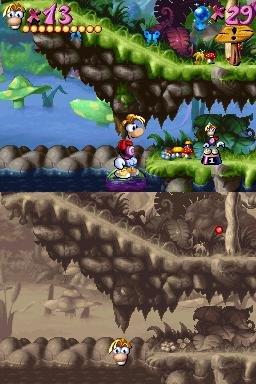
The Nintendo DS layout divides the game’s information from the action. Gameplay is shown on the top screen, while the lower Touch Screen presents Rayman’s health, progress and in-game statistics. The touch screen also supports a virtual analogue control option, providing an alternative to the system’s directional pad. That is the DS-specific addition to a game otherwise based closely on the Nintendo 64 version, making the second screen useful both as a status display and as an extra control surface.
Rayman DS should not be confused with the original Rayman released for PlayStation and Atari Jaguar, or with Rayman Advance on Game Boy Advance. Those versions concern the earlier 2D Rayman adventure; Rayman Advance is a portable port of that original game. Rayman DS instead follows the later 3D Rayman 2: The Great Escape, with a different game world, objective and style of movement. For a player choosing between the handheld releases, that distinction matters: Rayman DS is the portable Nintendo 64-based Rayman 2 experience.
It also differs from the PlayStation version of Rayman 2. The PlayStation edition was remade for that console’s more limited resources and includes substantial changes, whereas Rayman DS is derived directly from the Nintendo 64 version. The DS release therefore belongs alongside the Nintendo 64 lineage in its level set, then adds the portable system’s dual-screen presentation and optional touch-driven virtual analogue input. It is a useful version to identify precisely because the Rayman catalogue contains several games and ports with similar names but different foundations.
For anyone exploring the DS library, Rayman DS is a portable take on a 3D platformer rather than a touchscreen-only reinvention. The top screen carries the adventure, the lower screen keeps key status information close at hand, and the virtual analogue option makes touch input available without replacing the familiar buttons entirely. Its combination of jumping, swimming, skiing, flying, rocket rides, whirlwinds and lava surfing gives the rescue of the Lums a steady variety of challenges across its 45 levels.
Gallery

Details
- Developer
- Ubisoft
- Publisher
- Ubisoft
- Genre
- Platformer
- Players
- 1
- Release Date
- December 7, 2009
- System
- NDS