About
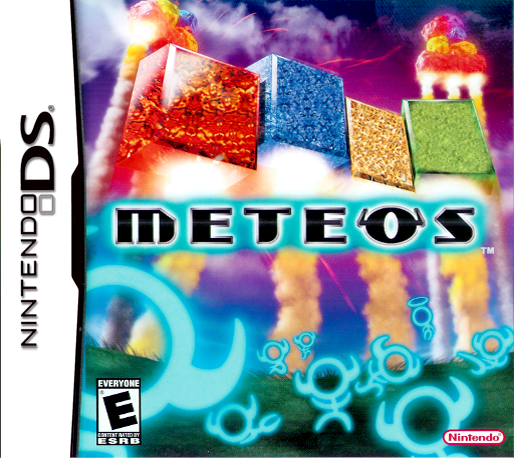
Meteos for Nintendo DS is a fast-moving action puzzle game developed by Q Entertainment, designed by Masahiro Sakurai, and produced by Tetsuya Mizuguchi. Bandai published it in Japan on March 10, 2005, while Nintendo handled releases in North America and Europe later that year. Its central idea fits the DS especially well: a planet called Meteo rains destructive material onto worlds across the galaxy, and players must turn that falling debris into a counterattack using the touchscreen.
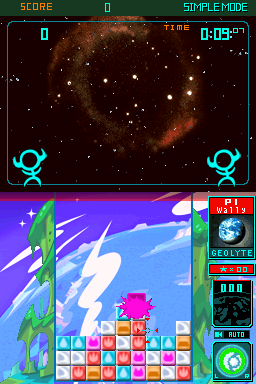
The lower screen is the main battlefield. Columns of colored blocks, known as meteos, fall toward the ground and steadily occupy the play area. With the stylus, players swap neighboring meteos vertically to arrange three or more matching colors in a horizontal or vertical line. A completed line ignites and lifts off like a rocket, carrying any blocks resting above it upward. Meteos that clear the top of the playfield are launched away, so a small match can become the start of a much larger escape chain.
That upward motion is the key distinction in Meteos. Rather than simply removing every matched tile in place, ignition changes the shape and momentum of the whole stack. A player has to read the falling columns, create launch points before the screen becomes crowded, and use blocks above a match as cargo. The pace rises as the board fills, and the game ends when the accumulating meteos reach the danger line. Controls can also be handled with the Nintendo DS buttons, but the stylus makes quick, direct rearrangement central to the original design.
Star Trip supplies the game's journey through a collection of alien worlds. The threat from Meteo has pushed the inhabitants of different planets to return the invading meteos to space, and the player travels aboard the Metamo Ark to take part in that response. Individual planets do more than provide a backdrop: their gravity and other rules affect how ignited blocks rise and fall, giving familiar matching rules different physical behavior from stage to stage. Progress also unlocks additional planets, characters, and audio material through meteos sent out of the field.
The Nintendo DS release includes several ways to play beyond Star Trip. Simple mode offers a customizable session, while Deluge challenges players to last as long as possible under the constant fall of blocks. Time War sets score or launch targets within a limit. These modes let the core system work as a brief arcade-style challenge or a longer run built around planet-specific rules. The game's presentation supports that variety with colorful extraterrestrial designs and music that changes with the planets, while the dual screens make the upward launches visible beyond the active board.
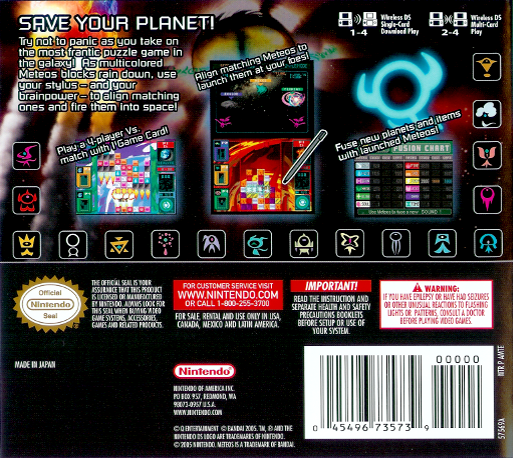
Meteos also supports local wireless competition for two to four players. With Download Play, one cartridge can provide a trial version to other nearby Nintendo DS systems, making its competitive puzzle play accessible without every participant owning the game. In Japan, Nintendo listed the title as a one-to-four-player game and specifically highlighted both wireless play and Download Play. This combination of single-player planet progression and portable multiplayer made the game an early showcase for the DS's touchscreen and communication features.
The game sits in the same creative orbit as Sakurai's Kirby and Super Smash Bros. work and Mizuguchi's Space Channel 5 and Rez productions, yet its falling-and-launching puzzle system is its own. Q Entertainment later revisited the concept in related releases, including the Nintendo DS follow-up Meteos: Disney Magic, but the 2005 original remains the version built around the standard upright DS layout and vertical-only swaps. For players seeking a Nintendo DS puzzle game with rapid touchscreen decisions, shifting gravity, and chain reactions that send whole stacks skyward, Meteos offers a distinctive take on the genre.
Gallery
Details
- Developer
- Q Entertainment
- Publisher
- Nintendo
- Genre
- Logic Puzzle
- Players
- 1-4
- Release Date
- June 27, 2005
- System
- NDS