About
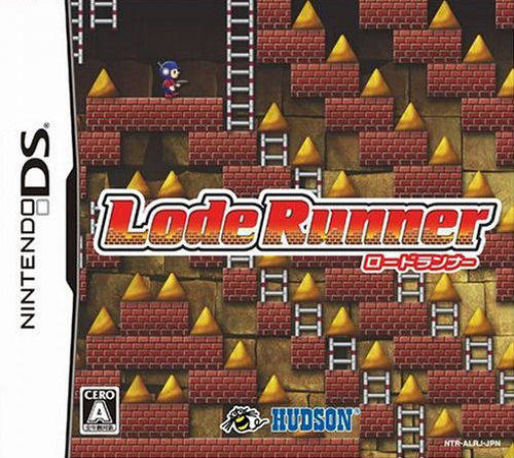
Lode Runner for Nintendo DS is Hudson Soft’s 2006 return to the long-running action-puzzle series, released in Japan on October 26, 2006. Rather than replacing the classics with a wholly new adventure, this handheld edition gathers Hudson’s Famicom versions of Lode Runner and Championship Lode Runner, then adapts them around the Nintendo DS’s dual-screen hardware. It is a single-player puzzle game built around planning routes, outmaneuvering pursuers and collecting every piece of treasure in a stage before finding the exit.
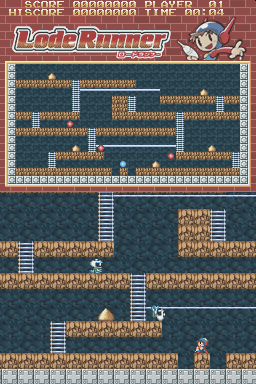
Each screen is a compact maze of brick floors, ladders, hanging bars, gaps and gold. The Runner can move left and right, climb, descend and hang, but cannot jump or attack enemies directly. His crucial tool is the ability to dig temporary holes in diggable bricks on either side. A pursuing robot can fall into a hole and be delayed, allowing the player to pass over it, recover dropped treasure or use the brief pause to reach another part of the map. The same action is risky in the player’s hands: a hole eventually closes, and a poorly timed dig can block a route or trap the Runner himself.
Success depends on reading the layout before committing. Some gold is exposed, while other pieces require a carefully chosen dig, a detour around a one-way passage or a plan for luring an enemy into position. Once all treasure has been taken, an escape ladder appears and the player must reach the top of the stage. The rules are easy to understand, but they produce puzzles where route order, enemy timing and the short life of a dug hole matter as much as quick movement. The Championship selection raises the pressure with a separate set of tougher stages designed for players ready for more demanding solutions.
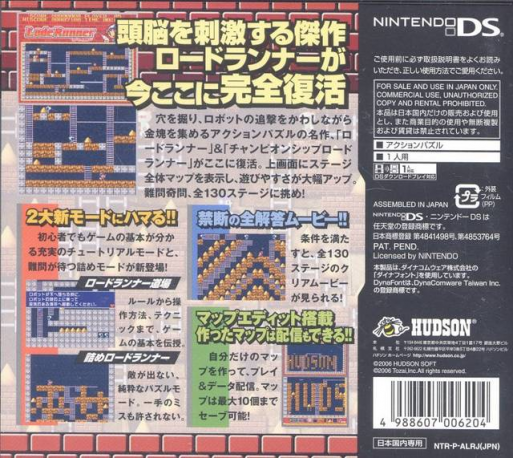
Hudson’s DS version makes the full stage easier to monitor by dividing the view between the two screens. One display can present an enlarged, scrolling playfield while the other shows the wider map, helping players keep track of ladders, treasure and enemies beyond the immediate area. The game also offers three graphic styles, so its classic maze design can be viewed with different visual treatments. This approach preserves the recognizable structure of the Famicom games while tailoring their spatial puzzles to a portable system with a second display.
The package includes 50 standard Lode Runner levels and 50 Championship Lode Runner levels, along with 30 Tsume Lode Runner puzzle stages. Tsume Lode Runner removes enemies and concentrates on the pure logic of clearing a layout, making it a focused test of digging, movement and route construction rather than a chase. Tutorial completion unlocks a video collection of solutions for the included stages, offering a way to study difficult layouts without changing the core challenge of working through them yourself.
A stage editor extends the game beyond its built-in puzzles. Players can use the Nintendo DS touch screen to build original maps in two available sizes, then share creations through the system’s communication features. Designing a level means deciding where treasure, ladders, breakable bricks and hazards should go, so the editor reflects the same balance of freedom and constraint that defines play. It also continues one of Lode Runner’s most enduring ideas: the game is not only about solving authored levels, but about thinking like a puzzle designer.
The Nintendo DS release belongs to a series that began with Doug Smith’s 1983 computer game and became especially associated with Hudson’s 1980s Famicom adaptation. The fundamental appeal remains intact here: there are no elaborate weapons or sprawling worlds, only a small set of rules that become increasingly expressive as stages grow more intricate. For players exploring Lode Runner on Nintendo DS, the combination of classic and Championship material, dedicated puzzle stages, map-aware presentation and editable levels makes this a substantial portable collection of the series’ strategic maze gameplay.
Gallery
Details
- Developer
- Hudson Soft
- Publisher
- Hudson Soft
- Genre
- Platformer
- Release Date
- October 26, 2006
- System
- NDS