About
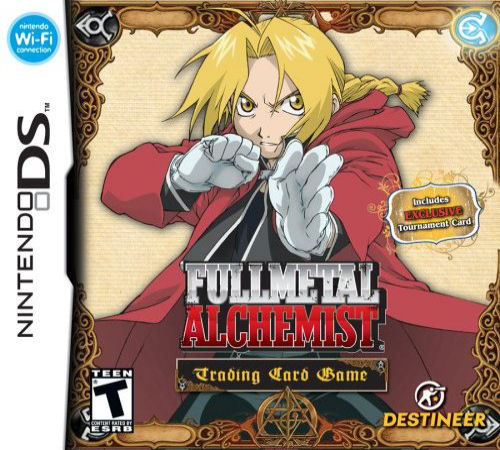
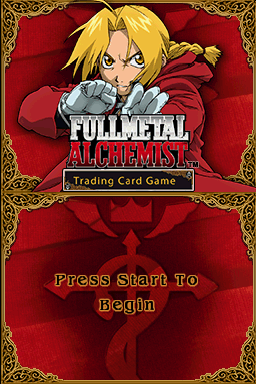
Fullmetal Alchemist: Trading Card Game is a Nintendo DS adaptation of Press Pass’s collectible card game, developed by Magellan Interactive and published by Destineer. It arrived in North America in October 2007, drawing on the English-language Fullmetal Alchemist anime and presenting its characters, art, music and voice clips in a turn-based card-battle format. The DS release includes the Premier Edition card set and the Blood & Water expansion, bringing nearly 500 cards into a single cartridge.
The game’s central contest is a race for the Philosopher’s Stone. Rather than simply reducing an opponent’s life total, players pursue clues by contesting locations; each location can impose its own effect, victory condition and clue value. Securing enough clues reaches the Stone first, while another route to victory is to leave the opposing side without an attribute pool. This makes the changing location an important part of a match, as it determines which strengths matter at a given moment.
Before play, each side selects a leader and builds a deck around that choice. Leaders belong to factions from the series, and their command limits the total cost of allies recruited in a round. Characters contribute statistics such as Strength, Wits and Alchemy to the team totals used at locations, while allies, equipment, abilities and events supply the tactical options. The deck construction game is consequently about finding a coherent mix of leader, faction, attributes and effects instead of merely collecting the highest-value cards.
Character Mode supplies the main single-player progression. It puts the player through matches with character-specific decks and brief pieces of Fullmetal Alchemist framing, then awards booster packs for wins; completing a character path can also unlock another leader. The mode features figures including Edward and Alphonse Elric, Roy Mustang, Scar, Cornello, Lust and Envy. It uses the franchise’s quest for the Philosopher’s Stone as its premise, but it is not a full narrative adaptation of the television series.
Tutorial and Single Match options make the rules available outside that progression, while Fantasy Mode removes the collection restriction for deck experimentation. In Fantasy Mode, the player is supplied with 99 copies of every card for a match, letting them test combinations immediately. Custom decks can be assembled and saved, and the collection interface preserves the pleasure of opening earned booster packs without requiring physical purchases.
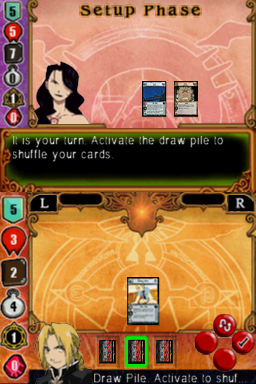
The two DS screens carry the card table and its supporting information, with the stylus used to choose, shuffle and move cards. Players can also use the system’s buttons for much of the interface, examine card details, and simulate tearing open booster packs on the touch screen. The presentation favors static reproductions of the real cards over animated battles, supplemented by music and short English voice samples associated with the anime.
For opponents beyond the computer, the game supports local wireless play and Nintendo Wi-Fi Connection matches. The online options originally allowed ranked or unranked play and configurable match rules, while nearby players could connect directly. Like other Nintendo Wi-Fi Connection titles, its official online service is no longer active, but the original feature set made the DS version both a digital card collection and a portable way to play the tabletop rules against other people.
Gallery

Details
- Developer
- Magellan Interactive
- Publisher
- Destineer
- Genre
- Card Game, Other Strategy
- Release Date
- October 15, 2007
- System
- NDS