About
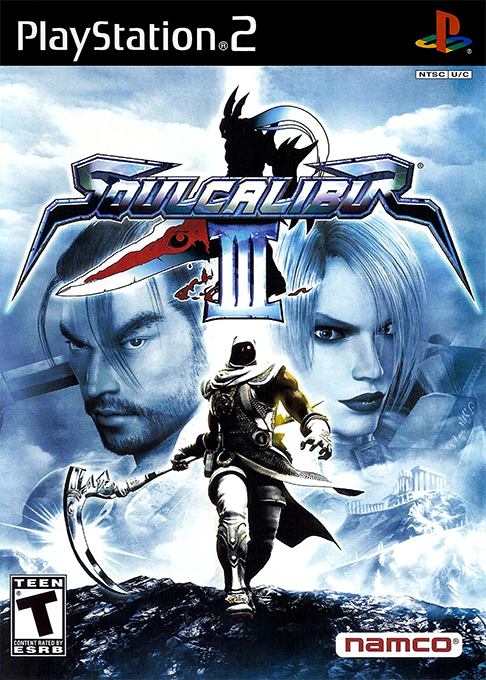
Soulcalibur III for PlayStation 2 is Namco's 2005 weapon-based 3D fighting game and the direct follow-up to Soulcalibur II. Developed by Project Soul and published by Namco, it brings the series' duels of swords, axes, staffs, shields, and other signature weapons to a PlayStation 2-exclusive home release. Its adventure takes place in 1590, when the cursed blade Soul Edge and its holy counterpart Soulcalibur draw warriors from across a fictionalized historical world into conflicts over power, vengeance, and survival.
Matches are one-on-one contests fought in three-dimensional arenas, where victory comes from reducing an opponent's health, forcing a ring out, or winning on time. Each fighter has a distinct weapon and move set, so their range, speed, stances, defensive options, and combinations demand different approaches. Horizontal strikes help control movement around an opponent, vertical blows create openings, while kicks, throws, guards, evasive movement, and charged attacks round out the close-quarters contest. Positioning matters as much as damage: a player can circle away from danger, pressure an opponent toward an edge, or turn a single mistake into a fast ring-out.
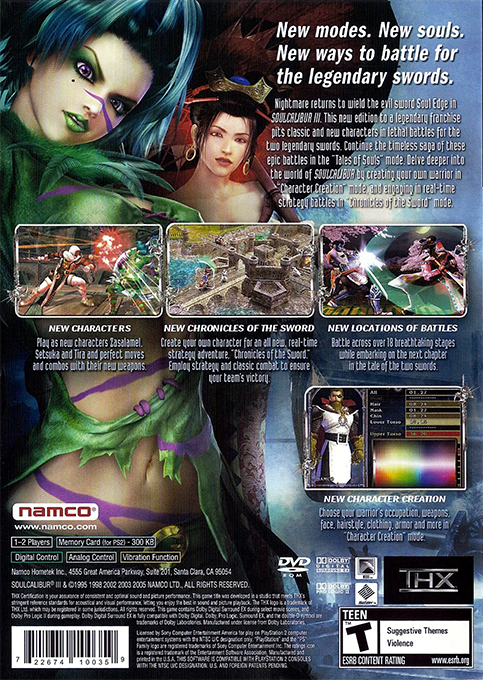
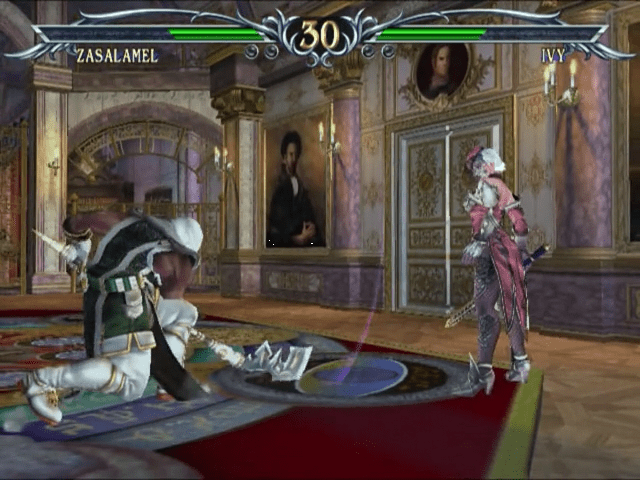
The core roster reunites many series regulars while adding Zasalamel, Tira, and Setsuka, each built around a new weapon style. Character-specific Tales of Souls scenarios provide the principal narrative mode. Presented as a branching book-like journey, these stories combine narrated scenes, battles, and occasional button prompts that can affect a scene or the conditions of the fight that follows. The mode gives individual fighters their own routes through the wider struggle surrounding Soul Edge instead of limiting the game to a single shared arcade ladder.
Soulcalibur III also puts substantial emphasis on making a fighter of your own. Character Creation lets players select an occupation and fighting discipline, alter physical features, and equip clothing, armor, weapons, and skills. Many created characters can use styles based on the established cast, while their equipment choices affect both appearance and their capabilities. The system links with the game's other modes through unlocks, making it possible to build a custom combatant over time rather than treating the editor as a purely cosmetic extra.
Chronicles of the Sword expands that custom-character focus into a single-player campaign that mixes map-based strategy with traditional Soulcalibur battles. The player serves as a commander, moves forces across objective-filled maps, captures strongholds, and can personally settle encounters in a standard fight. Its rewards connect with the wider game, alongside options such as quick play, mission battles, training, versus play, and CPU tournament formats. Local multiplayer supports head-to-head matches on the same PlayStation 2 system; this installment concentrates on its offline modes rather than online competition.
As the fourth main entry in the Soulcalibur series, Soulcalibur III arrived after the multi-platform Soulcalibur II and used its PlayStation 2-only format to concentrate on an especially broad selection of solo content, unlockables, arenas, and character customization. It was followed by Soulcalibur III: Arcade Edition in 2006, an arcade-specific revision with rebalanced and corrected features, but the PlayStation 2 version remains the original full home release with Tales of Souls, Chronicles of the Sword, and its extensive creation-driven progression. For players exploring the series on PS2, it is a substantial fighting game built around both competitive duels and long-form offline discovery.
Gallery
Details
- Developer
- Namco
- Publisher
- Namco
- Genre
- Fighting
- Players
- 1-2
- Release Date
- October 25, 2005
- System
- PS2