About
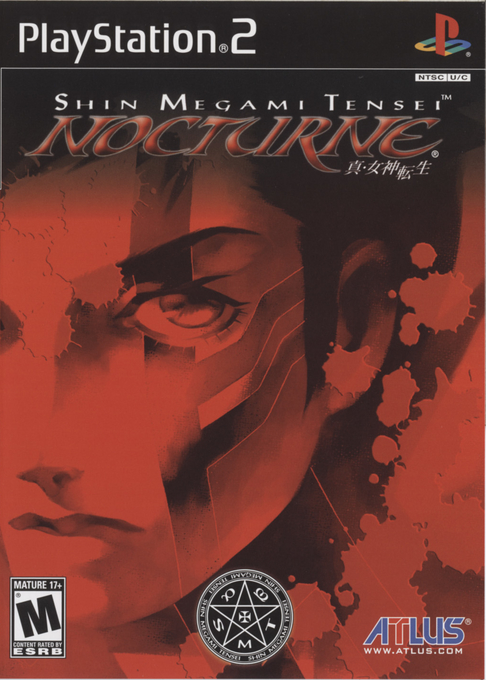
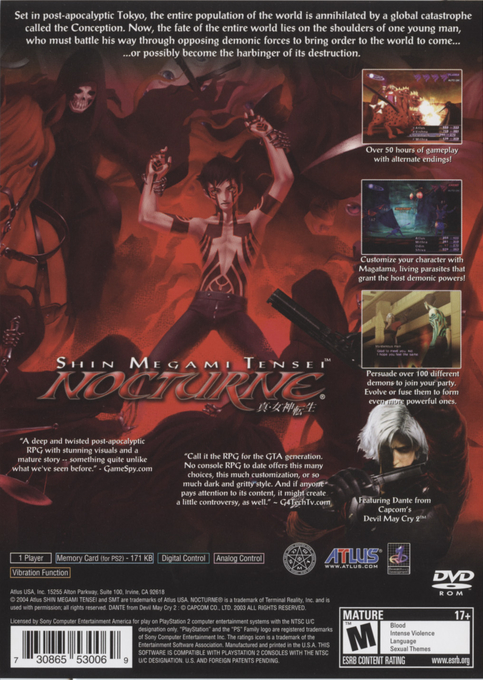
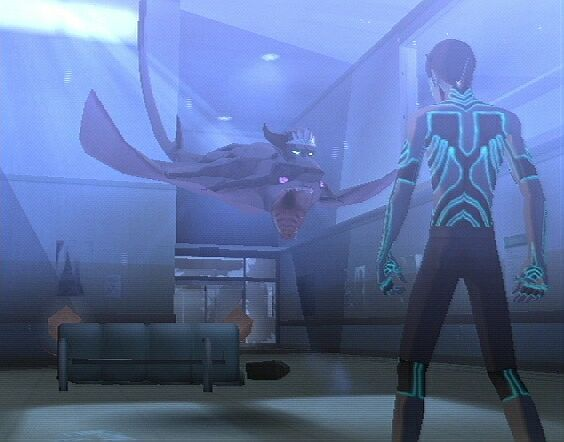
Shin Megami Tensei: Lucifer’s Call for PlayStation 2 drops a nameless Tokyo student into the immediate aftermath of the Conception, a catastrophe that erases the familiar world and leaves the city folded into the eerie Vortex World. A mysterious boy gives the survivor a Magatama, transforming him into the tattooed, half-demonic Demi-fiend. From there, the journey is less about restoring what was lost than deciding what, if anything, deserves to replace it. Empty streets, ruined landmarks and supernatural strongholds give its vision of Tokyo a stark, unsettled character.
The player explores on-foot 3D areas and a world map, moving between dungeons, shops, healing fountains and Terminals that eventually make long-distance travel easier. The world is full of demons, but the human survivors matter just as much: former friends and other figures develop incompatible ideas about how the next world should be ordered. Their competing Reasons turn the story into a sequence of philosophical choices rather than a simple struggle between heroes and villains. Decisions and progress through certain story paths lead to different conclusions, so the fate of the Vortex World is deliberately not fixed.
Combat is turn-based, but its Press Turn system makes every action a small calculation. A full party receives a set number of turns; landing a critical hit or exploiting an elemental weakness can preserve part of that momentum and open another action. Missing, attacking into an immunity, or striking an enemy that repels an element can waste turns instead. Enemies obey the same rules. Learning what a foe fears, protecting the party from a known element, and knowing when not to take a risky shot often matter more than simply choosing the strongest attack.
The Demi-fiend fights beside up to three recruited demons, and those allies are the centre of party-building. Conversations with hostile demons can end in an alliance, but demands and moods vary, so recruitment is not automatic. Recruits bring their own resistances, weaknesses and skills; the useful response to the next dungeon may be a completely different lineup. Demon fusion lets two or more allies be combined into new forms, creating a steady trade-off between keeping a proven specialist and pursuing a demon with better abilities or affinities.
The protagonist develops through Magatama: living parasites that can alter his resistances and teach him skills as he gains experience. Choosing which one to carry is therefore part equipment decision, part long-term build planning. The demon roster is not a set of disposable copies of the hero, either. A carefully fused companion can cover a weakness, supply healing or status support, and inherit a selection of abilities from its ingredients. Encounters reward preparation, while bosses ask the player to reconsider both the Demi-fiend’s Magatama and the whole team’s elemental coverage.
Its spaces range from damaged city districts to dense, multi-level labyrinths. Maps fill in as the player advances, and the freely adjustable camera plus a first-person Look option help make sense of corners, doors and vertical routes. The Amala Labyrinth is an optional, extensive area apart from the main world, offering a deeper route through the setting’s mysteries and demanding combat. The shifting phase of the ominous Kagutsuchi in the sky also affects the atmosphere and certain opportunities, giving exploration a rhythm beyond the immediate route to the next objective.
Lucifer’s Call is the European PAL name for Shin Megami Tensei III: Nocturne. It is not the earlier Japanese base release: Europe received the localized version of the 2004 Nocturne Maniax director’s cut, the same expanded form released in North America as Shin Megami Tensei: Nocturne. That edition adds the Devil May Cry demon hunter Dante and the associated Amala material. The title changed in Europe because Ghostlight did not secure the Nocturne name there; otherwise the central game and expanded content match the western Nocturne release.
Developed by Atlus and published in Europe by Ghostlight, Lucifer’s Call reached PAL PlayStation 2 systems on 1 July 2005. It was the first mainline Shin Megami Tensei game released in Europe, arriving after the series had largely been known outside Japan through related works. Its cel-shaded presentation and Shoji Meguro’s score give the ruined city a distinctive identity, but the lasting tension comes from the systems underneath: every turn can vanish, every demon can be negotiated with or remade, and every vision of the future asks the Demi-fiend to take a side.
Gallery
Details
- Developer
- Atlus
- Publisher
- Ubisoft
- Genre
- JRPG
- Players
- 1
- Release Date
- October 12, 2004
- System
- PS2