About
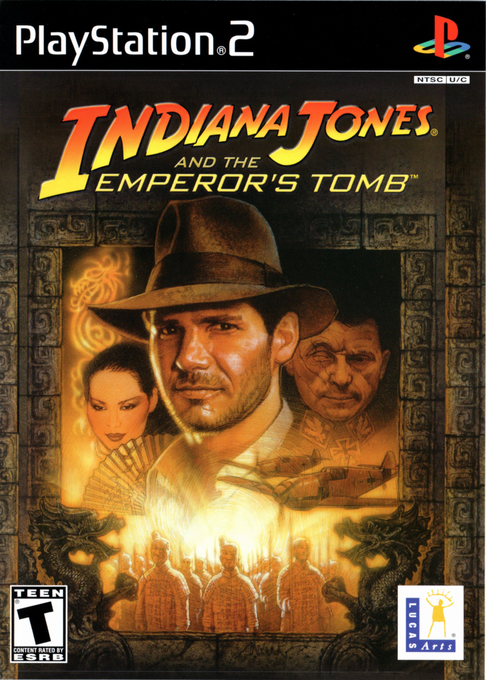
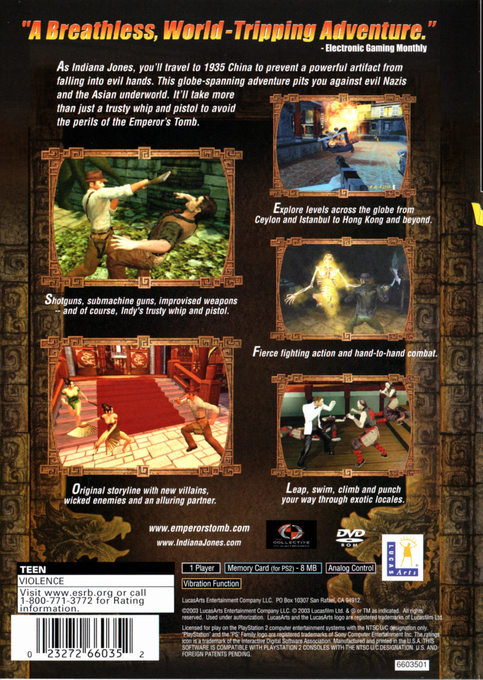
Indiana Jones and the Emperor's Tomb for PlayStation 2 is a third-person action-adventure released in 2003. Developed by The Collective and published by LucasArts, it sends the globe-trotting archaeologist on an original 1935 expedition set before the events of Indiana Jones and the Temple of Doom. The PS2 game turns the series' mixture of ancient mysteries, perilous travel, and pulp-era villains into a single-player adventure built around exploration, platforming, puzzle solving, and close-quarters action. Its search for the legendary Heart of the Dragon ultimately leads Indy toward the tomb of Qin Shi Huang, China's first emperor.
The journey begins in the jungles of Ceylon, where Jones finds a clue concealed in an idol and clashes with Nazi agent Albrecht von Beck. Back in New York, Chinese official Marshall Kai Ti-chan asks him to help locate the Heart of the Dragon before hostile forces can use its supernatural power. The trail grows into a race for pieces of the Mirror of Dreams, an artifact needed to reach the emperor's crypt. From Prague and Istanbul to Hong Kong and a private island fortress, the campaign connects its locations with cinematic set pieces and a story of shifting alliances.
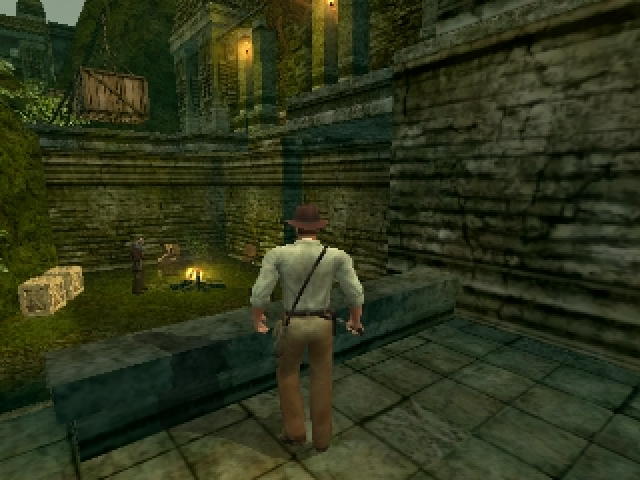
On PS2, players guide Indy from a third-person viewpoint through ten levels filled with ledges, ruins, traps, switches, and enemy encounters. He can run, jump, climb, swim, and negotiate environmental obstacles while looking for routes through each location. The bullwhip is both a trademark weapon and a traversal tool: it can disarm or strike opponents and can also latch onto designated overhead points to swing across gaps. Context-sensitive prompts identify actions such as pulling levers, using a knife to cut vines, or placing explosives, keeping the focus on moving the expedition forward rather than on a separate inventory-heavy interface.
Combat gives Emperor's Tomb a more physical emphasis than many earlier Indiana Jones games. Indy has punches, kicks, grappling moves, a pistol, and firearms picked up during the adventure, but the environments also provide improvised tools. Chairs, tables, shovels, and other objects can become temporary weapons in brawls against gangsters, soldiers, and other foes. Health is restored from Indy's canteen, which can be refilled at points in a level. That combination of fisticuffs, weapons, and environmental interaction gives fights a deliberately scrappy feel suited to the character rather than presenting him as a specialist soldier.
The game expands its film-era setting with original supporting characters including Mei-Ying, Kai's assistant, and Wu Han, who also appears in Temple of Doom. As the search advances, Indy discovers that Kai and the Nazis have competing plans for the Heart, while the Mirror opens the way through submerged ruins, mountain temples, and the emperor's final resting place. The supernatural side of the plot brings guardian creatures, ghosts, and a final confrontation over the artifact, yet the route to that climax remains anchored in recognizable Indiana Jones staples: archaeological clues, booby-trapped chambers, pursuit sequences, and escapes from overwhelming danger.
Emperor's Tomb followed 1999's Indiana Jones and the Infernal Machine but was designed as a more action-forward interpretation of the license. The Collective built it with an enhanced version of the technology used for its Buffy the Vampire Slayer game, and LucasArts released versions for Xbox, Windows, and PlayStation 2 in 2003; the PS2 edition arrived in North America in June. Harrison Ford's likeness is used for Indy, while David Esch provides the character's voice, and Clint Bajakian composed a score that incorporates John Williams' familiar Raiders March. For PS2 players, the result is a self-contained Indiana Jones adventure that bridges classic film iconography with the action-adventure design of its era.
Gallery
Details
- Developer
- The Collective
- Publisher
- LucasArts
- Genre
- Other Adventure
- Players
- 1
- Release Date
- August 29, 2003
- System
- PS2