About
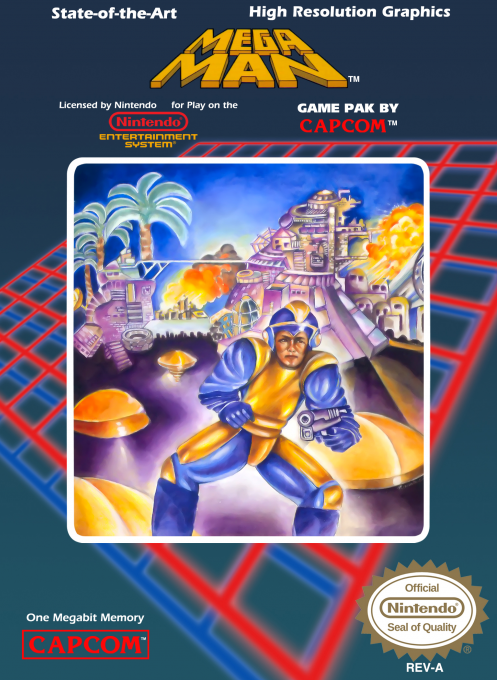
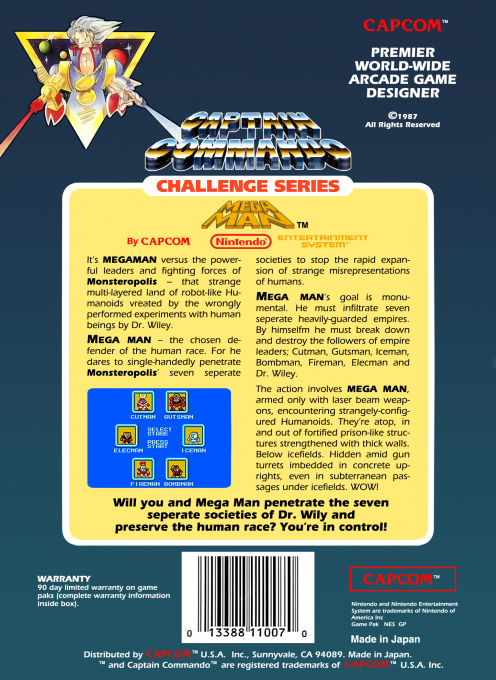
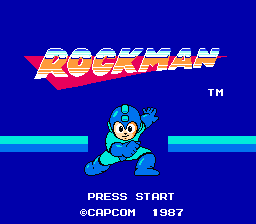
Mega Man for the NES is Capcom’s 1987 side-scrolling action-platformer and the beginning of the company’s long-running robot-hero series. Released in Japan as Rockman for the Famicom, it puts the player in control of Rock, a household robot rebuilt as Mega Man after Dr. Wily takes over six advanced robots created by Dr. Light. The result is a compact science-fiction adventure built for Nintendo’s 8-bit system, with a bright mechanical world, precise movement, and a structure that lets players choose their first destination.
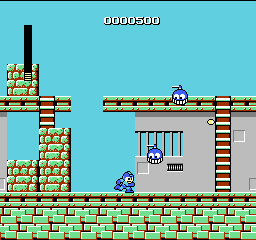
The opening stage-select screen offers six Robot Master levels: Cut Man, Guts Man, Ice Man, Bomb Man, Fire Man, and Elec Man. Each is a self-contained obstacle course with its own visual theme, regular enemies, hazards, and boss encounter. Mega Man runs, jumps, climbs ladders, and fires his arm cannon while navigating moving platforms, narrow ledges, disappearing blocks, and hostile machinery. The stages can be attempted in any order, so a player may pursue the route that best suits their skill or return with a newly acquired tool.
Defeating a Robot Master is central to the game’s progression. Mega Man copies that opponent’s special weapon, adding attacks such as the Rolling Cutter, Super Arm, Ice Slasher, Hyper Bomb, Fire Storm, or Thunder Beam to his selectable equipment. These weapons draw from limited energy supplies, replenished by pickups, and particular bosses are vulnerable to particular attacks. That relationship turns the stage order into a practical puzzle: victory in one area can make a later confrontation far more manageable, while the standard arm cannon remains available when conserving power matters.
The campaign uses a health meter and item drops rather than a sprawling role-playing inventory. Defeated enemies can yield weapon energy and life-restoring capsules, and careful positioning is essential when hazards or enemy shots leave little room to recover. One optional utility, the Magnet Beam found in Elec Man’s stage, creates temporary platforms and expands how Mega Man can cross gaps. Its inclusion gives the original NES game a small but memorable layer of exploration beyond simply reaching the boss door.
After the six Robot Masters fall, the story moves to Dr. Wily’s fortress, a sequence of tougher stages that revisits earlier adversaries and introduces new mechanical threats. Because weapon energy carries through this final stretch, resource use becomes especially important. The game’s futuristic premise is simple but establishes the characters and recurring conflict that shaped the Classic Mega Man line: Dr. Light’s creations, Dr. Wily’s schemes, and a blue robot who repeatedly chooses to protect people.
Mega Man was developed and published by Capcom at a time when the company was extending its work beyond arcade conversions for the home console market. Its Japanese name, Rockman, reflects the music-themed naming used for Rock and his sister Roll; Mega Man became the Western title. The NES release established familiar series ideas including Robot Masters, copied boss weapons, stage selection, Dr. Wily’s fortress, and an energetic chiptune identity. Later sequels greatly expanded the formula, but this first game remains the foundation of the original 8-bit Mega Man series.
Gallery
Details
- Developer
- Capcom
- Publisher
- Capcom
- Genre
- Platformer
- Players
- 1
- Release Date
- December 1, 1987
- System
- NES
/Jajamaru_no_Daibouken.png)
/Puyo_Puyo.png)