About
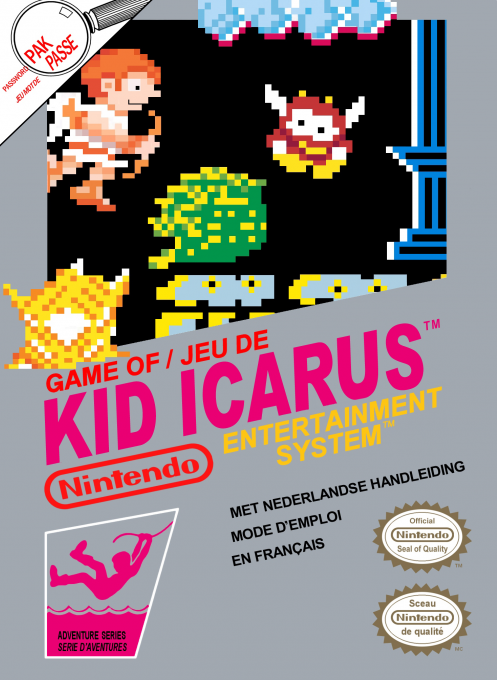
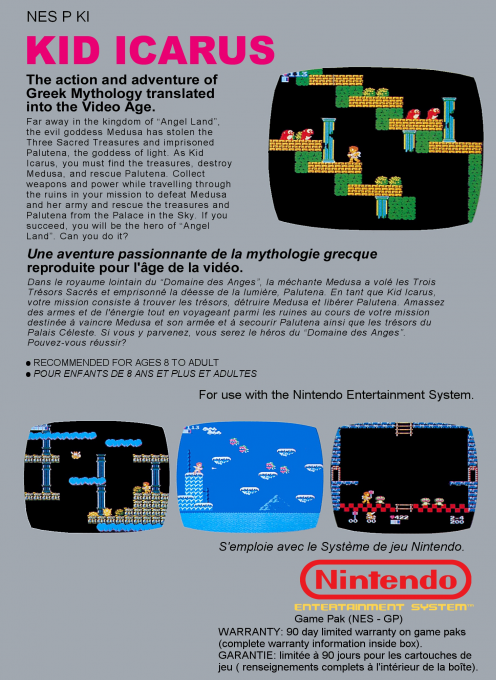
Kid Icarus for the NES is Nintendo's 1987 action-platform adventure, released first in Japan in late 1986 as Hikari Shinwa: Parutena no Kagami for the Famicom Disk System. Developed and published by Nintendo, it follows Pit, a young angel who escapes the Underworld to save Angel Land. Medusa has seized the three Sacred Treasures, imprisoned the goddess Palutena, and turned her forces to stone. Pit must climb out of the Underworld, cross the surface world, and reach the Palace in the Sky before he can confront Medusa. Its Greek-inspired fantasy setting gives the game a distinct identity among Nintendo's early NES releases, even as its tone leaves room for unusual enemies and comic touches.
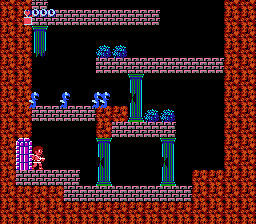
The adventure begins with Pit carrying a bow and an unlimited supply of arrows. Players guide him through two-dimensional platform stages, firing horizontally or upward while judging jumps across narrow ledges, moving hazards, and enemy-filled passages. The early ascent through the Underworld is especially important to its character: stages scroll vertically as Pit climbs, and falling below the bottom of the screen costs a life. Later surface stages shift toward more conventional side-scrolling travel, so the route's structure changes along with the scenery. Progress is organized around three regions—Underworld, Overworld, and Skyworld—each culminating in a maze-like fortress and a guardian battle.
Defeated monsters leave hearts, which function as currency rather than health recovery. Pit can spend them in shops on useful equipment, while other rooms offer hot springs, treasure, enemy challenges, or chances to improve his abilities. The game also tracks performance across a stage. Strong play can increase Pit's health capacity and improve the strength of his bow, while the game's special training rooms test whether a player earns a defensive or offensive power-up. That mixture of platform action, stores, permanent upgrades, and route management makes each run more involved than a simple dash to the exit.
Fortresses change the rhythm again. Instead of a straightforward climb, Pit searches interconnected screens for the way forward, with navigation items available to help map the route. He can carry mallets that free Centurions from stone statues; these rescued fighters then lend support during the fortress boss encounter. Beating a guardian awards one of the Sacred Treasures, including the Mirror Shield, Light Arrows, and Wings of Pegasus. Once Pit has recovered them all, the final approach changes into a scrolling aerial assault, using the treasures to break through Medusa's defenses at the Palace in the Sky.
Kid Icarus on NES differs in an important practical way from its Japanese predecessor. The Japanese Famicom Disk System version could save progress to its Disk Card, whereas the cartridge release used a password system to continue an adventure. The overseas version also updated parts of the ending presentation and added staff credits. Its combination of upward-scrolling platforming, labyrinth fortresses, and character growth was an ambitious fit for an early console action game. The design can be demanding, particularly in its climbing stages and fortresses, but it rewards attention to enemy patterns, resource spending, and the placement of each jump.
The original Kid Icarus established Pit, Palutena, Medusa, and Angel Land as the foundation of a Nintendo series. It was followed by Kid Icarus: Of Myths and Monsters on Game Boy, while Pit later returned in Kid Icarus: Uprising for Nintendo 3DS. The NES original has also been made available through several Nintendo re-releases, including the NES Classic Edition. For players interested in the formative years of Nintendo's action-adventure design, Kid Icarus remains a singular blend of mythology, platform challenges, arcade-style combat, and long-form progression.
Gallery
Details
- Developer
- Nintendo
- Publisher
- Nintendo
- Genre
- Platformer
- Players
- 1
- Release Date
- February 15, 1987
- System
- NES
/Mad_City.png)