About
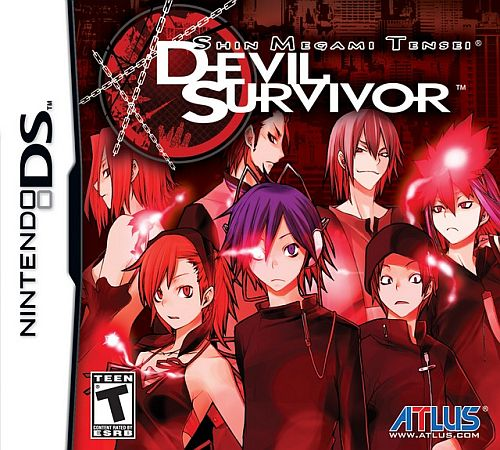
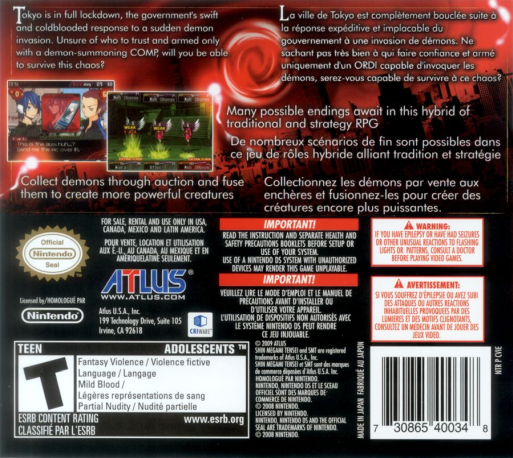
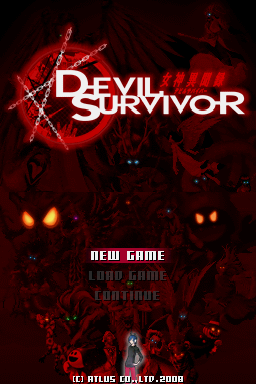
Shin Megami Tensei Devil Survivor Nintendo DS is a single-player tactical role-playing game from Atlus, released in Japan in January 2009 as Megami Ibunroku: Devil Survivor and in North America that June. A Megami Tensei spin-off, it places an unnamed high-school protagonist and his friends in contemporary Tokyo after a demon outbreak seals off the area inside the Yamanote Line. With the authorities presenting the emergency as a gas leak, the people left within the quarantine must contend with dwindling services, hostile demons, and other survivors who have gained the means to command monsters.
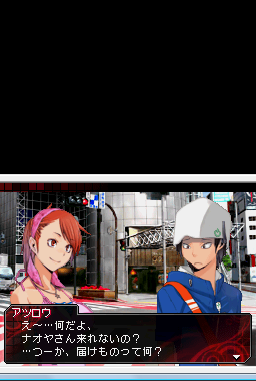
The crisis begins when the protagonist, Atsuro Kihara, and Yuzu Tanikawa receive modified COMPs from the protagonist’s cousin Naoya. These handheld devices run a Demon Summoning Program that allows their owners to make contracts with demons and bring them into battle. The protagonist also receives warnings through Laplace Mail and can see a Death Clock above people’s heads, an ominous countdown that turns decisions about where to go and whom to help into a central part of the story. Over seven in-game days, the group investigates the lockdown’s cause while trying to avert deaths and learn what the coming deadline means for Tokyo.
Devil Survivor divides play between location-based story events and tactical encounters. Visiting a district may advance a character’s plot, reveal information, open a battle, or consume time; events that occur at the same point can require the player to choose one opportunity over another. The schedule is therefore more than a backdrop to the narrative. It determines which meetings, rescues, and confrontations remain available as the seven-day ordeal develops, and the choices made along the way shape the route that the story follows.
Battles begin on a top-down grid, where the player positions and moves squads composed of a human leader and up to two demons. Actions carry turn costs that affect the order in which units act, encouraging careful positioning and planning before an enemy group is engaged. When squads meet, combat switches to a first-person, turn-based exchange displayed across the Nintendo DS’s two screens. Striking an elemental weakness or landing a critical hit grants extra turns, while skills can consume HP or MP for attacks, healing, or status effects. Defeating a squad’s human leader immediately removes that squad, giving objectives and target selection particular importance.
The demon roster is built through several familiar Megami Tensei systems adapted to the game’s tactical framework. Early encounters provide allies, while the Demon Auction House lets players spend Macca competing for additional recruits. The Cathedral of Shadows supports fusion, combining demons into new forms and allowing inherited skills to be selected from the parents. Battles award experience, money, and Magnatite, which can teach demons skills. Human allies develop differently: the Skill Crack system lets a designated squad learn an enemy’s ability after defeating the target, then makes that skill available for the human characters to equip.
Tokyo’s lockdown brings the trio into contact with civilians, demon tamers, religious figures, and military personnel, including allies such as Keisuke, Midori, Kaido, Haru, Gin, Mari, and Izuna. Naoya and the Shomonkai priestess Amane stand near the center of the larger conflict as the party discovers that the disaster is also a judgment on humanity. The original DS version offers several possible conclusions, influenced by critical decisions and by the people the protagonist manages to save. Rather than presenting one fixed resolution, its branching structure lets the player’s alliances and actions determine how the survivors answer the catastrophe.
Atlus developed and published the Nintendo DS release, with Shinjiro Takada serving as director and producer. The project brought together staff with experience on the Growlanser series, while Suzuhito Yasuda designed the human cast and longtime series artist Kazuma Kaneko contributed demon designs. Its 2009 release established the Devil Survivor branch of Megami Tensei and was followed by the separate Nintendo DS sequel Shin Megami Tensei: Devil Survivor 2. The Nintendo DS original remains a distinct version: its seven-day Tokyo story, grid strategy, demon negotiation through systems such as auctions and fusion, and player-directed routes stand on their own without the later Nintendo 3DS expansion’s additional scenario content.
Gallery
Details
- Developer
- Atlus
- Publisher
- Atlus
- Genre
- Tactical RPG
- Players
- 1
- Release Date
- June 23, 2009
- System
- NDS