About
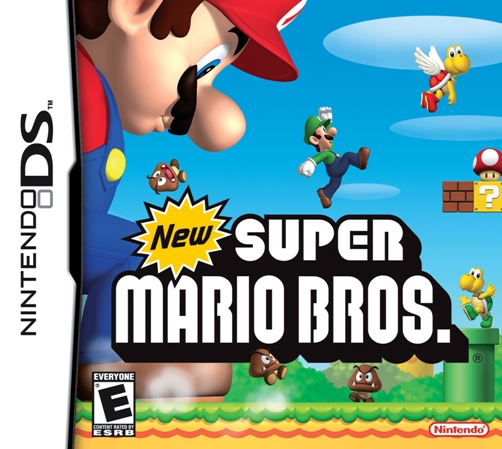
New Super Mario Bros. is Nintendo's 2006 side-scrolling platform game for Nintendo DS, developed and published by Nintendo. It launched in North America on May 15, 2006, returning Mario to a newly made 2D adventure after a long run of remakes, ports, and 3D entries. Its familiar run-and-jump foundations are presented with three-dimensional character models and objects, while stages still play from a side-on viewpoint. That blend gives the Mushroom Kingdom a contemporary DS look without changing the direct, readable platforming structure associated with classic Super Mario Bros. games.
The adventure begins when Bowser Jr. kidnaps Princess Peach outside her castle while Mario is distracted by trouble at the fortress. Mario pursues him across the Mushroom Kingdom, facing Bowser's forces in courses full of question blocks, pipes, enemies, secret routes, and castle confrontations. Luigi is also available as a playable hero after the appropriate unlock, but the central objective remains reaching Peach and stopping Bowser Jr. and Bowser. The straightforward rescue premise gives the varied worlds a clear journey from the opening grasslands to the final castle.
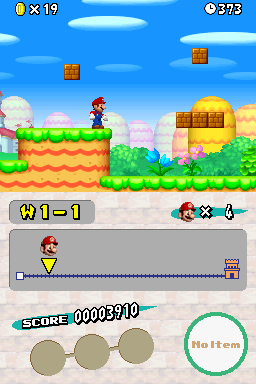
New Super Mario Bros. builds its platforming around running, jumping, stomping foes, hitting blocks, and reaching a flagpole, then expands Mario's movement with wall jumps, triple jumps, and ground pounds. The D-pad and two main action buttons keep the essential controls simple, while the DS’s second screen supports the world map and other status information. Courses use these moves for vertical routes, hidden areas, moving platforms, ropes, and hazards, making precision and observation as important as simply racing to the goal.
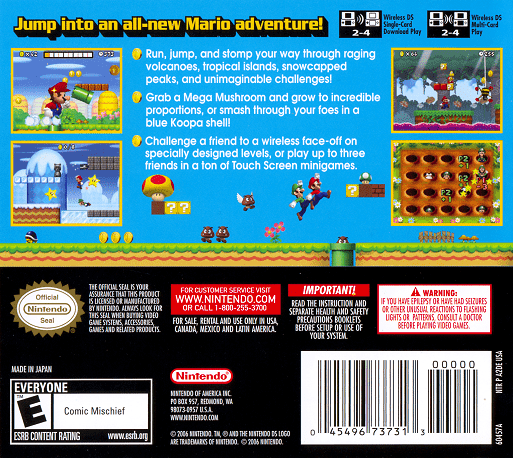
Classic transformations return in the Super Mushroom, Fire Flower, and Super Star, while three notable DS-era power-ups change how a level can be approached. The Mega Mushroom makes Mario enormous enough to smash through enemies and much of the scenery; the Mini Mushroom shrinks him for narrow passages, higher jumps, and runs across water; and the Blue Shell lets him retreat into and dash along in a Koopa shell. An item reserve also allows a spare power-up to be saved for later use, adding a useful decision between immediate safety and future preparation.
Across eight worlds and more than 80 courses, every main stage hides three Star Coins, for a total of 240 to find. These large collectibles reward players who investigate alternate paths and riskier jumps, and some unlock access on the overworld map. The worlds range through environments such as water, sky, ice, and desert, with routes that can branch as secrets are discovered. This collectible structure makes the game suitable both for a first trip to the ending and for a more thorough search for every route and Star Coin.
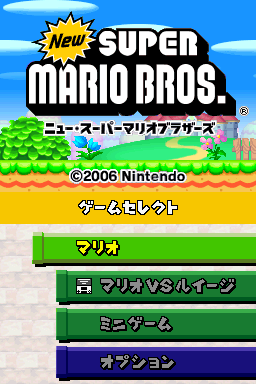
Beyond the solo quest, the Nintendo DS game includes Mario vs. Luigi, a local wireless two-player contest in which Mario and Luigi compete to collect the required number of stars first. Players can interfere with one another and steal an opponent’s stars, making it a competitive companion rather than campaign co-op. The game also offers a selection of touch-screen minigames, playable alone or in supported local multiplayer configurations. Those wireless and stylus-focused modes place New Super Mario Bros. firmly in its original DS context; later Wii U Virtual Console availability did not retain the original cartridge’s wireless communication features.
Gallery
Details
- Developer
- Nintendo
- Publisher
- Nintendo
- Genre
- Platformer
- Players
- 1-4
- Release Date
- May 15, 2006
- System
- NDS