About
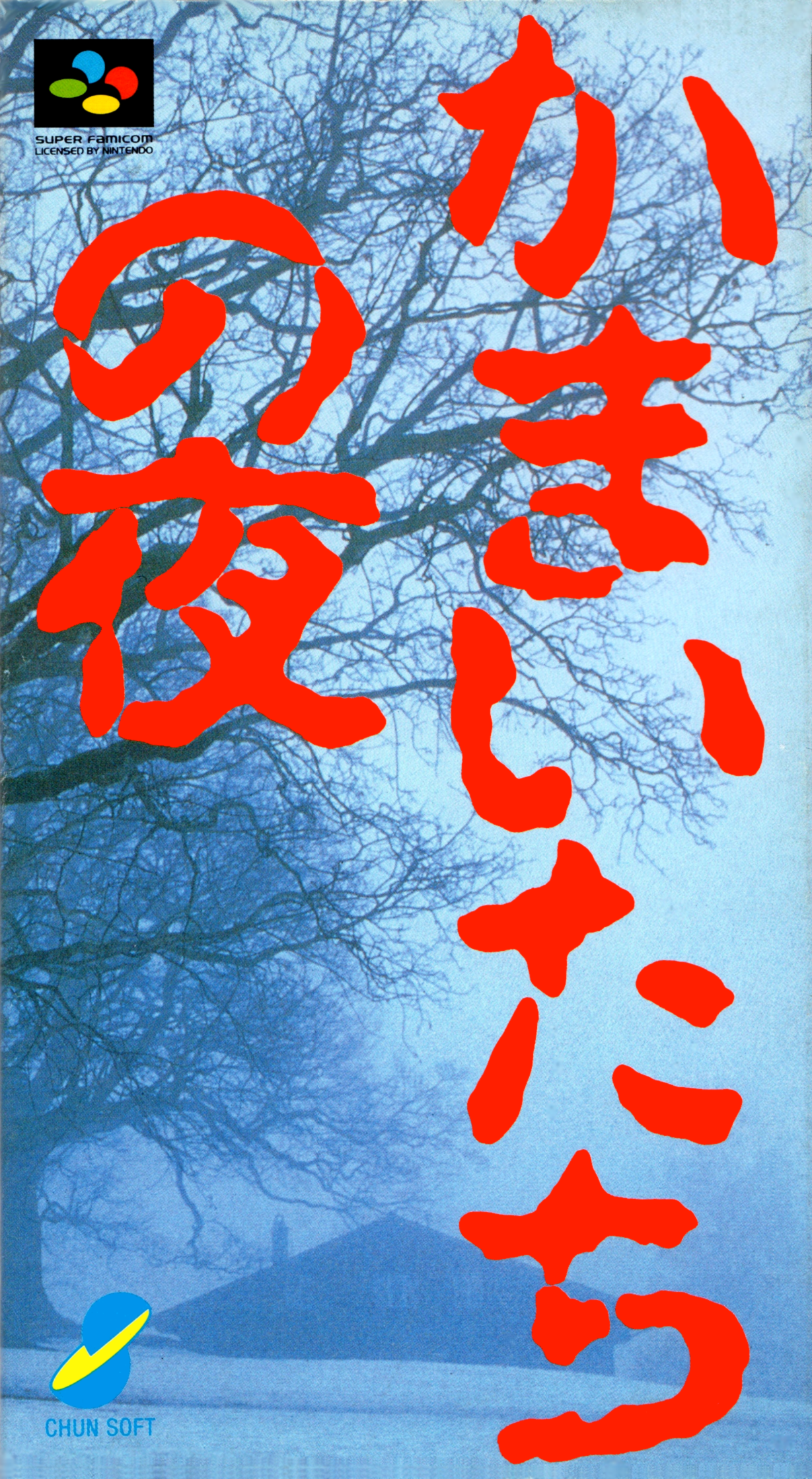
Kamaitachi no Yoru is Chunsoft’s 1994 Super Famicom sound novel, a Japanese adventure game built around a closed-circle murder mystery. Released in Japan on November 25, 1994, it followed Chunsoft’s earlier Otogirisō and used prose, still imagery, music, and player choices to tell its story. Written by mystery novelist Takemaru Abiko, the game centers on Tōru and his girlfriend Mari as an ordinary winter trip turns threatening at an isolated ski-lodge pension.
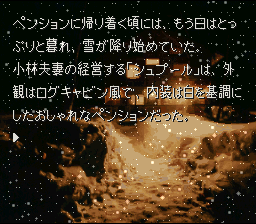
The Super Famicom game is played by reading Japanese text and selecting responses at key moments. Rather than moving a character through a map or issuing attacks, the player’s decisions determine what Tōru does, whom he trusts, and which leads he follows. Choices can redirect scenes, reveal different information, and send the narrative down separate routes. This makes investigation part of the play experience: noticing what has changed, reconsidering an earlier decision, and returning to a fork can matter as much as reaching the next piece of dialogue.
The central scenario begins after Tōru and Mari arrive at the mountain lodge during ski season. A snowstorm isolates the guests from the outside world, and an ominous message warning that someone will die is followed by a murder. Tōru becomes involved in working out what happened while the remaining visitors confront suspicion, fear, and the possibility of further violence. The setting gives the game the shape of a traditional locked-room or snowbound mystery, while the branching format lets the same premise produce very different outcomes.
Chunsoft presented the people on screen primarily as colored silhouettes rather than conventional character portraits. Photographic and carefully composed backdrops, atmospheric audio, and the reader’s imagination do much of the visual work. That approach is especially effective for a mystery: it keeps attention on the narration and dialogue while making familiar rooms and corridors feel unsettled once the lodge’s guests can no longer be taken at face value. Music by Kōjirō Nakashima and Kōta Katō supports changes in tension without turning the game into an action title.
Kamaitachi no Yoru rewards replaying its story. Reaching one conclusion is not the end of its design; the choices open alternative paths and endings, including material that can shift the tone away from the first mystery. The result is closer to a branching novel than a single linear detective tale. Players learn the structure by comparing outcomes, finding new decisions, and gradually seeing more of the scenarios housed within the same winter-night setting.
The game was developed and published by Chunsoft, with Kazuya Asano credited as director and company founder Kōichi Nakamura as producer. Its success helped establish the visibility of Chunsoft’s “Sound Novel” style, a label the company used for text-led games enhanced by sound and visuals. Kamaitachi no Yoru became an important point of reference for later Japanese narrative adventures, especially those interested in choice-driven suspense rather than conventional arcade-style challenges.
Later Japanese releases brought the story to PlayStation, Game Boy Advance, computers, mobile devices, and Nintendo’s Virtual Console services. The series continued with Kamaitachi no Yoru 2 and Kamaitachi no Yoru × 3, while a 2017 PlayStation Vita remake, Kamaitachi no Yoru: Rinne Saisei, reworked the presentation and added a new scenario. An English iOS localization appeared in 2014 as Banshee’s Last Cry, adapting names and the setting for that version. For the original Super Famicom release, however, Kamaitachi no Yoru remains a landmark example of a Japanese sound novel: a suspenseful story whose route through the snowbound lodge depends on the reader’s next choice.
Gallery

Details
- Developer
- Chunsoft
- Publisher
- Chunsoft
- Genre
- Visual Novel
- Players
- 1
- Release Date
- November 25, 1994
- System
- SNES