About
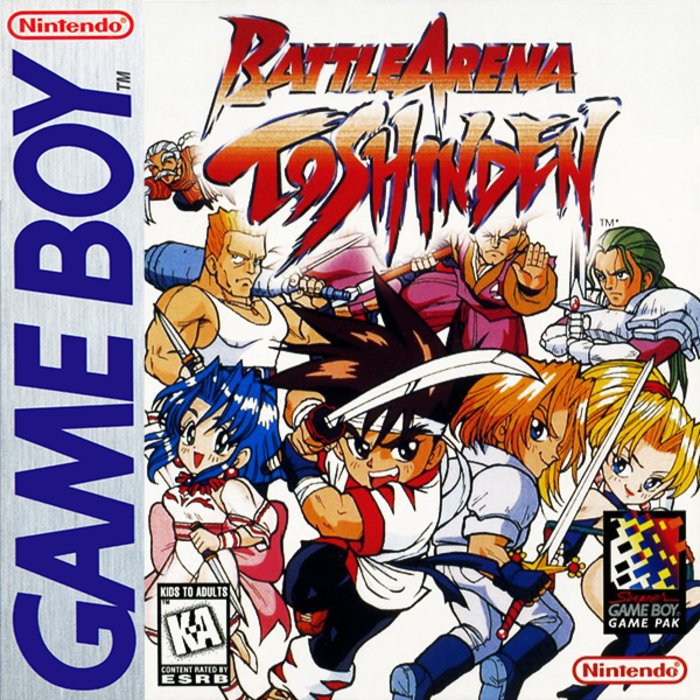
Nettou Toshinden is the Japanese Game Boy entry in Takara’s Battle Arena Toshinden fighting-game series. Released in Japan in March 1996, it reworks the 1995 PlayStation game for Nintendo’s monochrome handheld as a side-on, two-dimensional weapon fighter. The western release arrived later in 1996 as Battle Arena Toshinden, published by Nintendo. Although it draws on a series created by Tamsoft, this Game Boy conversion was developed by Betop and is a separate production rather than a reduced version of the original 3D game.
The action is staged around the secret Toshin Daibukai tournament, whose organizers invite a selected group of armed combatants to determine the strongest fighter. Each entrant comes with a personal reason to take part. Eiji Shinjo, the sword-wielding adventurer, is searching for his missing brother; Kayin Amoh returns to battle after life as an underground prize fighter; and other familiar contenders include Sofia, Rungo Iron, Duke B. Rambart, Fo Fai, Mondo and Ellis. Character-specific introductions and endings give the tournament route a small story framework while preserving the martial-arts fantasy atmosphere of the parent series.
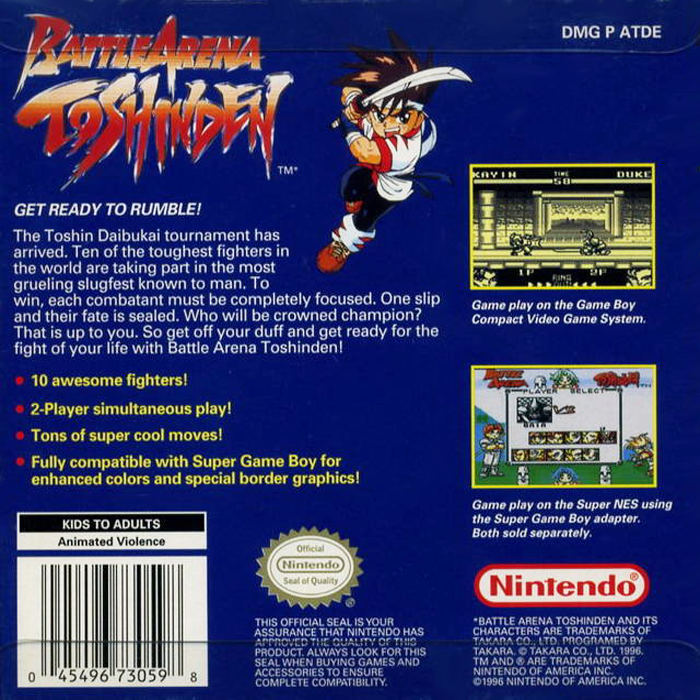
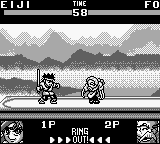
Nettou Toshinden Game Boy centers on one-on-one bouts in a 2D arena. The D-pad handles walking, crouching, jumping, guarding and directional inputs, while the A and B buttons perform kicks and punches. Holding an attack changes its strength, and close-range inputs allow throws. Players can also dash forward, backstep away, dodge attacks, taunt an opponent and combine both face buttons for a stronger strike. Each fighter has individual special attacks entered with directional commands and buttons, with an alternate easy-command method available for certain moves.
A strength gauge and timer govern each round, but the arena edge is an equally important concern. Invisible ropes can save a fighter from a ring-out only a limited number of times; once that protection has been exhausted, being forced beyond the boundary loses the round. This makes positioning, throws and pressure near the side of the screen part of the match strategy. The game also supports cancelling from regular attacks into special moves, rewards attacks that land from behind with additional damage, and reserves secret special moves for moments when a fighter’s strength gauge is flashing.
The main single-player option is a story tournament in which one of the eight selectable fighters faces computer-controlled rivals in best-of-three encounters. A separate VS CPU mode lets players choose both combatants for practice, while the options menu adjusts difficulty, round time, match points, health and the rope setting. Two-player versus battles require two Game Boys, two cartridges and a Game Link Cable. The cartridge also works with the Super Game Boy, where two SNES controllers can be used for head-to-head matches.
Rather than attempt the PlayStation original’s free-roaming 3D sidestepping, the Game Boy adaptation changes the contest into a compact 2D fighter and presents its cast in a super-deformed style associated with Takara’s Nettou line. It retains returning figures such as Eiji, Kayin and the bosses Gaia and Sho, while adding Gaia 2 and Uranus to its own lineup. For players exploring Battle Arena Toshinden on Game Boy, the result is a handheld-specific branch of the series built around weapon combat, ring-out danger and local multiplayer.
Gallery
Details
- Developer
- Tamsoft
- Publisher
- Takara
- Genre
- Fighting
- Players
- 1-2
- Release Date
- November 2, 1996
- System
- GB