About
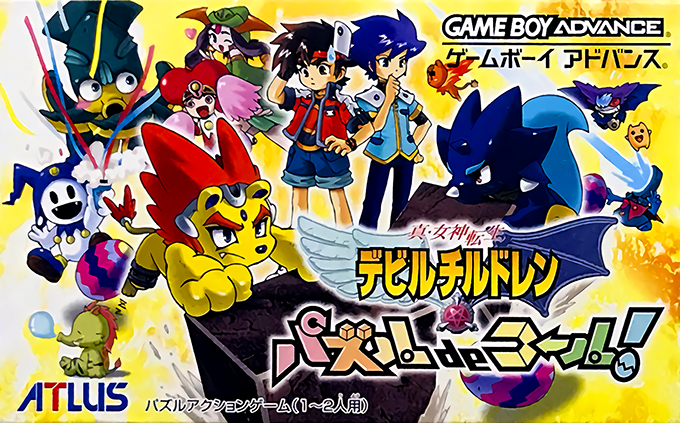
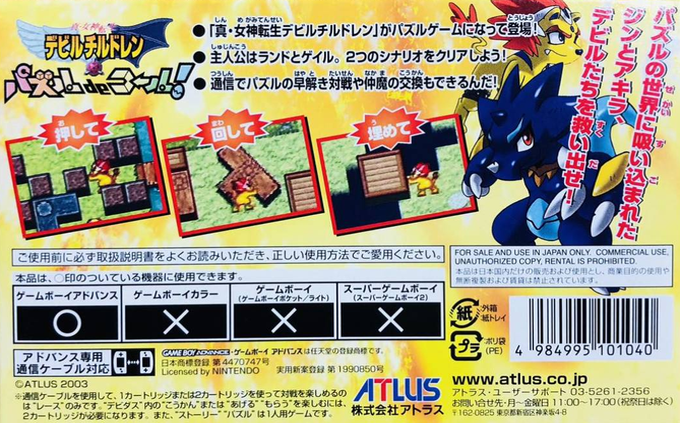
Shin Megami Tensei Devil Children: Puzzle de Call! is a Game Boy Advance puzzle game published by Atlus in Japan on July 25, 2003. It is a distinctly different kind of entry in the Shin Megami Tensei Devil Children line: rather than another demon-collecting role-playing adventure, it turns the series’ characters, monsters, and Valhalla setting into compact, screen-by-screen spatial puzzles. Released during the GBA era alongside the Light Book and Dark Book storyline, Puzzle de Call! uses the Japanese Devil Children name and was designed around a more immediate, puzzle-focused format.
The story begins when the Devil Children protagonists Jin and Akira investigate a strange summons from an apparently deserted village. A mysterious object draws them into a puzzling miniature world, leaving their allies Rand and Gale to follow and search for a way through. Players choose Rand or Gale at the outset; that choice determines the viewpoint and route through the story, while the basic puzzle rules remain the same. The premise connects the game to the Valhalla-era cast without requiring the turn-based exploration and party battles that define the main Devil Children games.
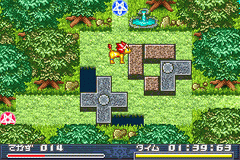
Each round is built around reaching a red magic-circle goal. The essentials resemble a classic box-pushing puzzle: blocks can be pushed but not pulled, and they must be positioned carefully to make paths or fill holes. Later layouts add moving doors that rotate around a central point, hazards, and other arrangements that make planning each step important. Some stages also place a recruited devil beside the player character, requiring both characters to be guided to the exit or goal before the round can be cleared. The result is a focused GBA puzzle challenge in which a single misplaced block can change the solution.
Devils remain central to the game, but they support its puzzle structure rather than forming a conventional battle party. Eggs found within rounds can contain devils, and collecting them expands the game’s record of companions. Story progress also leads to boss stages: players move across special markers while avoiding attacks, using the devils gathered during play as a form of life reserve. This keeps recognizable Devil Children ideas—companions, magical symbols, and a bestiary—present in a format with its own goals and rules.
Puzzle de Call! offers four main ways to play. Story Mode follows the chosen route through the rescue adventure, while Puzzle Mode presents a separate set of 30 stages for players pursuing standalone solutions. Race Mode supports head-to-head puzzle competition through the Game Boy Advance Game Link Cable, and Devildas serves as a catalogue for the devils collected during play, with trading functions tied to link play. Those modes give the cartridge both a solo puzzle campaign and a social element typical of handheld games of its period.
Within the wider MegaTen catalogue, Shin Megami Tensei Devil Children: Puzzle de Call! stands as one of the Devil Children series’ non-RPG experiments. Its accessible character designs and monster companions come from a younger-skewing branch of the franchise, while its mechanics ask players to think about routes, object placement, timing, and efficient use of limited space. For a Game Boy Advance collection, it is a notable spin on the Devil Children formula: a Japanese GBA release that puts block puzzles, character switching, and link-cable races ahead of the usual demon-battling journey.
Gallery
Details
- Developer
- Multimedia Intelligence Transfer
- Publisher
- Atlus
- Genre
- Logic Puzzle
- Players
- 1
- Release Date
- July 25, 2003
- System
- GBA



/F-Zero_Climax.png)