About
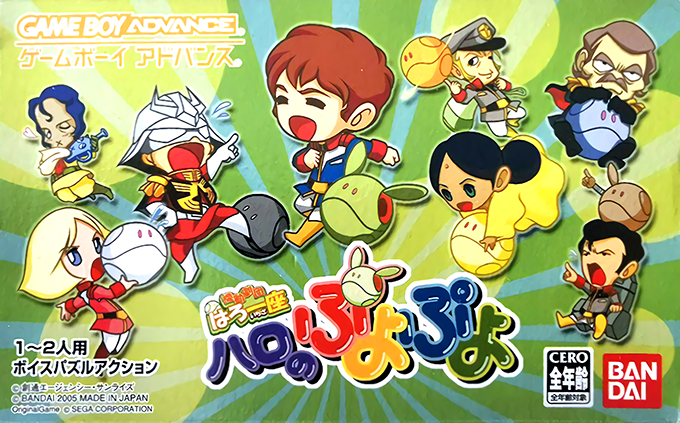
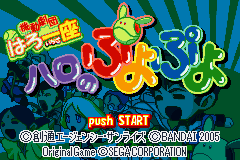
Kidou Gekidan Haro Ichiza: Haro no Puyo Puyo is a Game Boy Advance puzzle game released in Japan on July 21, 2005. Developed by Arowana and published by Bandai under license from Sega, it adapts the competitive falling-piece play of Puyo Puyo to the comic world of Kidou Gekidan Haro Ichiza, a parody-flavoured SD Gundam presentation built around characters from the original Mobile Suit Gundam. Rather than asking players to learn a new kind of puzzle game, this crossover uses familiar rules while giving the board, cast and dialogue a distinct Gundam identity.
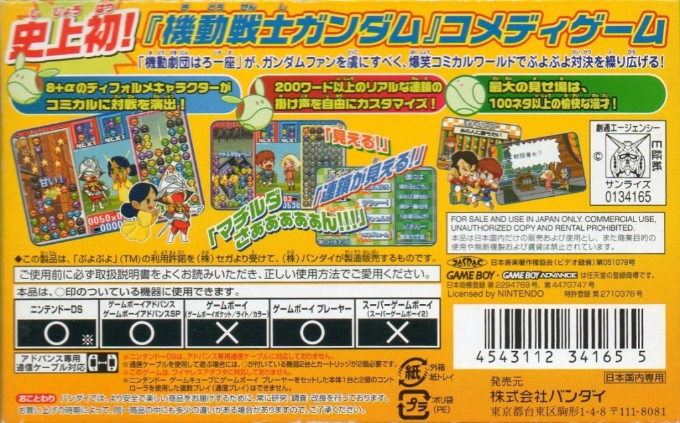
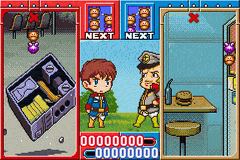
Matches take place on a shared split screen. Connected pairs of coloured Haro capsules descend into each player’s field, and the D-pad is used to move and rotate them before they land. Linking four or more Haros of the same colour horizontally or vertically removes them. The real objective is to plan the clear so that pieces above fall into a new matching group, creating a chain reaction. Longer chains send obstructive pieces to the opponent and make it increasingly difficult for them to find space for their own drops.
This is a five-colour version of the Puyo Puyo Tsu-style ruleset. The board has room for quick improvised clears, but successful attacks usually come from constructing a small arrangement, then triggering it at the right moment. Incoming nuisance pieces can be cancelled by making chains of one’s own, so a match becomes a contest between building an efficient attack and keeping a playable field. The game preserves the immediate, real-time pressure that defines head-to-head Puyo Puyo, while the Game Boy Advance’s controls keep the action focused on directional movement, rotation and timing.
The visual substitution is central to the crossover. The ordinary Puyo are replaced with the round Haro mascot familiar from Gundam, while nuisance pieces appear as Psycho Haros. The opponents are rendered as super-deformed versions of figures associated with the original Mobile Suit Gundam story, including Amuro Ray, Char Aznable, Sayla Mass, Lalah Sune, Bright Noa and Ramba Ral. Their appearances, backdrops and exchanges turn a sequence of puzzle battles into a playful parade of references for viewers familiar with the anime.
A single-player route pits the player against computer-controlled characters and links the matches with short scenes. There are different possible exchanges for matchups, lending repeat attempts some extra variety beyond simply trying to improve at chains. Endless play offers a more solitary test of survival and score-building while periodic garbage attacks keep the field from remaining comfortable for long. A two-player mode lets two people use the same cartridge for direct competitive matches, making the basic Puyo Puyo formula the centrepiece whether the player is pursuing the character material or a quick puzzle duel.
Haro no Puyo Puyo also puts unusual emphasis on its audio presentation. Chain voice clips can be collected through play and assigned in a customizable sequence, allowing a character’s reactions to be arranged rather than always following a fixed order. This feature fits the game’s theatrical, gag-driven framing and helps distinguish it from a straightforward reskin. It was the first Kidou Gekidan Haro Ichiza game; later entries in that small line moved to Gundam-themed mahjong on Nintendo DS, leaving this 2005 Game Boy Advance release as its Puyo Puyo chapter.
Gallery
Details
- Developer
- Bandai
- Publisher
- Bandai
- Genre
- Tile-Matching Puzzle
- Players
- 1
- Release Date
- July 21, 2005
- System
- GBA