About
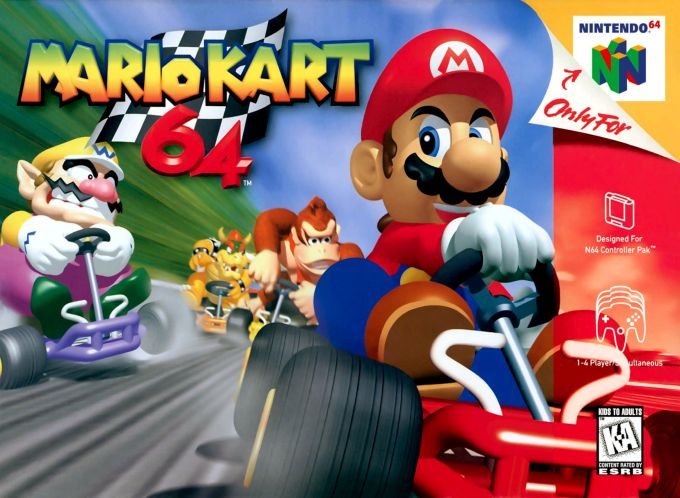
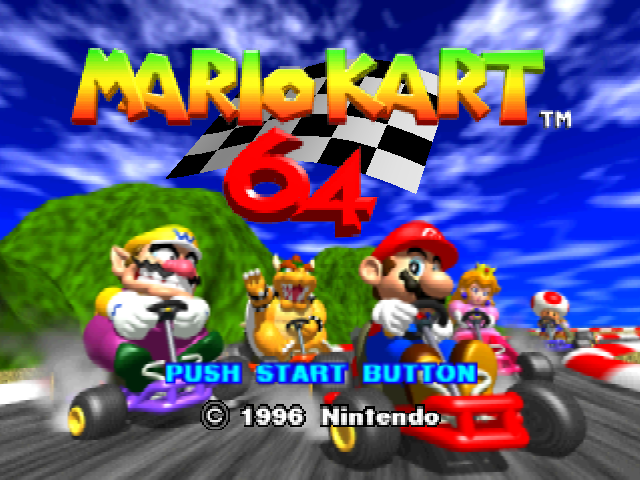
Mario Kart 64 for Nintendo 64 is Nintendo's kart-racing sequel to Super Mario Kart. Developed by Nintendo EAD and published by Nintendo, it arrived in Japan in December 1996, North America in February 1997, and Europe in June 1997. Players choose from eight familiar Mushroom Kingdom racers—Mario, Luigi, Peach, Toad, Yoshi, Bowser, Donkey Kong, and Wario—and compete in compact karts across a colorful, obstacle-filled set of 3D courses.
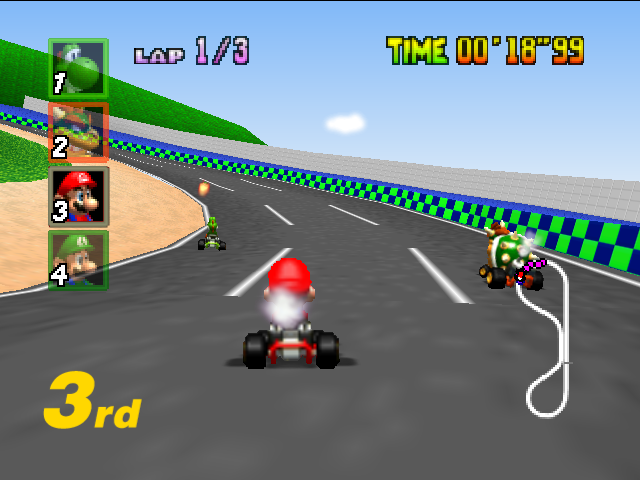
The basic aim is simple: finish ahead of the field, but the races demand more than steering cleanly through each turn. The analogue stick handles acceleration, direction, braking, reverse, and hopping into slides, while well-timed drifts help a kart carry speed through corners. Question-mark item boxes distribute familiar Mario-themed tools, from speed-boosting mushrooms and invincibility stars to shells and banana peels that can disrupt rivals. Drafting behind another racer can also provide a burst of speed, giving long straights their own tactical opportunities.
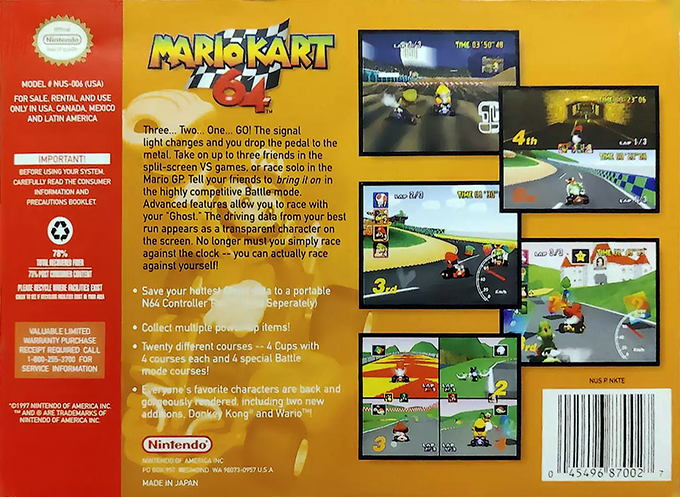
Grand Prix is the central single-player challenge, and it can also be played by two people. Each cup consists of four three-lap races; positions award points, and a racer needs to place highly enough to continue toward the trophy. Mushroom, Flower, Star, and Special Cups together cover 16 courses, with engine classes at 50cc, 100cc, and 150cc setting the pace and difficulty. Completing the cups at the highest class with first-place results unlocks Mirror mode, which reverses every circuit from left to right. Time Trials instead strips away opponents and items, letting one player chase a three-lap record and save ghost data to a Controller Pak.
Its locations turn Mario settings into racing hazards and landmarks. Drivers weave around traffic on Toad's Turnpike, avoid rolling rocks on Choco Mountain, pass a train in Kalimari Desert, and negotiate the narrow paths of Yoshi Valley. Other tracks bring penguins, cows, icy patches, lava, caves, a haunted boardwalk, and a long neon Rainbow Road into the route. The game’s characters have differing weight classes, which influence acceleration, top speed, and handling, so a lightweight choice such as Toad or Yoshi feels distinct from heavier rivals such as Bowser, Donkey Kong, and Wario.
Mario Kart 64 also helped make the Nintendo 64 a group-play fixture. Its split-screen Versus mode supports two to four players racing on any course, while Battle mode moves the action to dedicated arenas. In Battle, each kart starts with three balloons and players use items to pop their opponents' balloons; losing all three removes a racer from contention, though they can still interfere as a bomb kart. The console’s four controller ports made these local contests possible without an accessory, while the game’s cartridge-based design kept the races focused on immediate, pick-up-and-play competition.
As the second Mario Kart, Mario Kart 64 carried the series from the Super NES original into a 3D track environment while retaining its approachable racing-and-items formula. It introduced the blue spiny shell, the now-famous item that homes in on the race leader. Nintendo later made the game available through Wii and Wii U Virtual Console services, and it joined the Nintendo 64 collection for Nintendo Switch Online. Its combination of cups, time attacks, four-player racing, and battle arenas remains a defining snapshot of Nintendo 64-era Mario competition.
Gallery
Details
- Developer
- Nintendo
- Publisher
- Nintendo
- Genre
- Racing & Driving
- Players
- 1-4
- Release Date
- February 10, 1997
- System
- N64