About
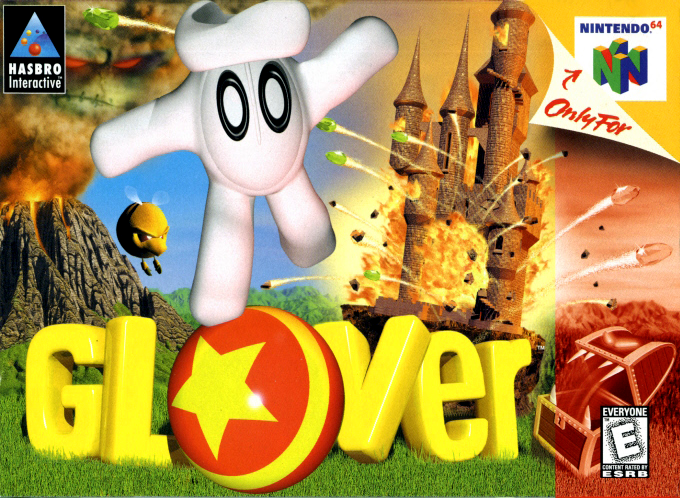
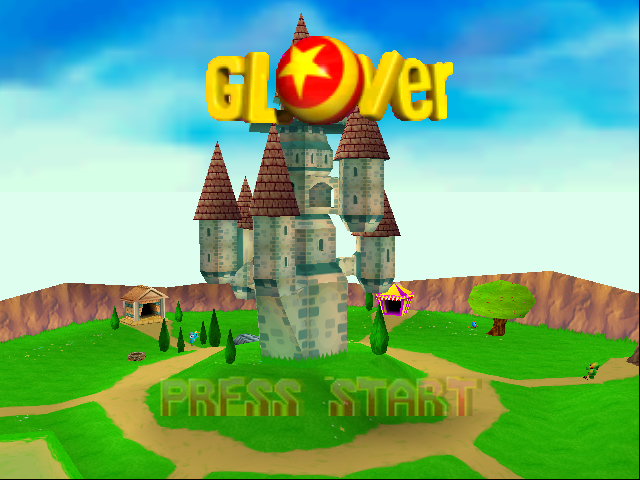
Glover is a Nintendo 64 puzzle-platformer from 1998, developed by Interactive Studios and published by Hasbro Interactive. It turns a remarkably simple image—a four-fingered magic glove and a ball—into the basis for an unusual 3D adventure. Rather than treating jumping as the entire solution, the game asks players to guide a fragile magical ball through hazardous, obstacle-filled stages. Its strange protagonist, storybook setting, and physics-focused design give Glover a character that stands apart from more conventional late-1990s platform games.
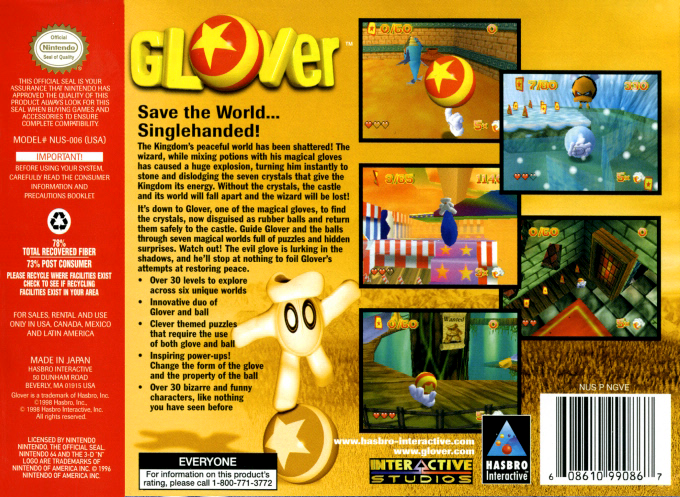
The adventure begins in the Crystal Kingdom, where a wizard’s botched potion experiment causes a catastrophic explosion in Crystal Castle. The accident turns the wizard to stone, scatters the kingdom’s seven life-giving crystals, and sends his two enchanted gloves in different directions. Glover escapes the castle and turns the falling crystals into rubber balls before they can shatter. The other glove is corrupted by the cauldron and becomes Cross-Stitch, an antagonist who attempts to prevent the restoration of the kingdom. Glover’s task is to recover the lost crystals, return them to the castle, and undo the damage caused by the explosion.
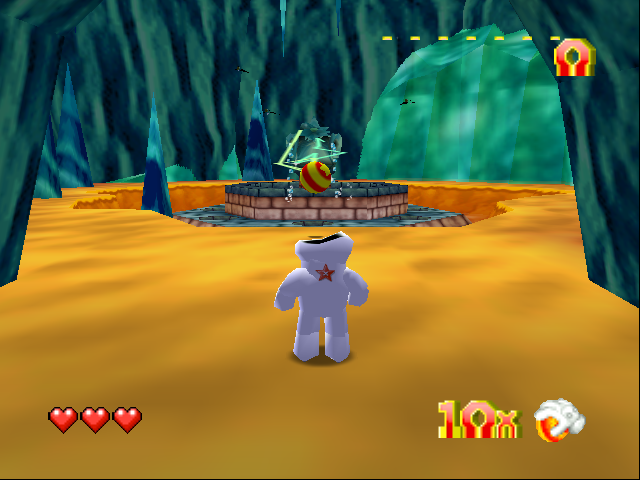
The central challenge in Glover is shepherding the ball to a goal while keeping it intact. Glover can bounce, slap, roll, throw, dribble, and ride on the ball, as well as use it like a trampoline. Those actions make the ball both a tool and a responsibility: it can bridge gaps, trigger switches, defeat enemies, and reach distant platforms, but careless handling can send it into water, traps, or other dangers. Glover can still jump, cartwheel, and search for the ball when separated from it, yet most puzzles depend on controlling the ball’s movement with care.
Different ball forms add another layer to the Nintendo 64 version’s puzzle design. The standard rubber ball is versatile and can float on water, while the heavier bowling ball is sturdier and useful against enemies but sinks. A ballbearing provides more precise handling and magnetic properties, and the original crystal form is especially delicate but rewards players with extra points for collectibles. Selecting or discovering the appropriate form changes how a hazard is approached, encouraging players to weigh momentum, bounce, durability, and terrain instead of relying on a single movement set.
Glover travels through six themed worlds reached from Crystal Castle, with three principal stages and a boss encounter associated with each crystal. The settings range from an Atlantis-inspired environment and a circus park to pirate territory, a horror-flavored fortress, prehistoric landscapes, and outer space. Collectible Garib cards are scattered through the levels, and collecting every card in a world opens a bonus stage. Mr. Tip, a living hat, supplies guidance during the journey, while Cross-Stitch’s traps and monsters give the otherwise whimsical quest a recurring source of pressure.
Released in 1998 for Nintendo 64 and Windows, Glover was later adapted for PlayStation, though the original Nintendo 64 edition is the version represented here. Contemporary responses often recognized the game’s originality, colorful environments, and blend of platforming with object-based puzzles, while also noting that its ball physics could make precision demanding. That tension remains central to its identity: Glover is a game for players willing to experiment with an unpredictable magical ball, learn the quirks of each form, and solve stages that ask for patience as much as reflexes. A planned sequel, Glover 2, was ultimately cancelled, but the first game remains a distinctive example of experimental 3D design from the Nintendo 64 era.
Gallery
Details
- Developer
- Interactive
- Publisher
- Hasbro Interactive
- Genre
- Platformer
- Players
- 1
- Release Date
- October 31, 1998
- System
- N64