About
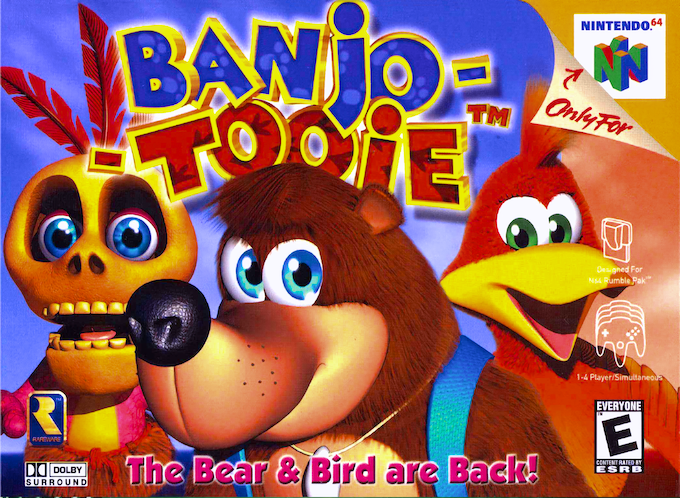
Banjo-Tooie for Nintendo 64 is a 3D platform adventure developed by Rare and published by Nintendo. Released in North America in November 2000 and in Europe in April 2001, it continues the story of Banjo-Kazooie with Banjo the bear and Kazooie the breegull returning to Spiral Mountain. The sequel builds on the collect-and-explore format of the first game, sending the pair through the sprawling Isle o’ Hags to thwart the witch Gruntilda and her sisters, Mingella and Blobbelda.
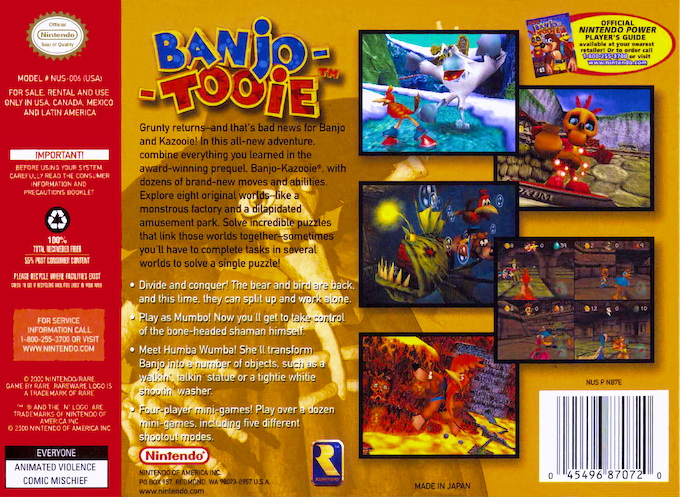
The adventure begins after Gruntilda is freed from the boulder that trapped her at the end of the earlier game. Now reduced to a skeleton, she and her sisters use the drilling machine HAG 1 to begin a campaign of destruction. Their larger scheme involves the B.O.B. life-force extractor, which they intend to use to restore Gruntilda and devastate the island. Banjo and Kazooie follow the trail from Jinjo Village, where scattered Jinjos and the crisis facing King Jingaling establish the quest’s early objectives.
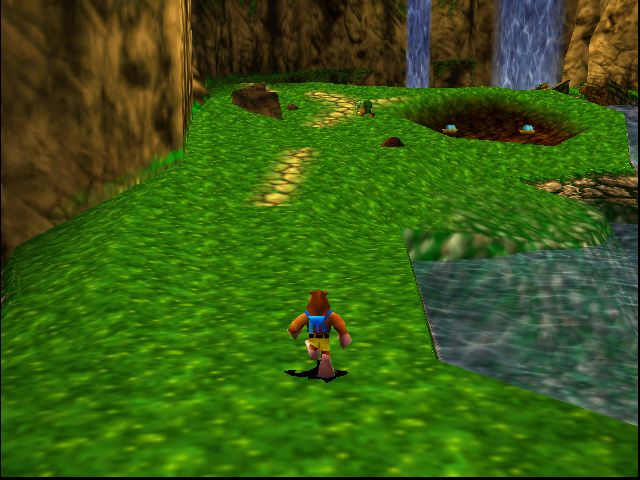
Like its predecessor, Banjo-Tooie is played from a third-person view and mixes running, jumping, combat, exploration, and puzzle solving. Golden Jiggies remain the central progression item. Rather than placing separate puzzle doors around the lair, the game uses the temple of Master Jiggywiggy: meeting each world’s Jiggy requirement unlocks a timed puzzle challenge and opens the way forward. Collectible notes are used to purchase techniques from Sergeant Jamjars, Bottles’ drill-sergeant brother, while familiar items such as Jinjos and empty honeycomb pieces reward careful exploration.
Rare greatly expands the duo’s toolkit. Banjo and Kazooie retain their established moves, then gain additional attacks and traversal abilities, including first-person aiming and new varieties of eggs. A major change lets the two heroes separate, so Banjo and Kazooie can tackle different tasks with their own specialized moves before rejoining. Mumbo Jumbo is also playable in this installment, using spells at designated pads to alter parts of a world. His former transformation role is taken by Humba Wumba, whose magic changes the heroes into forms suited to particular challenges in exchange for Glowbos.
The worlds are designed as a connected adventure rather than isolated stages. Paths, doors, and other routes link many locations to one another and to the Isle o’ Hags overworld, making newly learned skills useful in places already visited. Chuffy, a train that can travel between worlds with stations, adds another way to move characters and solve cross-world problems. This structure gives Banjo-Tooie its large-scale sense of exploration, from industrial areas and ancient sites to an amusement park, while placing a premium on remembering unfinished tasks and returning with the right ability.
Banjo-Tooie also adds a separate multiplayer component for up to four players, using Nintendo 64 controllers. Its 14 competitive minigames adapt ideas from the main adventure into contests that include egg-shooting battles, bumper-car events, and ball games. The original Nintendo 64 release supports the Rumble Pak and includes a widescreen display option. In 2009, 4J Studios produced an Xbox Live Arcade version with modern presentation improvements and restored Stop ’N’ Swop connectivity; that version later appeared in Rare Replay. As the second main entry in the Banjo-Kazooie series, Banjo-Tooie remains a notably expansive example of Rare’s Nintendo 64-era character platformers.
Gallery
Details
- Developer
- Rareware
- Publisher
- Nintendo
- Genre
- Action-Adventure
- Players
- 1-4
- Release Date
- November 20, 2000
- System
- N64