About
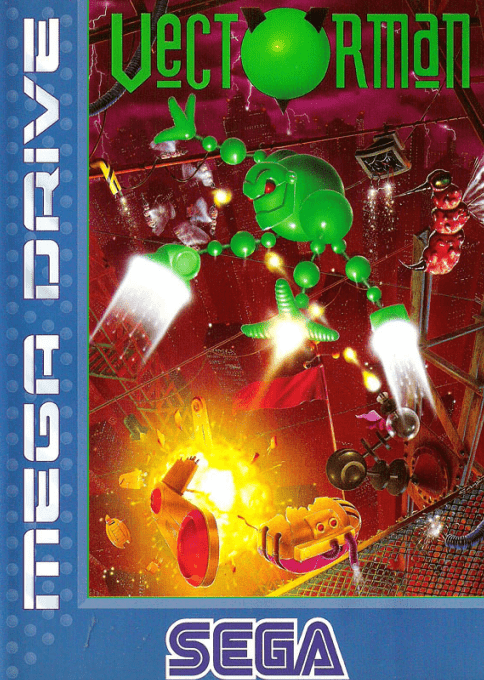
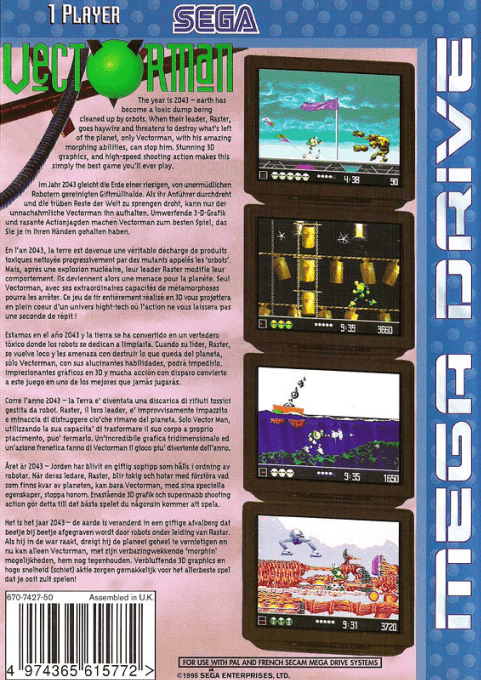
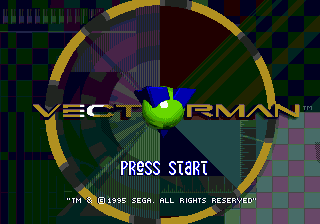
Vectorman for the Sega Genesis/Mega Drive is a 1995 single-player action platformer developed by BlueSky Software and published by Sega. Released in North America in October and in Europe later that year, it arrived late in the 16-bit system's commercial life with a science-fiction setting and an unusually animated robotic hero. The game casts the player as Vectorman, an orbot left behind to help clean an abandoned Earth while humanity searches for other worlds. When the supervisory machine Raster is accidentally linked to a nuclear missile and becomes the tyrannical Warhead, Vectorman returns from a sludge-disposal run to find the planet's other robots under hostile control.
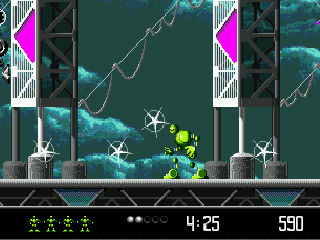
The objective is to guide Vectorman through a sequence of hazardous levels on the way to Warhead. He can run, jump and fire in several directions, giving the game both the forward momentum of a platformer and the constant enemy pressure of a run-and-gun action game. Stages lead through polluted industrial and outdoor environments filled with hostile orbots, traps, platforms and alternate routes. The player must judge jumps, position shots and keep moving while seeking a path to each level's exit before its timer expires.
Vectorman begins with a rapid energy attack, but collectible items change what he can do. Weapon power-ups supply alternatives such as drills and bombs, while damage multipliers make attacks more potent. Health is represented by a row of energy orbs that can be replenished with pickups, so hazards and enemy fire gradually reduce Vectorman's margin for error instead of ending a run immediately. These systems encourage exploration as well as survival: useful items and hidden areas can sit beyond the most direct route, and a lost life sends the player back to restart the current level.
Transformations give several portions of the Genesis game a different rhythm. Depending on the pickup, Vectorman can take forms suited to a particular challenge, including a helicopter that flies and a faster vehicle-like form. These changes are temporary tools rather than a replacement for the basic running, jumping and shooting controls, and they let BlueSky vary movement across the campaign. The game also offers an easier difficulty option after failure, making it possible to continue with a reduced challenge while retaining the same central adventure.
Its visual identity comes from Vectorman himself: rather than being drawn as one fixed character sprite, his body is made from moving spherical pieces. BlueSky used this approach alongside pre-rendered-looking art and smooth animation to create an elaborate presentation within Genesis hardware limits. The result suits the fiction of a machine hero rebuilding himself as he moves through a ravaged world. Jon Holland's electronic score reinforces the futuristic atmosphere, while the detailed environments and animated enemies make the clean-up mission feel like a fight through a malfunctioning automated planet.
Vectorman was a notable late-era Sega Genesis/Mega Drive release, made while newer console hardware was attracting attention. It did not originally launch in Japan, although it later reached Japan through a Windows Sega Smash Pack compilation. Sega subsequently brought the game to several collections and digital services, and it was included on the Sega Genesis Mini. Its direct sequel, Vectorman 2, followed on Genesis in 1996, but the first game remains the introduction to the series: a focused 16-bit journey in which a lone maintenance robot becomes Earth's defense against Warhead's robot regime.
Gallery
Details
- Developer
- BlueSky Software
- Publisher
- SEGA
- Genre
- Platformer
- Players
- 1
- Release Date
- November 30, 1995
- System
- Genesis/Megadrive