About
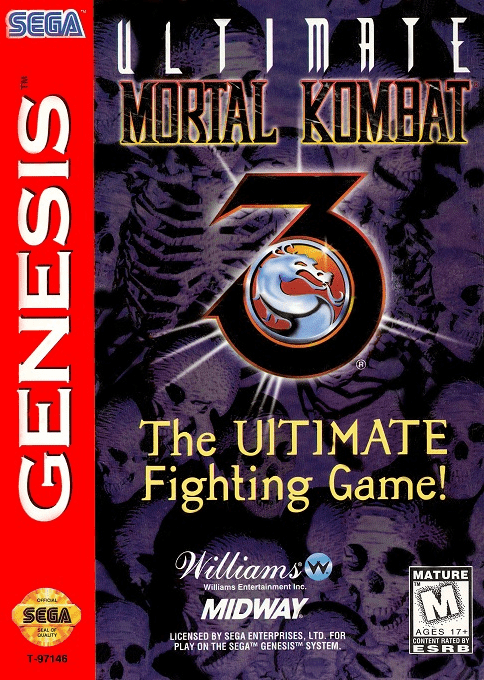
Ultimate Mortal Kombat 3 on Genesis/Mega Drive is the 16-bit home conversion of Midway's expanded 1995 arcade fighter, released in North America by Williams Entertainment on October 11, 1996. Avalanche Software developed the cartridge version, while Acclaim Entertainment published the European Mega Drive release. It returns to the war for Earthrealm as Shao Kahn's invasion draws a wide cast of warriors into rapid, violent one-on-one combat. Rather than a separate sequel in story or engine, Ultimate Mortal Kombat 3 is the substantial revision of Mortal Kombat 3: it restores several fan-favorite ninjas, adds arenas and secrets, and revises the underlying fighting game.
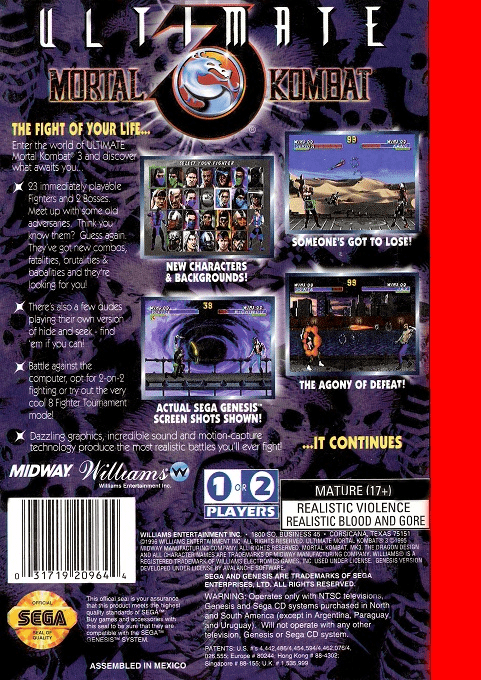
Matches retain the series' recognizable rhythm of high and low attacks, blocks, throws, projectiles, special moves, juggles, and lengthy preset chain combos. Every round can turn on spacing and an opening for a launcher, while familiar fighters bring sharply different tools: Scorpion's spear and teleport, Sub-Zero's ice, Liu Kang's fast pressure, Kitana's fans, Kabal's speed, and the cybernetic fighters' gadgets. The game supports standard one- or two-player battles, a 2-on-2 mode, and an eight-player tournament format. Solo players climb the tower toward Motaro and Shao Kahn, with multiple difficulty settings and Shao Kahn's treasure rewards providing further challenges and secrets after a victory.
The roster mixes the Mortal Kombat 3 cast with returning characters who had been absent from that game, including Scorpion, Kitana, Jade, and Reptile. Genesis players can also choose Mileena, Ermac, and Classic Sub-Zero without entering the arcade version's unlocking codes. The port has a particularly distinctive selection screen: Rain and Noob Saibot are playable here, despite not being normal playable characters in the original arcade release. Human Smoke can be accessed by a match-start code, while Motaro and Shao Kahn can be enabled for two-player fights through the cheat menus. The tradeoff is Sheeva, who is absent from this conversion.
The spectacle after a decisive round remains central to Mortal Kombat. Fighters can perform Fatalities, Babalities, Friendships, and stage-specific finishes when the required conditions and inputs are met. This Genesis edition also includes Brutalities, long attack strings that end by making the opponent explode; these were additions from Mortal Kombat Trilogy incorporated into the 16-bit releases. Its hidden options and Kombat Kodes add character bios, endings, level selection, and other switches to explore, and the cartridge even contains a small Pong-style hidden game called MK4. These extras suit a version built as much for finding secrets with friends as for mastering matchups.
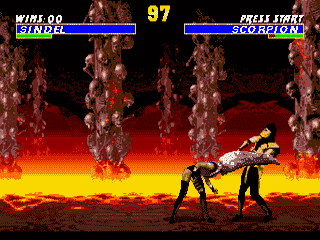
Its battlegrounds draw from both Mortal Kombat 3 and Ultimate Mortal Kombat 3, ranging from the Subway, Bank, Rooftop, Soul Chamber, Kombat Temple, and Pit 3 to Jade's Desert, Kahn's Kave, Scorpion's Lair, and River Kombat. Some settings preserve the series' theatrical hazards and visual storytelling, such as the fiery setting associated with Scorpion, but the Genesis hardware cannot reproduce every arcade transition. In particular, uppercuts in the Subway and Soul Chamber do not carry fighters into an upper level. The port retains more Mortal Kombat 3 stages than the Super NES version, which gives its arena selection a broad, varied feel even as individual scenes are simplified.
The conversion was made from the code of the earlier Genesis Mortal Kombat 3 rather than as a direct arcade recreation. Consequently, its digitized visuals and audio are reduced compared with the coin-op, and it reuses Mortal Kombat 3 music rather than fully reproducing the newer arcade soundtrack. The announcer still calls rounds, but does not announce fighters' names. Several finishing moves were altered to fit the version: Kitana's Kiss of Death uses a head-inflation effect, Scorpion's Hellraiser sends the victim to burn in the Hell stage, and Sonya uses her Mortal Kombat 3 Friendship. Animalities and the Mercy move are not available.
That combination of cuts, carryovers, and exclusive additions makes this more than a simple lesser copy of the arcade game. It is a late-generation Genesis/Mega Drive take on Ultimate Mortal Kombat 3 with its own character balance, familiar rough edges, and a roster unavailable in that form at the arcade. Shang Tsung can morph into Robot Smoke, Rain, and Noob Saibot in this port, and Nightwolf receives a Red Shadow shoulder move later used in Mortal Kombat Trilogy. For players revisiting the 16-bit era, it offers the crowded character select screen, punishing combo play, and secret-hunting spirit that made the third Mortal Kombat generation such a major event.
Gallery
Details
- Developer
- Midway
- Publisher
- Acclaim
- Genre
- Fighting
- Players
- 1-2
- Release Date
- January 1, 1996
- System
- Genesis/Megadrive