About
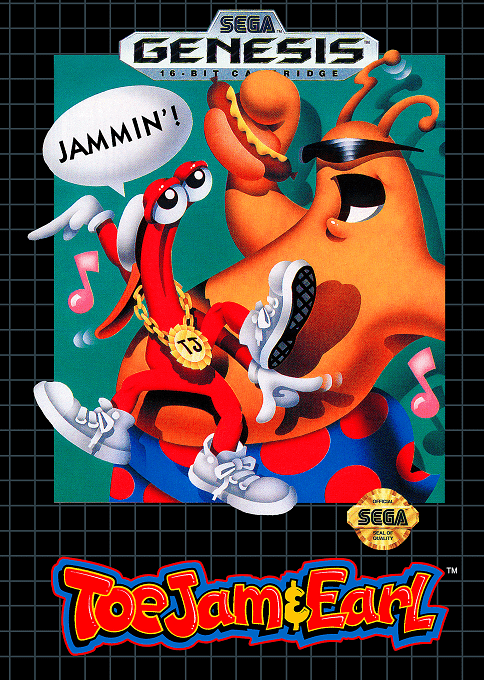
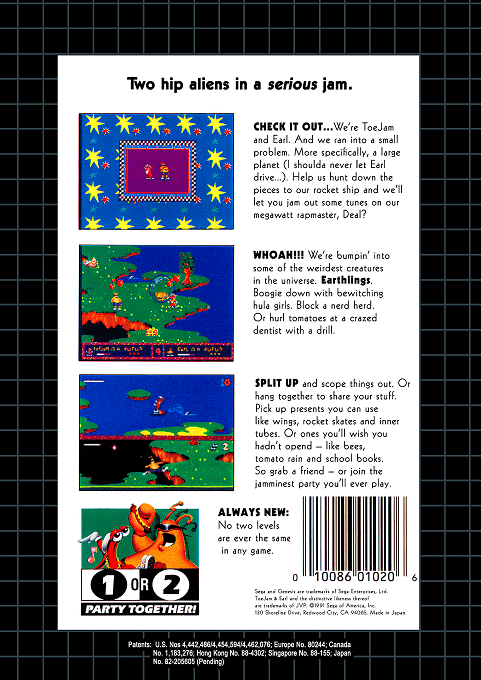
ToeJam & Earl Genesis is a 1991 action-adventure game developed by Johnson Voorsanger Productions and published by SEGA for the Sega Genesis/Mega Drive. The game introduces ToeJam and Earl, two aliens from Funkotron whose rocketship breaks apart after a disastrous trip to Earth. Their way home is simple in principle but unpredictable in practice: recover all ten pieces of the wreckage scattered across the planet's strange floating levels. The result is an offbeat exploration game built around improvisation, cartoon danger, and a funk-inflected sense of humor.
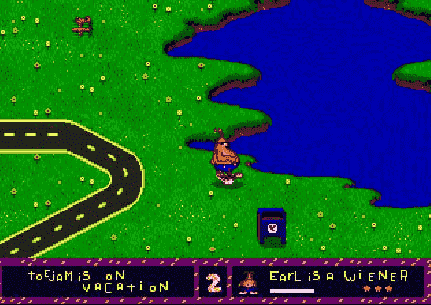
Players choose either the quick, three-legged ToeJam or the sturdier Earl, then move across each level from an angled overhead view. Elevators lead upward through the world, while a careless step over an edge drops a character down to the level below. The immediate goals are to search the terrain, locate elevators, find useful objects, and collect each ship part. Not every level contains a component, so the map and the arrival hints are important tools for keeping track of the expedition.
A major part of ToeJam & Earl is learning what its wrapped presents do. Their designs remain consistent during a run after their contents have been discovered, but an unopened package can bring help, trouble, or a temporary effect. Items can provide capabilities such as spring shoes, Icarus wings, or tomatoes, while food may restore health or cause harm. Money also has a purpose, because some of Earth's inhabitants offer services for a fee. This system makes deciding when to test an unfamiliar present as important as navigating the next island.
Earth is populated by bizarre hazards and occasional helpers rather than a conventional army of enemies. Players may encounter threats including groups of Nerds, giant hamsters, Bogeymen, hostile mailboxes, and produce-launching chickens. Direct confrontation is not the focus. ToeJam and Earl can sneak past sleeping Earthlings, use items to escape a bad situation, or take advantage of the environment as they explore. The characters' Coolness Rank adds another light role-playing-style layer to their progress through the adventure.
The Genesis controls keep the essentials close at hand: the directional pad moves the selected character, one button is used for sneaking and activating presents, and the other face buttons open the map and present list. Before starting, players can select a Random World, where the layout changes from game to game, or a Fixed World with a repeatable arrangement. That choice, combined with unidentified presents and shifting item placement, gives each journey a different rhythm while retaining the same objective of rebuilding the rocketship.
ToeJam & Earl Genesis supports one or two players. In cooperative play, each person controls one alien simultaneously. The display stays together when the partners are nearby and splits in two when they travel apart, allowing independent exploration without forcing either player to wait. Staying close still has benefits: partners can share health with a high five, and a present opened while both are on the same screen affects both characters. The split-and-merge presentation makes cooperation part of the game's design rather than merely an added mode.
This is the original Genesis entry in the ToeJam & Earl series, not the 1993 side-scrolling sequel ToeJam & Earl in Panic on Funkotron or the later Back in the Groove follow-up. Its blend of procedurally arranged exploration, item identification, two-player cooperation, and a playful early-1990s style established the duo's distinctive identity. For Genesis and Mega Drive players, it remains a singular trip through an Earth that is far stranger than the aliens who landed on it.
Gallery
Details
- Developer
- SEGA
- Publisher
- SEGA
- Genre
- Platformer
- Players
- 1-2
- Release Date
- October 15, 1991
- System
- Genesis/Megadrive