About
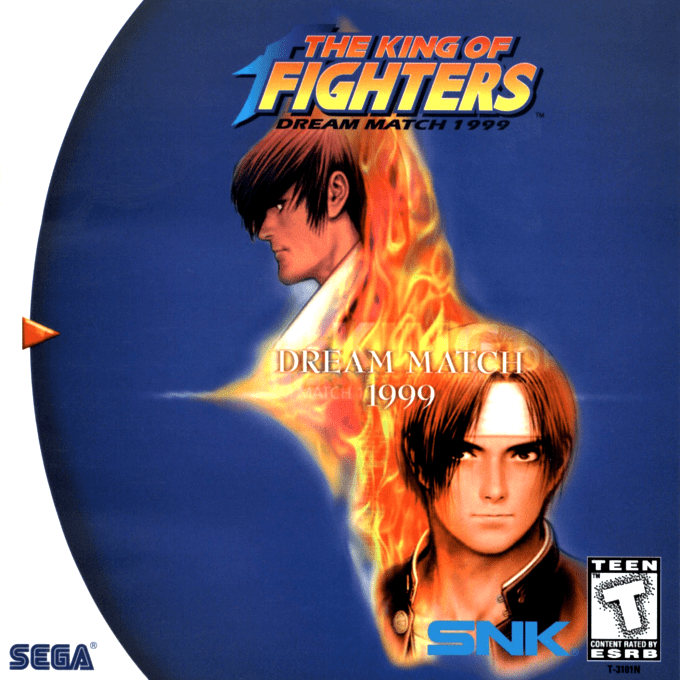
The King of Fighters Dream Match 1999 Dreamcast is SNK's 1999 home-console version of The King of Fighters '98, the all-star 2D fighter that followed the conclusion of the series' Orochi storyline. Released first in Japan for Sega's Dreamcast and later in North America, it is not the arcade game The King of Fighters '99 or the later Dreamcast release The King of Fighters: Evolution. Instead, Dream Match 1999 brings KOF '98's tournament-style battles and exceptionally broad returning cast to Sega's hardware, with a newly tailored presentation and console extras.
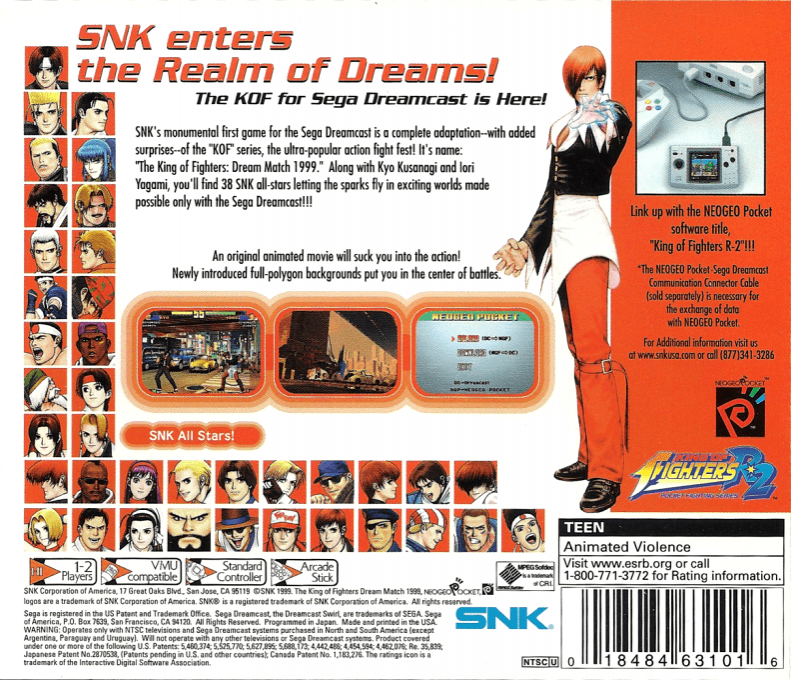
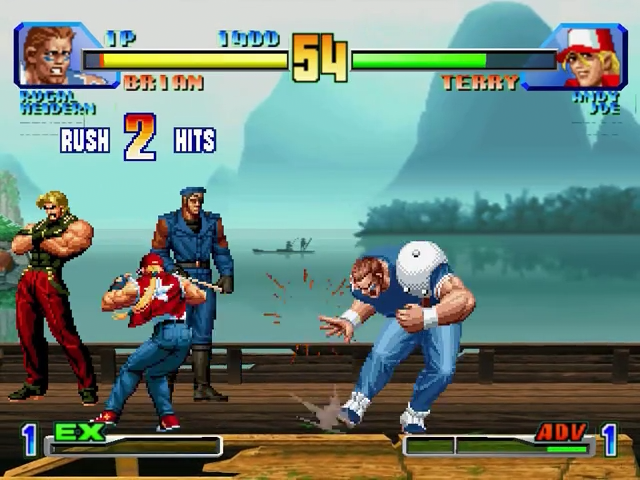
Matches use the classic King of Fighters format: choose three combatants, decide their order, and eliminate the opposing team one fighter at a time. The roster draws from the early years of the series, so familiar faces from the Japan, Fatal Fury, Art of Fighting, Ikari Warriors, Psycho Soldier, Women Fighters, Orochi, and other teams can meet in combinations the story-driven entries did not always permit. Kyo Kusanagi, Iori Yagami, Terry Bogard, Mai Shiranui, Ryo Sakazaki, Leona, Athena Asamiya, and many other SNK regulars each retain their own normal attacks, command moves, throws, special techniques, and Super Special Moves.
The Dreamcast controller maps movement, jumping, crouching, guarding, and the four strengths of punch and kick to the directional pad and face buttons, while button configuration is available in the options. At the start of a match, players select either Advanced or Extra control mode. Both preserve the series' focus on building and spending power for stronger attacks, but the systems handle gauge management and tactical options differently. This makes team selection only one part of the strategy: a player can choose characters and an energy system that suit their preferred approach to movement, pressure, counters, and high-damage special attacks.
Dream Match 1999 offers computer and local competitive play in both team and single-character forms. Team Play and Single Play handle solo battles, while Team VS and Single VS support two players. A second controller can also join an eligible one-player battle through the game's Burst-In feature. Survivor mode turns the formula into a time attack in which one selected character faces the cast with a life gauge that does not fully refresh between fights. Practice mode lets players set an opponent's stance, guarding, counters, and attack behavior, making it useful for learning commands and testing situations before a versus match.
Although its fighting engine remains rooted in the Neo Geo original, this is a purpose-built Dreamcast edition rather than a straight cartridge conversion. SNK replaced the original backdrops with stages that combine the series' 2D fighters with polygonal scenery, and added an animated opening produced with Digimation's cooperation. The game also includes Dreamcast-oriented configuration and save support, selectable stages for two-player games, a gallery of visual material, and a sound player. These additions frame the same character-driven clashes in a presentation designed around the newer console.
One of the version's more unusual features is its connection to SNK's Neo Geo Pocket title King of Fighters R-2. With the separate Neo Geo Pocket-Sega Dreamcast communication cable, Dream Match 1999 can exchange data with R-2. Victories in the Dreamcast game award character points, and qualifying points can provide skills for use in R-2's Making Mode; data sent back from the portable game can also unlock hidden images in Dream Match 1999. It is a small but revealing example of SNK linking its arcade-style fighting series across its home console and handheld systems.
Dream Match 1999 is therefore best understood as an expanded 1999 Dreamcast showcase for KOF '98, not a new chapter in the NESTS-era story that began with KOF '99. Its appeal comes from the deliberately celebratory premise: a large selection of fighters from the franchise's earlier games can be arranged into three-person teams without a new central plot dictating the lineup. For Dreamcast players, the result is a fast local fighting game whose console-specific stages, modes, animated introduction, and Neo Geo Pocket connection distinguish it from the original 1998 Neo Geo release.
Gallery
Details
- Developer
- SNK
- Publisher
- SNK
- Genre
- Fighting
- Players
- 1-2
- Release Date
- October 16, 1999
- System
- Dreamcast