About
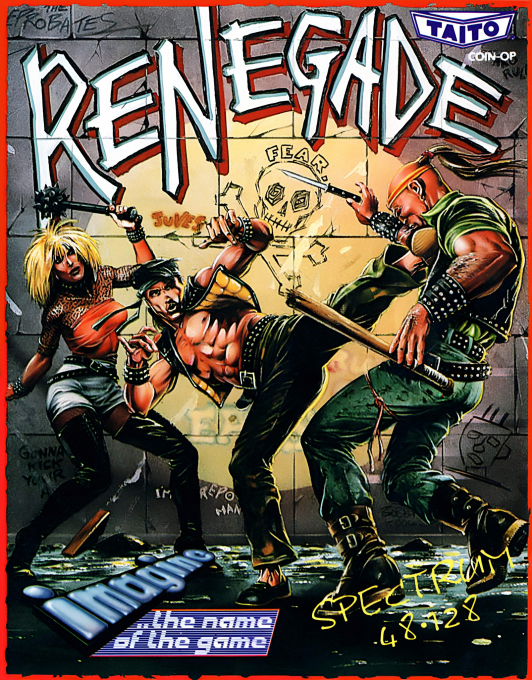
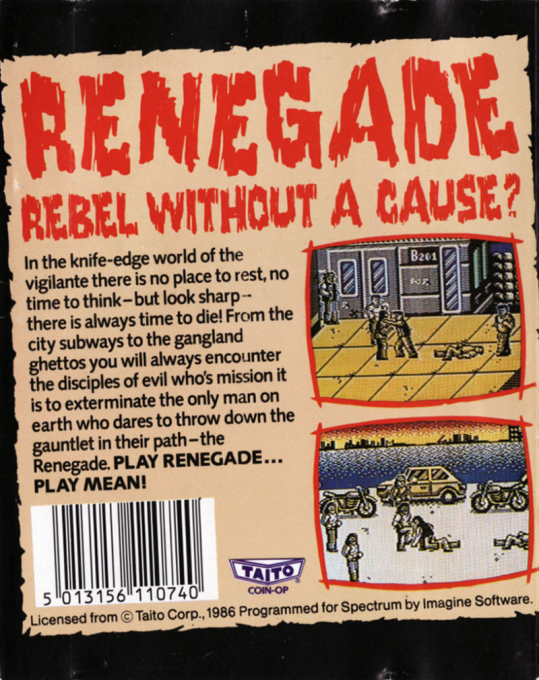
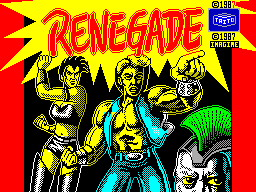
Renegade ZX Spectrum is Imagine Software's 1987 adaptation of Taito's 1986 arcade street-fighting game, licensed for European home computers through Ocean. Programmed for the Spectrum by Mike Lamb, with graphics by Ronnie Fowles and music by Fred Gray, it recasts the arcade brawler for the 48K and 128K machines. The story places a lone fighter on a hazardous nighttime journey to meet his girlfriend Lucy, taking him from a subway stop through gang-controlled parts of town. It is a one-player beat-'em-up built around clearing hostile streets before time runs out.
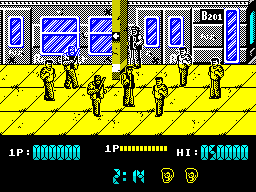
The Spectrum version uses a single horizontal plane with room to move up and down as well as left and right, letting attacks depend on the fighter's position relative to an opponent. Keyboard controls can be redefined, and Kempston and Sinclair-style joystick options are supported. Rather than duplicate the arcade cabinet's three action buttons, the conversion combines directional input with its jump/hit command to produce punches, rear kicks and flying kicks. Getting close to a staggered enemy also opens the way for knees and attacks on a floored opponent, so spacing and timing matter as much as simply facing the next attacker.
Progress is organized as a succession of fixed Spectrum screens rather than the arcade machine's continuous scrolling arenas. Each section has a timer, a player energy bar and, once the gang leader enters, a separate boss-energy display. The leader only joins after enough accompanying thugs have been beaten, which turns every encounter into a short battle of crowd management followed by a tougher finish. A player who exhausts his energy or misses the time limit loses a life; clearing the full route awards a bonus and returns the game to the beginning at a higher difficulty.
The journey begins in the Subway, where armed and unarmed muggers test the basic fighting moves. At the Pier, motorcycle riders attempt to run the player down before the fight continues against ordinary bikers and crowbar carriers. Sleezy Street changes the opposition to a women-led gang equipped with clubs and whips, culminating in Big Bad Bertha. The later street section is deliberately more perilous: razor-wielding foes can defeat the player with a single touch, making avoidance and positioning especially important. The 128K edition adds the Interior finale, where more of the gang and its gun-carrying leader stand between the fighter and his meeting with Lucy.
Those locations follow the Western Renegade scenario rather than the Japanese school-delinquent setting of Technos Japan's Nekketsu Kōha Kunio-kun. They also distinguish this Spectrum release from the substantially redesigned NES and Master System versions. The conversion was made for a machine whose releases commonly relied on a joystick and one fire button, and its input scheme and flip-screen structure reflect that hardware context. It remains a solo game; the later British follow-up Target: Renegade, not this original conversion, introduced a simultaneous two-player option.
Renegade ZX Spectrum arrived during the home-computer boom as one of several licensed versions of an influential arcade format. The original game helped establish the free-moving street-brawl style later associated with beat-'em-ups, while Imagine's Spectrum edition translated its gangs, bosses and close-range combat into a compact home-computer design. Its 1987 release was followed by Ocean/Imagine sequels Target: Renegade and Renegade III: The Final Chapter, but those were separate home-computer continuations rather than additional arcade installments from Technos.
Gallery
Details
- Developer
- Imagine
- Publisher
- Imagine
- Genre
- Beat 'em Up
- Players
- 1
- Release Date
- January 1, 1987
- System
- ZX Spectrum