About
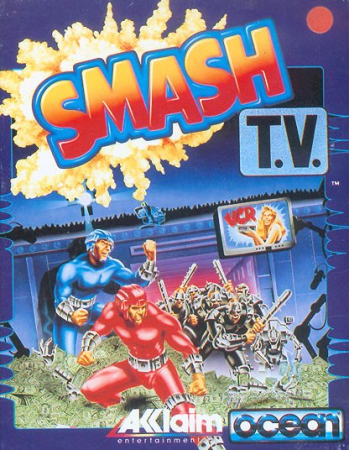
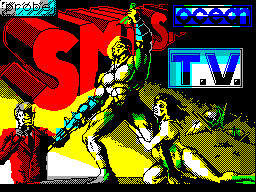
Smash T.V. for ZX Spectrum brings Williams Electronics’ 1990 arcade hit to the British home-computer scene in a 1991 release from Ocean Software. Developed by Probe Software, the conversion was programmed by David Perry and Nick Bruty. It adapts the original game’s knowingly lurid dystopian game-show premise: in the then-future year 1999, contestants enter a televised contest where survival, cash and conspicuously consumerist prizes are earned by blasting through lethal studio arenas.
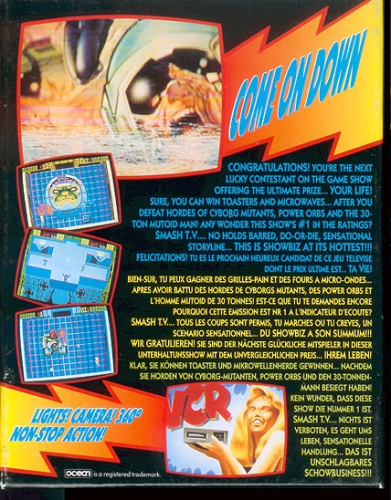
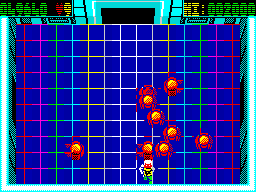
The Spectrum game is an arena shooter built around pressure, movement and fast decisions. Each room becomes a sealed combat space as enemies pour in from routes around the screen. The player must clear the attacking creatures, robots and hazards before an exit can open, then decide which route to take into the next section. That simple structure makes every screen an immediate fight for positioning rather than a slow exploratory level.
Its central challenge comes from the arcade design created by Eugene Jarvis and Mark Turmell, whose earlier Robotron: 2084 established the model of shooting in one direction while moving in another. On the ZX Spectrum, the conversion preserves the feel of directing a contestant through dense enemy waves while gathering dropped cash, gift-wrapped prizes and useful temporary pickups. Extra weapons, bombs, shields and other advantages can briefly change the odds, but the action quickly returns to the need to dodge and keep firing.
The television-show setting supplies the game’s character as well as its jokes. Big prizes such as appliances and luxury goods parody the rewards offered by popular entertainment, while the competition itself is unapologetically violent. The arcade game’s scenario drew on the dystopian media satire of films including RoboCop and The Running Man, and its aggressive show-business tone survives in the home conversion. Smash T.V. therefore works as both a high-speed shooter and a darkly comic exaggeration of a ratings-driven future.
Probe’s Spectrum version was designed to make the coin-op’s busy single-screen battles work within an 8-bit machine’s constraints. It supports 48K Spectrum hardware, with a version optimized for 128K models, and was sold on cassette. Contemporary documentation credits Perry for the Spectrum and Amstrad work, while the game’s production credits identify Probe as developer and Ocean as publisher. The result concentrates on the rooms, enemy swarms and prize-chasing rhythm that defined the source rather than trying to reproduce every arcade feature unchanged.
That concentration impressed the specialist press. CRASH reviewed the Spectrum release in late 1991, awarding it 97 percent and a Crash Smash award, with particularly strong marks for playability and overall presentation. The review praised the conversion’s speed and regarded it as a close recreation of the Williams coin-op despite the platform’s memory limitations. For ZX Spectrum players, Smash T.V. remains a celebrated example of Ocean and Probe translating an intense arcade shooter into a compact home-computer game without losing its frantic competitive spirit.
Gallery
Details
- Developer
- Probe Software
- Publisher
- Ocean
- Genre
- Run and Gun
- Players
- 1
- Release Date
- January 1, 1991
- System
- ZX Spectrum