About
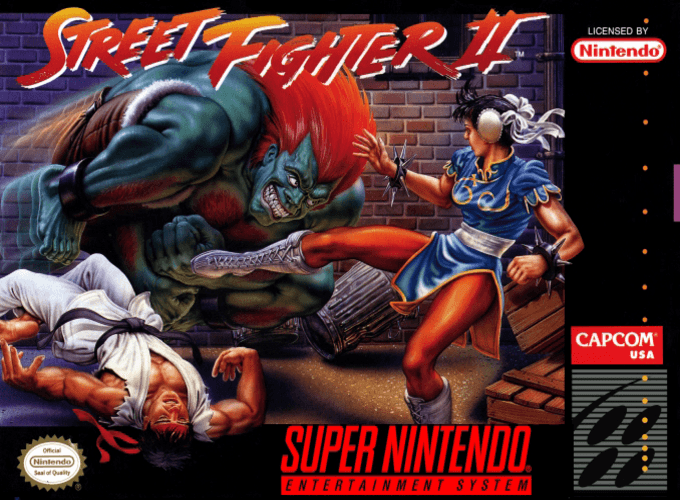
Street Fighter II SNES brings Capcom's landmark one-on-one fighting game to the Super Nintendo Entertainment System in 1992. Released first for Japan's Super Famicom in June before arriving in North America that August, this home version adapts the 1991 arcade game Street Fighter II: The World Warrior. Capcom developed and published the conversion, which made the tournament's international cast and precise six-button combat a major part of the 16-bit console era.
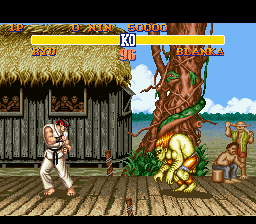
The basic contest is direct: choose a fighter, face an opponent in a best-of-three series of timed rounds, and reduce the rival's vitality gauge before the clock expires. A player wins the round by scoring a knockout or by holding more remaining energy when time runs out. Street Fighter II supports solo play against the computer and head-to-head matches for two players; while working through the single-player tournament, a second player can interrupt to issue a challenge, with the winner continuing on.
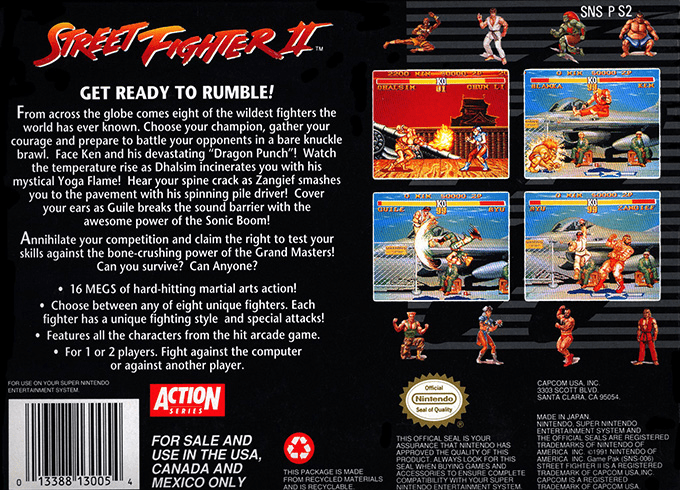
Its eight selectable World Warriors are Ryu, Ken, Chun-Li, Guile, Blanka, E. Honda, Zangief, and Dhalsim. Each has a different fighting style, nationality, stage, and special techniques, so the fireball-focused spacing of Ryu and Ken plays very differently from Zangief's close-range wrestling throws or Dhalsim's long-reaching limbs. In the single-player route, the chosen fighter battles the other regular competitors before meeting the four computer-controlled Grand Masters: Balrog, Vega, Sagat, and M. Bison. The character names of those bosses differ in Japan, a regional localization detail that has remained notable within the series.
Street Fighter II on Super NES uses the controller's directional pad for movement, jumps, crouching, and guarding, with light, medium, and heavy strengths assigned across punches and kicks. Stronger attacks normally trade speed for damage, while positioning affects the move that comes out. Throws, sweeps, jumping attacks, and signature command moves add a strategic layer beyond simple exchanges. Directional inputs combined with attack buttons produce techniques such as Ryu and Ken's Hadoken and Shoryuken, Chun-Li's rapid Lightning Kicks, Guile's Sonic Boom, and other character-specific attacks. Correctly timed hits can link together, rewarding players who learn the timing and range of their fighter's options.
The tournament moves between distinctive international backdrops, and the solo mode breaks up bouts with bonus rounds that ask players to smash a car, barrels, or oil drums for points. The SNES edition retains the original arcade roster rather than the later revisions' ability to select the four bosses. It does, however, include a hidden code that lets both players use the same fighter, distinguished by alternate colors. That distinction matters when identifying this release: Street Fighter II SNES is the foundational home conversion of The World Warrior, while later Street Fighter II editions expanded the roster, altered balance, or raised the game speed.
As the second main entry in Capcom's Street Fighter series, this version helped establish the template for competitive 2D fighters at home. Its match structure, contrasting character toolsets, special-move inputs, and local versus play encourage repeat sessions as players compare tactics and master favorite combatants. The Super NES release is therefore both a substantial arcade conversion and an early console showcase for the face-to-face competition that became central to the wider Street Fighter legacy.
Gallery
Details
- Developer
- Capcom
- Publisher
- Capcom
- Genre
- Fighting
- Players
- 1-2
- Release Date
- June 10, 1992
- System
- SNES
/Kuusou_Kagaku_Sekai_Gulliver_Boy.png)