About
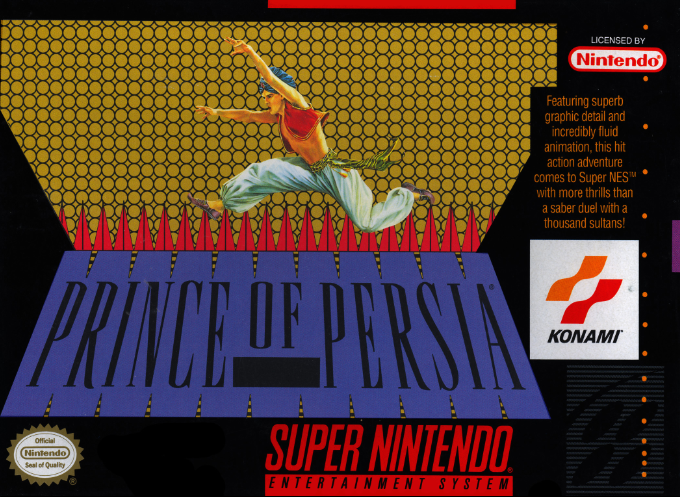
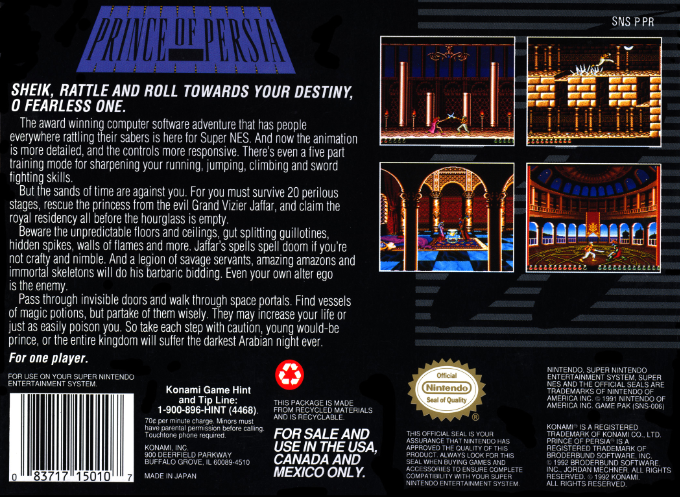
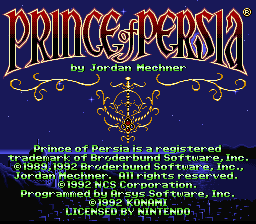
Prince of Persia for the Super Nintendo Entertainment System is a 1992 cinematic platform game developed by Arsys Software and published by Konami in North America and Europe. It adapts Jordan Mechner's original palace-escape adventure for the 16-bit console while expanding the challenge for a single player. In medieval Persia, the Sultan is away at war when the Grand Vizier Jaffar takes control. He imprisons the Princess and gives her an ultimatum, while the unnamed Prince is cast into the palace dungeon. The mission is clear from the opening: escape, reach Jaffar's tower, and rescue the Princess before the deadline expires.
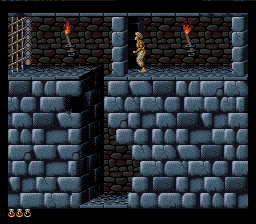
The SNES Prince of Persia unfolds across a chain of screen-by-screen dungeon and palace areas built around timing, observation, and deliberate movement. The Prince runs, walks, crouches, makes standing or running jumps, clings to ledges, and lowers himself from platforms. Each room can conceal a route forward, a pressure plate, or an immediate danger. Loose floor tiles, deep drops, spikes, closing gates, and slicing traps make reckless movement costly. A fall or hazard can send the player back to the start of the current stage, yet the clock continues to run, making every failed attempt part of the larger race rather than a consequence that can simply be erased.
Sword fighting adds another layer to the journey once the Prince has found his weapon. Encounters with Jaffar's guards are close-range duels in which position and timing matter: the player can advance, retreat, attack, and parry, watching both combatants' health. Direct combat is not the only answer in a palace full of traps, and the level design regularly asks players to consider the room around an opponent as carefully as the opponent himself. Health is represented by a row of units, with potions offering recovery or, in some cases, a dangerous surprise. This combination of precision platforming, environmental puzzles, and tense swordplay gives each new passage a practical purpose in the rescue.
The Super NES release is more than a straight replay of the earlier game. Arsys Software reworked the presentation for the system and added stages, enemies, traps, and music, producing a longer version with a 120-minute limit rather than the original game's one-hour rescue window. The extra time does not remove the pressure; it supports a larger route through the fortress and a denser sequence of hazards. Progress is recorded with passwords, so players can return to the adventure, but success still depends on managing the timer within a run. In Japan, the game was issued by Masaya/NCS, while Konami handled the North American and European releases.
Prince of Persia SNES remains closely tied to the qualities that defined the series' first game: animated movement that demands commitment, a villainous countdown, and a dungeon escape that turns simple actions into calculated risks. The Prince's movement has a measured, physical feel, so learning the distance of a jump or the recovery after a landing is as important as reacting quickly. Its expanded console design preserves the central contest against Jaffar while giving Super Nintendo players a distinctive version of the classic adventure, one where the Princess's fate, the palace's traps, and the remaining minutes are always connected.
Gallery
Details
- Developer
- Arsys Software
- Publisher
- Konami
- Genre
- Platformer
- Players
- 1
- Release Date
- November 1, 1992
- System
- SNES