About
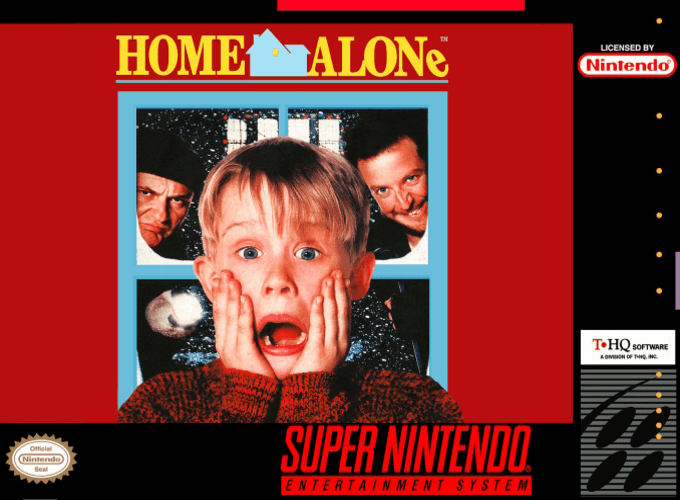
Home Alone for Super Nintendo Entertainment System turns the premise of the 1990 Christmas film into a tense single-player action adventure. Kevin McCallister has been left at the family house while the Wet Bandits, Harry and Marv, search for valuables. Rather than retell every scene from the movie, this 1991 console version asks Kevin to secure the McCallister possessions before the burglars can catch him. It is one of several very different Home Alone games released for early-1990s systems, so its mix of house exploration, item collection and basement danger should not be confused with the separate NES, computer, Sega or Master System adaptations.
The Super NES game was developed by Imagineering and released in North America by THQ, with Altron handling the Japanese release. It arrived during the first Christmas season after the film had become a major hit and uses the license’s familiar setting, characters and mischievous spirit as its foundation. Kevin is represented in a side-view house full of rooms, stairways, furniture and hazards. The goal gives the game an unusual priority for a film tie-in: success depends less on defeating every enemy than on moving carefully through a large domestic space while protecting what matters.
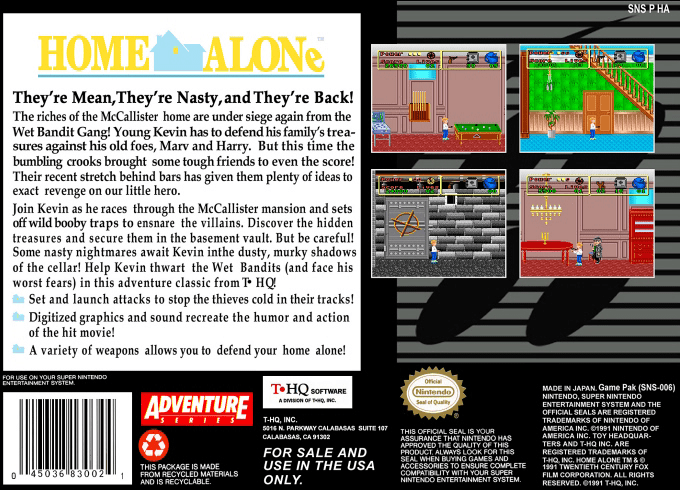
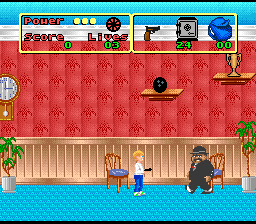
At the start of a run, Kevin searches the house for family valuables and sends them down a laundry chute to the basement safe room. Each object recovered brings the mission closer to completion, but the Wet Bandits patrol the home and contact with them is a serious threat. The arrangement makes route planning important. Players need to learn where valuables and exits lie, decide when to retreat toward the chute and avoid letting the burglars cut off a path through a room. The house becomes both the setting for a comedy and the game’s central maze, with familiar household spaces recast as an obstacle course.
Kevin is not entirely helpless. He can use a slingshot and a water pistol, and the environment supplies practical traps inspired by the film’s emphasis on improvised defense. A banana peel can send a pursuing burglar sliding, while objects such as bowling balls can be positioned to drop on an opponent. These tools create moments of slapstick retaliation, but they do not remove the need for caution. Ammunition, placement and timing matter, and the bandits remain a persistent pressure while Kevin gathers the required goods. That balance gives Home Alone a chase-game rhythm: explore, collect, escape, set up a brief advantage and keep moving.
Once the valuables have been deposited, the adventure shifts below the house. Kevin must make his way through the basement, facing hazards that include rats, bats, spiders and ghosts, before reaching the safe room and confronting the final obstacle. This change of setting reflects the film’s memorable basement anxiety while providing a more overtly hostile end section than the upstairs search. It also means that simply meeting the collection requirement is not the finish line. The player still has to preserve enough composure and resources to complete the descent and lock the family riches away.
Home Alone on SNES is best approached as a distinct 16-bit interpretation of the movie rather than as a conventional platform game. Its appeal lies in turning a well-known holiday premise into a compact survival-and-collection challenge, where the McCallister home is packed with routes, valuables and comic dangers. The game is a useful example of how licensed releases of the era could differ radically across platforms: this version shares Kevin, Harry, Marv and the basic story with its contemporaries, yet its specific objectives, weapons, traps and basement finale belong to the Super NES and Game Boy design. For retro players and collectors, it preserves a particularly direct attempt to make Home Alone’s cat-and-mouse fantasy playable.
Gallery
Details
- Developer
- Altron
- Publisher
- THQ Software
- Genre
- Platformer
- Players
- 1
- Release Date
- December 2, 1991
- System
- SNES