About
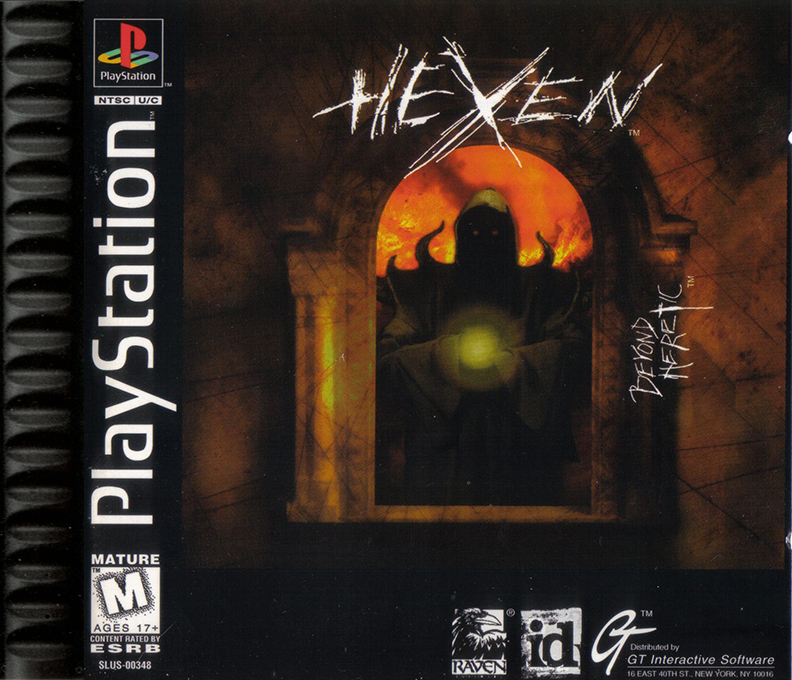
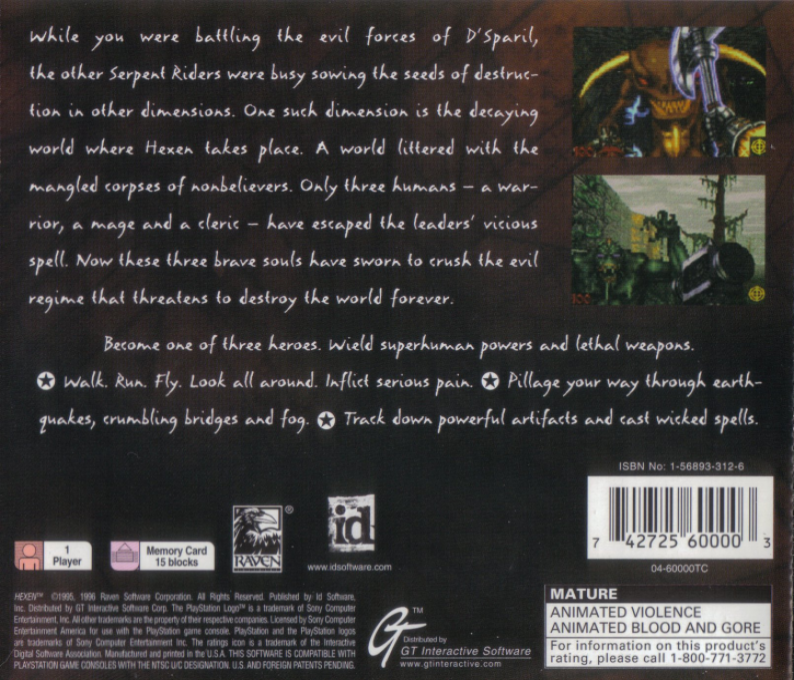
Hexen on PlayStation brings Raven Software’s dark fantasy first-person adventure to Sony’s 32-bit console. Set after Heretic, the campaign sends one hero into the ravaged world of Cronos to oppose Korax, a Serpent Rider whose rule has turned castles, crypts, forests, and elemental strongholds into hostile territory. It is a game of shadowy corridors, snarling monsters, secret walls, and ominous ambient sound, but its identity comes from asking the player to think beyond simply clearing every room.
Before the quest begins, choose one of three very different heroes. Baratus the Fighter is built for direct, close-range violence; Parias the Cleric sits between physical force and magical attack; Daedolon the Mage favors ranged spells but is less durable. Their weapons, strengths, and item effects vary by class, making the same route feel different on another playthrough. Each class can assemble a powerful ultimate weapon from three pieces: Quietus for the Fighter, Wraithverge for the Cleric, and Bloodscourge for the Mage.
The PlayStation game keeps Hexen’s distinctive hub structure. Rather than moving through a simple line of stages, players return to central areas and revisit connected levels as keys, switches, artifacts, and newly opened paths reveal the way forward. Teleporters link spaces within and between levels, while poison darts, crushing walls, spikes, collapsing bridges, bottomless pits, and other traps make exploration as dangerous as combat. Breakable windows, hidden passages, inventory items, and the automap reward a careful search of every room.
Its PlayStation controls are designed around the standard digital pad. The D-pad moves, X runs, Circle opens doors and activates switches, Square jumps, Triangle fires, and L1 or R1 strafes. R2 acts as a Shift button for extra functions, including using the selected inventory item with Circle, changing weapons with Triangle, and looking with X plus the D-pad. L2 plus the D-pad cycles inventory, while Select opens the map. The layered layout takes some adjustment, especially when lining up jumps or reacting to an ambush, but it puts Hexen’s movement, combat, map, and inventory tools on one controller.
This edition is a single-player adventure: it has neither Multi-Tap nor link-cable play. That matters because Hexen is often remembered alongside versions with multiplayer options. The original PC release supports network play, the Saturn version contains a two-player link-up cooperative and deathmatch mode, and the Nintendo 64 version offers four-player split-screen cooperative and deathmatch games. None of those modes are part of the PlayStation release, so this port is best approached as a solitary expedition through Cronos.
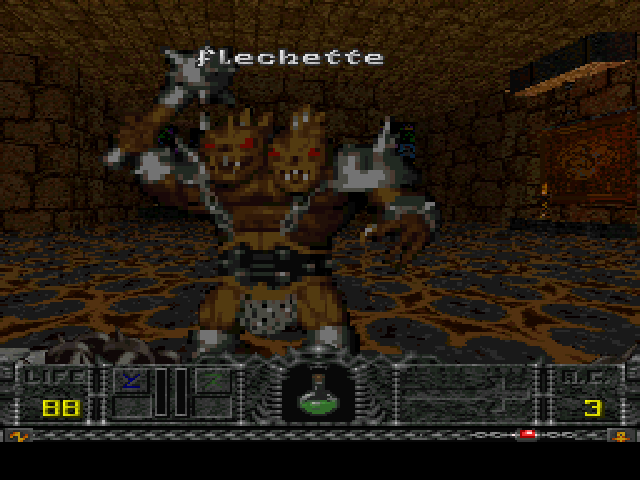
Probe Entertainment developed the PlayStation conversion, published by GT Interactive in 1997. It retains the full level set and the core layouts of the computer game, along with the CD-era full-motion-video scenes and Red Book music. The trade-off is a more compromised presentation: scenery detail and lighting are reduced, animation and scripting run more slowly, enemies use fewer viewing angles, and powerful kills do not display the gore seen in other versions. The result is recognizably Hexen, but tailored to the limits of the hardware.
The other console ports are not interchangeable with this one. The Saturn version shares many of the PlayStation version’s visual restrictions but has somewhat faster scripting and a slightly better, if still uneven, frame rate. Nintendo 64 Hexen takes a different path, with smoother filtering, stronger scenery detail, four-player split-screen, and new level introductions, but it omits the PlayStation and Saturn FMV and CD audio in favor of the original PC floppy version’s music. The PlayStation release therefore has its own mixture of CD presentation and technical concessions.
For players who enjoy first-person games with puzzles, route planning, and a grim fantasy atmosphere, Hexen offers more than a conventional corridor shooter. Choosing a class changes the rhythm of battle, while the hub-based campaign turns progress into a long chain of clues, keys, switches, and remembered locations. On PlayStation, the slower response and button-heavy control scheme make patience especially useful, but the appeal remains intact: a dense, eerie quest where discovering how a place works can be as important as surviving the creatures inside it.
Gallery
Details
- Developer
- Probe Entertainment
- Publisher
- GT Interactive Software
- Genre
- First-Person Shooter
- Players
- 1
- Release Date
- June 30, 1997
- System
- PS1