About
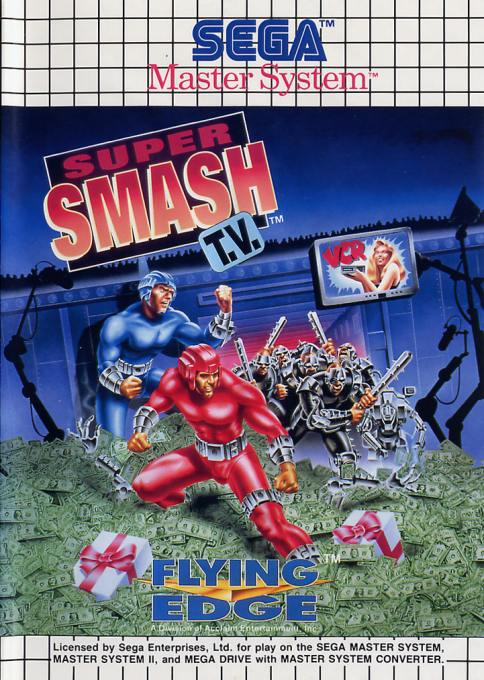
Super Smash T.V. for Sega Master System is a 1992 top-down arena shooter developed by Probe and published by Flying Edge. It adapts Williams Electronics' 1990 arcade game Smash TV for Sega's 8-bit console, retaining the deliberately exaggerated premise of a televised contest set in the then-future year 1999. One or two contestants enter a succession of sealed combat rooms, where survival, prize money and the status of Smash TV champion are all on the line. The Master System version is titled Super Smash T.V., as are several other Sega and Nintendo home conversions, but it is a separate adaptation rather than the original coin-operated game.
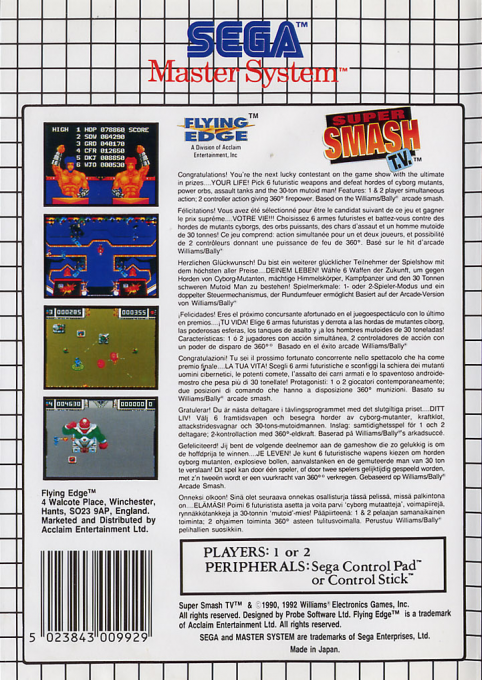
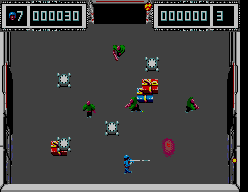
The basic routine is immediate: guide a contestant around a single-screen arena and shoot the enemies pouring in from entrances around its edges. Hostile crowds, armed attackers, robots and larger threats turn each room into a short endurance test. Destroying every enemy opens exits to the next arena; choosing an exit determines the route through the wider stage layout, and the stages culminate in boss encounters. A map between rooms shows the course ahead, while completed rooms cannot be revisited, so movement through the game is a forward push toward the end of each section.
Cash piles and wrapped prizes appear amid the fighting, matching the game show's promise of “big money” and household rewards. Temporary weapon pickups add more firepower and make rapid clearing of a crowded room possible, but players must keep moving to avoid contact and incoming attacks. Keys are also part of the progression system, with collecting enough of them tied to access to the Pleasure Dome bonus area. The absurd reward-driven setup and a relentless announcer give Super Smash T.V. its dark game-show character, even as its play is built around fast reactions and arena control.
The arcade Smash TV was designed around two joysticks, allowing a player to move in one direction while firing in another. That control idea is central to the game, and the Master System's standard pad has only a directional control and two action buttons, so Probe provided control options to fit the conversion to the hardware. Contemporary coverage also lists two-player support. As a result, the Master System release preserves the cooperative contest structure: two players can battle through rooms together, collect prizes along the way and compare their haul at the end of a stage.
This 8-bit version belongs to a broad group of Smash TV home conversions that also reached systems including NES, Game Gear, Mega Drive/Genesis and Super NES, each confronting the arcade game's distinctive twin-stick design in different ways. The Master System edition was released late in the console's commercial life and pairs the arcade premise with a more constrained home format. Its focus remains recognizably Smash TV: clear an arena, select the next door, pursue useful pickups and endure increasingly busy screens of enemies.
Super Smash T.V. also sits beside Williams' related arcade action game Total Carnage, released in 1992 and programmed by Mark Turmell, one of Smash TV's original arcade creators. The two games share an emphasis on intense, room-by-room shooting, although Total Carnage is not a direct sequel. For Master System players, Super Smash T.V. represents Probe's interpretation of the Williams game-show shooter: a two-player-capable top-down action game built around branching arena routes, prize collecting and the challenge of surviving one more room.
Gallery
Details
- Developer
- Probe Software
- Publisher
- Flying Edge
- Genre
- Run and Gun, Shoot 'em Up
- Players
- 1-2
- Release Date
- October 1, 1992
- System
- Master System