About
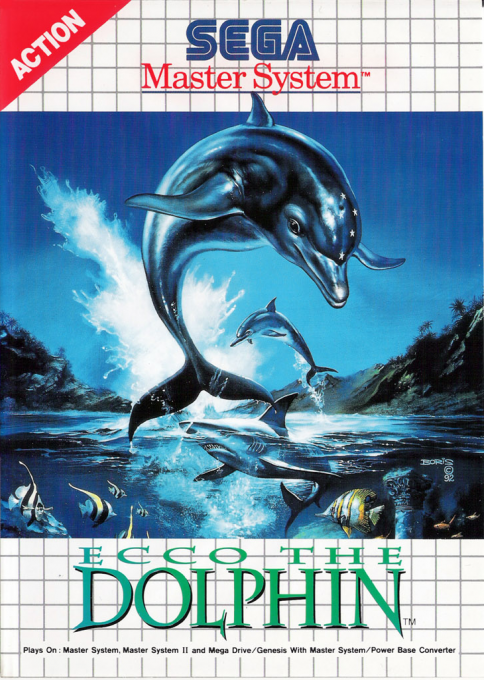
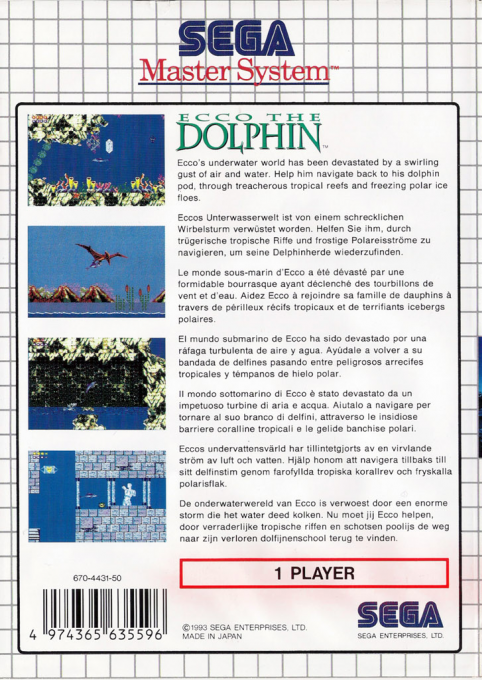
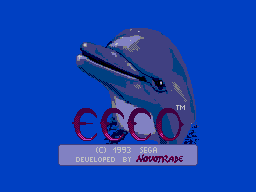
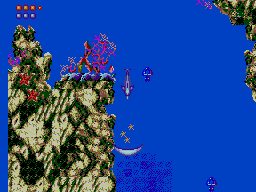
Published by Sega in 1993 for the Master System, Ecco the Dolphin is an 8-bit action-adventure developed by Novotrade. It revisits the premise of Sega's 1992 Genesis/Mega Drive hit, but it is not simply that game reduced for older hardware. This Master System release has its own route of stages, its own arrangements of encounters and puzzles, and its own music, making it a separate version of Ecco's first journey.
Ecco begins in Home Bay, swimming with his pod until a sudden waterspout tears through the sea and carries away every other creature. Left behind, the young bottlenose dolphin follows clues across the ocean, speaking with marine life and seeking the wisdom needed to find his missing family. What starts as a search through reefs and caves gradually becomes a strange science-fiction voyage involving Atlantis, time travel, and the alien Vortex.
Swimming is the center of the game. Ecco builds and maintains speed with repeated strokes, can leap clear of the surface, and rams enemies with a fast charge. He must also regularly reach open air or air sources before his breath supply runs out; health then begins to drain, while fish and other restorative objects can help him recover. That pressure gives even exploratory areas a careful rhythm of scouting, surfacing, and deciding when it is safe to dive deeper.
Ecco's sonar is both a way to communicate and an exploration tool. Singing to dolphins, whales, clams, and ancient glyphs can reveal information or trigger an effect, while holding the sonar produces an echo that outlines the surrounding space. Crystal glyphs act as the game's cryptic machinery: some impart clues, some block a passage, and others must be found or activated to open the way. Progress is therefore often about reading the environment and working out a sequence, not merely defeating sea creatures.
The Master System adventure moves through areas including Medusa Bay, the Undercaves, Ridge Water, Open Ocean, Cold Water, Deep Water, the City of Forever, Origin Beach, Dark Water, the Tube, the Machine, and the Vortex. Its puzzles lean heavily on moving or releasing block-like glyphs, locating the right object, and navigating enclosed water passages. Familiar story destinations remain, but the order and construction of the 17-stage journey differ from the longer 16-bit layout.
This version preserves the escalating arc of the original: Ecco seeks the ancient Asterite, uses Atlantean technology to travel into the distant past, gains the means to fight back, and returns to the moment of the harvest. The final stretch exchanges natural ocean spaces for the alien Tube, the mechanical interior beyond it, and the Vortex itself, ending in a confrontation with the Vortex Queen and the rescue of Ecco's pod.
The Game Gear edition derives from this 8-bit design rather than from the Genesis version, so its basic stages and adventure structure are closely related to the Master System game. The two machines differ in presentation, however: Game Gear has its broader color palette and handheld screen, while the Master System uses the console's controls. Because the Master System has two face buttons rather than the Genesis controller's three, performing Ecco's charge attack requires pressing both action buttons together.
Even within the limitations of the Master System, Ecco retains the series' unusual blend of movement, atmosphere, action, and opaque environmental riddles. The new version's more compact stage plan and altered level content give it its own identity, while the need to manage air, interpret sonar responses, and survive hostile waters keeps the central tension of the adventure intact.
Gallery
Details
- Developer
- Novotrade
- Publisher
- SEGA
- Genre
- Other Adventure
- Players
- 1
- Release Date
- January 1, 1994
- System
- Master System